
Join the Joey'z Family!

You're staring at a room that feels tired, but the obvious fixes all seem expensive. The sofa is still usable, the walls are fine, and a full renovation would be excessive, especially if you're renting. The smartest affordable home decor ideas don't begin with a shopping spree. They begin with identifying the few changes that alter light, softness, scale, and daily function without creating a repair bill later.
The strongest budget updates are usually removable and modular. Curtains, blinds, rugs, lamps, pillow covers, baskets, and carefully chosen accessories can make a room feel considered while preserving flexibility. That matters because cheap decor can become expensive when it peels, breaks, damages a wall, creates a safety hazard, or ends up unused.
A low-priced item is not automatically an affordable choice. If it fails quickly, damages a wall, clashes with the room, or breaches a lease, the replacement or repair becomes part of its real cost. A modest window treatment, rug, lamp, or textile can offer greater value when it improves privacy, light control, comfort, and proportion without permanent installation.
Household spending supports that broader view. One consumer report estimates that Americans spend about $1,598 per year on home decor and $5,635 on renovation and remodeling (2024 Home Decor Report). The figures do not require heavy spending. They show why a deliberate budget matters, especially when removable upgrades can solve a room's most visible problem without committing to construction.
Start with an audit rather than a shopping list. Stand at the doorway and identify what draws attention first, then check what affects comfort every day. Bare windows, glare, harsh overhead lighting, a dark corner, an undersized rug, or a crowded media wall may matter more than decorative clutter.
Ask what could create a hidden cost as well. Adhesive may leave residue, drilled hardware may violate a lease, unsecured cords may create a safety risk, and fragile furniture may not withstand ordinary use. Check rental rules before painting or installing anything that requires holes. If paint is permitted, color blocking or one carefully defined accent area can change the room without the labor and material demands of repainting every wall. For preparation, edging, and a cleaner finish, consult these SuperiorPRO painting tricks for walls.
Use what you already own before buying replacements. Move a lamp, switch pillow covers, regroup artwork, or place a basket where loose items collect. Editing the room often improves its appearance because the eye can read a clear focal point.
Practical rule: Spend first on the feature that changes how the room feels, not the smallest item on sale.
The DIY home decor market is large, with estimates ranging from $218.3 billion in 2024 to $304.3 billion by 2031, including a projected 4.9% CAGR, while another forecast places it at $282.6 billion in 2024 and $352.5 billion by 2030 (ReportPrime DIY home decor market analysis). Forecasts differ, but the market's scale confirms that install-it-yourself decorating is an established buying pattern. Choose projects for their lifespan, removability, and practical effect, not just because they cost less at checkout.
Windows occupy a large visual area, so changing them can make a room appear taller, calmer, brighter, or more private without touching the floor plan. The short answer is simple: treat the window as architecture, not as an afterthought.

Start by deciding what the window needs to do. A bedroom may need darkness and privacy, while a living room may need daylight softened without losing the view. A kitchen window often needs moisture resistance and simple cleaning rather than luxurious fabric.
Measure before you shop. Record the inside width, outside width, sill height, and distance from the top of the window to the ceiling. For a taller appearance, mount the rod above the frame and let curtains fall close to the floor, provided the fabric won't create a trip hazard or collect moisture.
The hardware often determines whether the result looks intentional. A simple rod with clean finials can look custom when it's wide enough to let the panels stack beside the glass rather than blocking it. Use consistent metal finishes throughout the room, and check the wall or window frame before choosing screws, tension hardware, or adhesive supports.
For more room-specific styling ideas, see this guide to modern window treatments for a living room. The useful principle is consistency. A treatment can be inexpensive and still look polished when its length, fullness, and mounting position suit the room.
Here's a visual installation reference to use after you've chosen the treatment:
Before drilling, renters should check the lease and ask whether the property permits replacement rods, brackets, or blinds. If drilling isn't allowed, prioritize removable solutions, document the original condition, and keep every original component together. The cheapest-looking solution isn't a bargain if it leaves patched holes or damaged trim.
Cheap decor can create costs beyond its sticker price. A loose rug, reachable blind cord, or poorly secured bookcase can cause injury, while drilled hardware or damaged trim can create lease problems. Treat safety, access, and removal as part of the design brief, especially in homes with children, pets, older adults, or anyone who needs clear routes and simple controls.
Corded window coverings need particular care. The U.S. Consumer Product Safety Commission reports that about nine children age 5 and younger die each year from strangulation involving corded blinds, shades, draperies, and other window coverings. It also recorded more than 200 child incidents over a 13-year period, with fatalities in 48% of those incidents (U.S. Consumer Product Safety Commission window-covering safety notice).
Choose cordless lifts, continuous-loop wands, or motorized controls where appropriate. Inspect the entire covering, including inner lift cords and accessible control loops, with extra attention to bedrooms and play areas. A removable cordless shade can cost more initially than a basic corded option, but it reduces a serious hazard and avoids replacing an unsuitable treatment later.
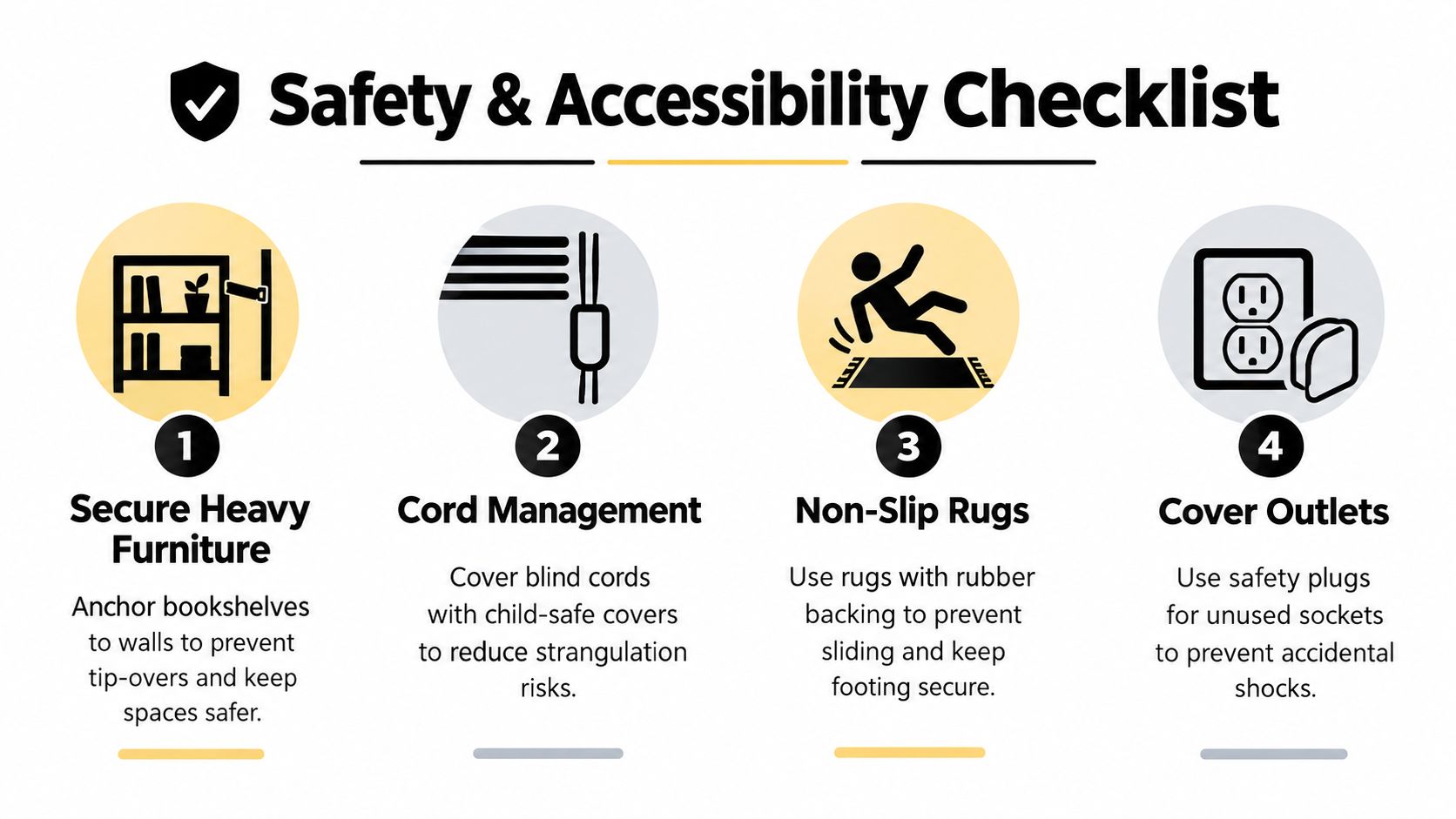
A room-by-room safety check should cover these pressure points:
Accessibility also affects online purchasing. Product pages need descriptive text, clear headings, readable contrast, keyboard-friendly controls, and meaningful image descriptions. Shoppers should be able to confirm whether a blind is cordless, how it operates, and which hardware comes with it before ordering.
Property managers can apply the same checks during turnover. For a broader guide organized by living space, review these room by room home safety upgrades. Compare decor by safety features, upkeep, removability, and installation impact, not only by purchase price. A warning label does not make an accessible cord safe, and a cheap fixture is not a bargain if removing it leaves damaged walls or trim.
A peel-and-stick tile project can look inexpensive until removal reveals damaged flooring, adhesive residue, or a short service life. The backing paper is the easy part. Results depend on the surface beneath it, the room's conditions, and whether the lease allows the installation.
Dust, unevenness, dampness, texture, and existing damage can all cause tiles to lift. Wirecutter guidance on installing peel-and-stick tiles recommends cleaning the substrate, correcting irregularities, and setting straight reference lines before placement. Preparation takes longer than sticking, yet it determines whether the finished floor looks intentional.
Use this order:
Small, dry, smooth areas are better candidates than busy floors or moisture-prone rooms. Lower material and installation costs can come with shorter service life, replacement work, and removal damage. Edge lift, bubbling, residue, and dimensional changes can turn a low-cost update into a repair bill. Renters should confirm approval requirements before buying materials, then photograph the original surface and keep the product details.
Before installation: Test one tile in an inconspicuous area and confirm that removal will not pull finish from the substrate.
If a tile lifts, identify whether dirt, moisture, unevenness, or pressure caused the failure before repairing it. Follow the product's repair instructions. For removal, the Wirecutter guidance recommends slow peel-back at a 90-degree angle with low heat. Stop if the finish begins to come away.
Removable trim can offer a lower-impact alternative for a quick visual change. This guide to peel-and-stick window trim follows the same rule as flooring: surface preparation matters more than adhesive marketing. Test first, document the original condition, and choose upgrades that can leave the property intact.
Seasonal decorating becomes expensive and wasteful when every refresh depends on disposable objects. Keep the larger pieces stable, then change the room's mood with washable textiles, adjustable lighting, and a few accents. This approach also reduces storage demands and makes lease compliance easier because removable updates leave walls and fixtures intact.
Warm neutrals and layered lighting support that flexibility. A neutral base can shift from winter to summer through a different throw texture, pillow cover, curtain weight, or plant position. Lighting changes the atmosphere without taking much floor space. Combine ambient light with a lamp, task light, or adjustable bulbs instead of relying on one harsh overhead fixture.
A Rently rental decor trends survey points toward the same practical priorities. It found that 38% of renters plan to keep decor spending between $101 and $500, while 29% will spend up to $1,000. The styling direction is also clear: 79% prioritize layered lighting, and 72% prefer minimalist warm neutrals. These figures support a flexible plan, not a requirement to buy every trend.
Choose pieces that can serve more than one room or season:
The survey also found that 69% of renters want eco-friendly decor, while nearly half choose it only when affordability is acceptable. That trade-off is reasonable. Sustainable buying includes durability, repairability, shipping, packaging, and expected use, not only a material label. Check the lease before making permanent changes, especially with paint, mounted fixtures, or treatments that could damage surfaces.
Ask whether you would still want an item after the season ends. If not, borrow it, repurpose something you own, or make a smaller textile change. For further guidance on worker and material considerations, review this discussion of fair-trade home decor.
Budget projects rarely fail because someone lacks taste. They fail because a measurement was guessed, a lease clause was ignored, or a low-cost material was used in the wrong environment. These answers address the moments where a small decision can protect the whole project.
Measure the window in its installed position, then decide whether the rod will sit inside or outside the frame. For a fuller appearance, allow the panels to stack beyond the glass, and measure the finished drop from the actual rod position to the point where the fabric should end.
For floor-length curtains, check the floor carefully. A tiny amount of clearance can keep the hem cleaner, while a slight break creates a softer look. Don't order until you've accounted for rod brackets, rings, clips, and the heading style.
Start with the window and the lighting layers, not with decorative objects. A sheer or light-filtering treatment can soften glare while preserving daylight, and a lamp placed near a seating area can create a warmer evening zone.
Then remove anything that blocks light or makes the room feel visually heavy. A mirror may help reflect available light, but it won't compensate for a window treatment that is too dark or mounted directly across the glass.
Stop and diagnose the cause. Dust, wax, uneven flooring, moisture, poor alignment, and temperature changes can all undermine adhesion. Pressing the edge repeatedly may hide the problem for a short time but won't fix the substrate.
If the tile can be removed without damage, work slowly and avoid tearing the surface. For replacement, clean and stabilize the area first, then test adhesion before committing to a larger repair. If the floor is damp or structurally uneven, choose a different project rather than adding more adhesive.
Read the lease before buying hardware. Some agreements allow removable rods or replacement coverings but require the original fixtures to be stored and reinstalled. Others restrict drilling, adhesive products, or changes to window frames.
Photograph the window before work begins, keep original brackets and screws in a labeled bag, and ask the landlord for written approval when the language is unclear. A removable treatment is only renter-friendly if removal won't damage paint, trim, or the fixture itself.
Limit the palette, repeat a material, and vary texture. For example, warm neutral curtains can work with a woven basket, a wood surface, and a darker lamp base without making every object match.
Edit as you add. If a room feels cluttered, remove one accessory before buying another. The most convincing affordable home decor ideas usually rely on proportion, light, and restraint rather than a large quantity of small decorations.
For search-friendly implementation, keep the page title unique, concise, and accurate to the content, following Google Search Central's SEO starter guidance. A visible FAQ can also be paired with valid structured data when the page contains genuine questions and answers, using Google's FAQPage structured-data guidance. The markup should describe the content users can see, not manufacture extra claims.
Joey'z Shopping offers curtains, blinds, valances, tiebacks, and other home decor options for renters and homeowners planning practical room updates. Visit Joey'z Shopping to compare window treatments and textile accents that support safer, more flexible decorating.