
Join the Joey'z Family!

You wake before sunrise because a thin ribbon of light is cutting across your bedroom wall. The shade says “blackout,” yet the curved top of the window is glowing around the edges. That frustrating result is common with an arched window blackout shade because the challenge isn't only the fabric. It's the curve, the mounting position, and every small gap around the perimeter.
A successful blackout shade for arched window openings must match the geometry of the arch and seal the places where the panel meets the frame. This guide walks through the shapes, measurements, mounting options, safety details, and practical solutions that help you choose a treatment that blocks light without hiding the character of the architecture.
At 5:30 a.m., a homeowner watches a pale line of dawn trace the bedroom window's upper curve. The cellular shade below is closed, its fabric looks dense, and the product description promises blackout performance. Yet the room is still bright. The problem is often the opening's shape, not the cloth itself.
Rectangular-window advice assumes two straight sides and a level headrail. It also assumes that familiar side channels can close the edges. An arch removes those assumptions at once. A shade can block light through its center while leaving a crescent-shaped path around the perimeter.
Look for these failure points:
These defects are easy to miss from across the room. At night, however, even a thin exposed section can project a distinct streak of daylight onto the wall or ceiling. Guidance on blackout shades for arched windows points to installation gaps as a common source of residual light, even when the shade material can block light through its own surface.
Practical rule: Treat the arch as a geometry problem first and a fabric problem second.
Blackout fabric limits light passing through the panel. It cannot correct a mismatched radius, an uneven frame, or an uncovered top corner. For an arched window, the useful question is therefore how continuously the treatment follows and seals the curve. Opacity matters, but the perimeter often decides whether the room is dark.
An arched window has a curved top instead of a straight horizontal edge. Two windows can look alike from across the room yet need different shade templates, because the curve determines where a blackout panel can meet the frame.
Identify the profile before choosing a treatment.
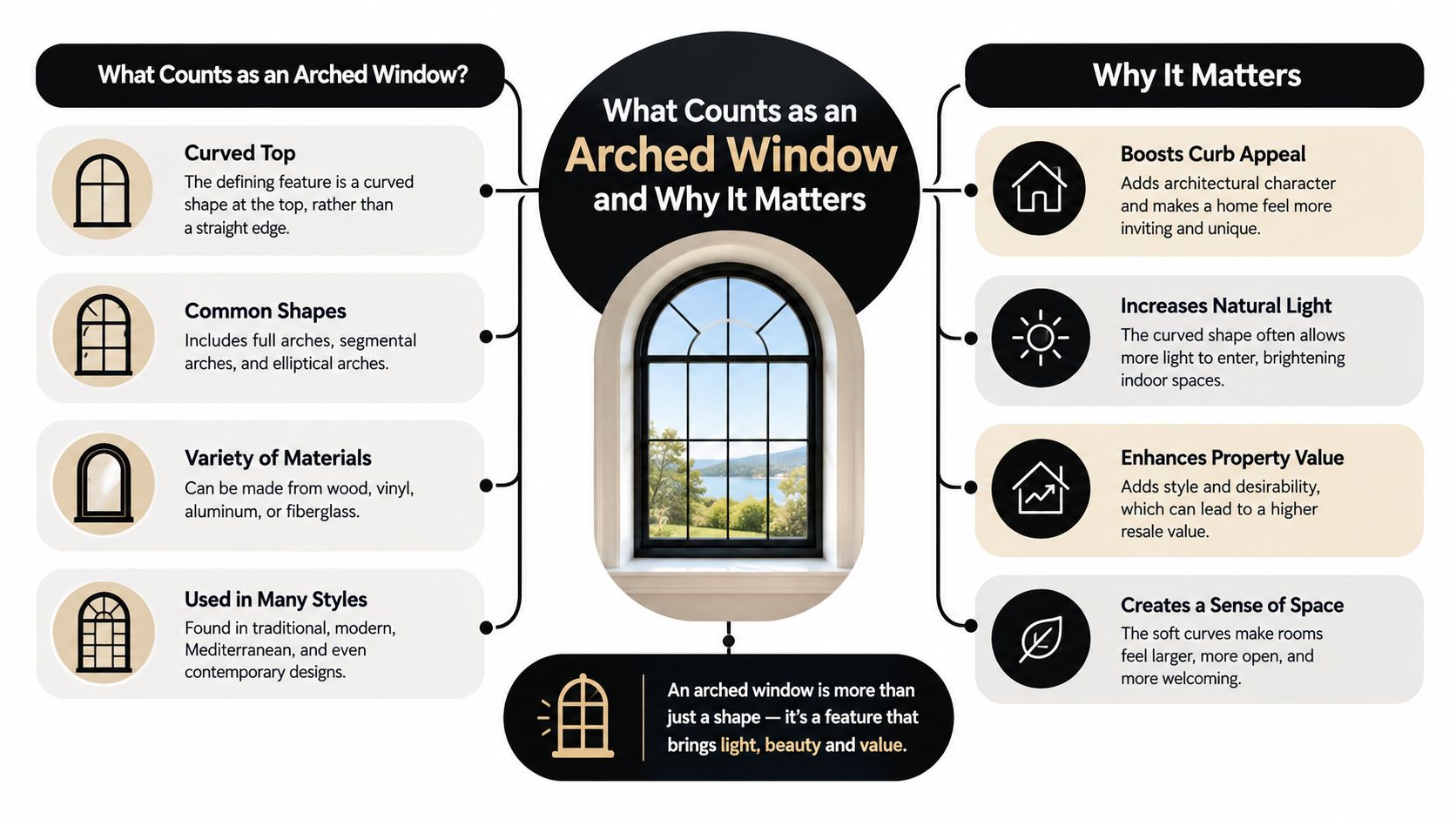
The chord is the straight-line width across the curved section's base. It is the span from one side of the opening to the other beneath the arch.
The rise is the vertical distance from that chord to the curve's highest point. It shows how far the arch climbs. The radius identifies the circle used to form a true curve, helping separate a Perfect Arch from a shallow or irregular shape.
These measurements guide the shade's actual outline. A Perfect Arch requires a circular panel matched to its radius. A Slight Arch may work with a rectangular cellular shade and a separate curved topper. Misclassifying the window can leave a panel that matches the width but pulls away from the glass at the top, creating a light gap.
That is why the window's geometry matters more than its label. Measure the curve you need to seal, not merely the rectangular area below it. DIY can suit a simple, regular profile, while an unusual curve may call for a template and custom fabrication.
There are four practical solution families for a blackout shade for arched window openings. Each can work, but they solve different problems and carry different compromises.
A custom cellular or honeycomb arch shade is the most integrated option. The panel is cut to the curve, and the cellular construction combines light blocking with insulation, a feature consistently described in current product guides such as this blackout arch shade listing.
It preserves the architectural outline and can provide a strong perimeter fit when the template is accurate. The trade-offs are a higher cost tier and a longer wait for fabrication. It makes the most sense in a primary bedroom, nursery, or street-facing room where the arch must remain visible.
A standard rectangular blackout shade can cover the lower sash while a custom or DIY arched topper covers the curved glass above it. This approach is flexible, often more affordable than a one-piece custom arch, and easier to repair or replace.
The compromise is the seam between the two components. If the topper doesn't overlap the lower shade properly, that junction becomes a new leak path. Layering works best when the upper piece is rigid or securely mounted rather than left as a loose decorative valance.
A shaped blackout-backed board, foam panel, or fabric-wrapped insert can sit over the opening with screws, brackets, or magnets. It can block light effectively because it covers the entire glass and frame instead of trying to move within the arch.
The drawback is permanence. You'll lose the view whenever the insert is installed, and frequent removal can become inconvenient. This is a sensible choice for a media room, an occasional-use bedroom, or a window where daylight control matters more than visibility.
Template-based kits let you trace the curve, cut the fabric or panel, and attach it to a low-profile track. They have the lowest cost tier and can suit a confident DIYer with a steady hand.
They also leave the least room for measuring errors. A cut that is slightly too small creates a permanent light gap, while a panel that is too large may bind against the frame. For an irregular plaster opening, a custom workroom is usually safer.
| Solution | Light Block | Cost Tier | Lead Time | Best For |
|---|---|---|---|---|
| Custom cellular arch | Strongest potential perimeter fit | Higher | Longer fabrication wait | Bedrooms and visible feature windows |
| Layered treatment | Strong when the seam overlaps correctly | Moderate | Mixed | Value-conscious rooms |
| Mounted mask or insert | Excellent when fully oversized | Moderate | Short to moderate | Media rooms and permanent darkening |
| DIY template kit | Depends heavily on the cut and seal | Lower | Short | Careful DIY projects |
If you're comparing window-control ideas more broadly, Aloha Window Bros' Ojai CA solar screen guide provides useful context on how screen-based treatments differ from blackout systems. Solar screens can manage glare and heat, but they aren't a substitute for a sealed blackout panel.
A curved opening can look simple from the room, yet a shade must follow its changing width without leaving a bright crescent along the glass. Measure the opening in the same order the shade will be shaped: establish the base, find the rise, then map how the curve narrows.
A Perfect Arch may follow a specific relationship between its chord and rise. If your measurements do not match that configuration, do not force the opening into a Perfect Arch order form. Choose a product that accepts the actual profile or ask the manufacturer to confirm the shape before ordering.
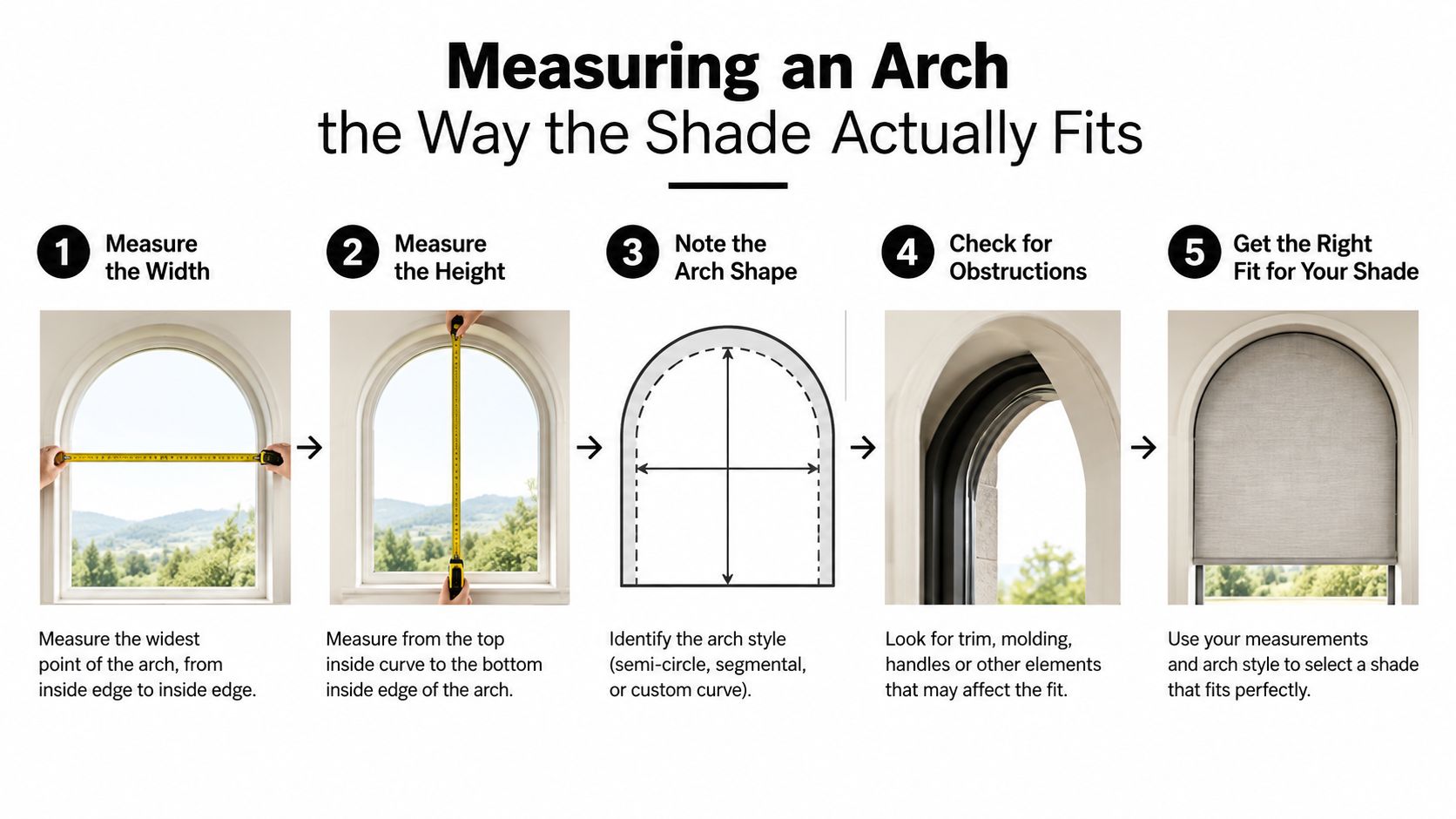
A half-round arch keeps a constant radius, so its width changes at each height rather than behaving like a rectangle. That geometry affects the seal. A flat panel can pull away from the glass near the curve, leaving a light gap even when its bottom width is correct.
Measure the opening itself, not just the visible glass. Check whether the frame bows, the plaster varies, or one side sits farther forward than the other. These irregularities can shift the shade's fit and create gaps along the curved edge.
Custom instructions may specify a tolerance, often 1/8 to 1/4 inch per side, based on the mounting method. Confirm the allowance with the manufacturer instead of subtracting automatically.
For layered treatments below the arch, this guide to the right curtain length for every room provides useful planning context. For the arch, Joey'z Shopping's guide to measuring arched windows helps organize the measurements before a custom order.
Use a rigid straightedge for the chord and a level for vertical measurements. A loose tape can sag, and one transposed number can turn an accurate sketch into an ill-fitting shade. If the curve is irregular, send the drawing and measurements to the fabricator before cutting.
Inside-mount and outside-mount installations can both look polished. They don't perform identically when the goal is near-total darkening.
| Factor | Inside-Mount | Outside-Mount |
|---|---|---|
| Frame visibility | Preserves the arch silhouette | Covers some or all millwork |
| Light risk | Perimeter channel can admit light | Overlap naturally covers more edge area |
| Installation surface | Fits within the opening | Needs suitable wall or trim clearance |
| Appearance | Cleaner, more integrated look | More substantial visual presence |
| Best use | Regular frames with accurate geometry | Irregular frames or maximum edge coverage |
An inside mount sits within the opening and keeps the curved trim visible. That makes it attractive for decorative arches, but the narrow channel around the shade can become a visible leak path. Side channels, a light-blocking lip, and carefully placed gasket material can reduce the exposure.
An outside mount extends over the frame and can overlap the arch edge. It hides more millwork and requires a stable surface for brackets, but that overlap often gives it an advantage when the plaster or wood return is uneven. General installation guidance also identifies outside mounting as a way to improve edge coverage, while this inside-mount blinds guide explains the cleaner frame-integrated approach.
Pay special attention to the top corners where the curve meets the frame. On a Perfect Arch, a small radius mismatch at either corner can create a bright triangular streak. A narrow masking piece or a carefully fitted gasket often fixes that junction more effectively than a heavier fabric.
Cordless operation should be the default in a family home, not an optional styling upgrade. Dangling cords can attract children and pets, and an arched opening can make cord routing less predictable because the headrail and frame don't follow a simple rectangle.
The U.S. Consumer Product Safety Commission says cordless window coverings are the safest choice for homes with young children and the only option that eliminates the strangulation hazard from cords. Its window-covering safety update says stock coverings sold in stores or online should be cordless, have inaccessible cords, or use short cords of eight inches or less.
If a product uses a cord stop, the CPSC says it should sit within 1 to 2 inches from the head rail when the blind is fully lowered, as explained in its cordless and cord-safety guidance. Follow the manufacturer's adjustment instructions rather than improvising hardware placement.

A retrofit cleat isn't a complete solution. On a curved opening, the cord may not hang straight enough to maintain tension, and a cleat can leave the underlying loop hazard in place. For a room used by children, choose a purpose-built cordless design and follow the installation instructions closely. Joey'z Shopping also publishes options and guidance related to window shades without strings.
A blackout label describes what the material does when light reaches the cloth. It doesn't guarantee that the finished installation will seal the opening. Technical textile guidance describes blackout fabrics as coated, laminated, or multilayer composites, with zero-openness or 99%+ light-blocking constructions achieved through foam coatings, bonded backings, or metallized layers, as explained by this blackout fabric comparison.
The installation can still fail around the edges. On arched windows, the curve magnifies small inaccuracies because the gap changes as the shade follows the radius.
Close the shade at midday and wait two minutes for your eyes to adjust. Then follow each light streak back to its source.
Typical locations include:
Even a tight fabric panel can leak when the return wall is uneven. The cloth may follow the intended curve, while the frame bends, steps, or widens in a way the template didn't capture.
Blackout is a system, not a swatch. The fabric, mounting method, edge seal, and window geometry all have to cooperate.
This is also why “room darkening” and “blackout” shouldn't be treated as interchangeable. Buying guides commonly describe room-darkening options as falling in the 90% to 100% light-blockage range, while blackout fabrics are often marketed at 98% to 100% light reduction, as summarized in the SelectBlinds product information above. Those ratings describe material or product performance, not the daylight that slips around an imperfect perimeter.
Choose the treatment by asking four questions: How much can you spend, what does the room do, how severe is the curve, and must the arch remain visible?
A custom cellular arch shade is worth considering for a primary bedroom or a prominent feature window where the curve matters visually and the fit needs to be integrated. A layered flat blackout shade with an arched valance is usually the smarter compromise when the lower sash needs daily operation but the upper curve can remain fixed.
A foam-and-fabric mask can be acceptable for a guest room or a nursery nap zone, provided it is mounted securely and doesn't create a child-accessible cord or loose hardware hazard. It isn't the right choice when you need an unobstructed view or frequent shade operation.
Measure the chord first, then the rise, followed by widths at selected heights. Confirm whether the window is a Perfect Arch, Slight Arch, half-round, or another profile before entering measurements.
No. An outside mount can reduce peripheral leakage by overlapping the frame, while an inside mount can work when the opening is accurate and the perimeter receives proper sealing.
Look for a fully opaque blackout construction, but don't judge the installation by fabric rating alone. A high-performing panel can still leak around the curved edge, side channels, top corners, or bottom rail.
First determine whether the gap comes from the panel width, the mounting position, or an irregular frame. A shaped overlap panel, dense foam seal, or remade template can solve the cause more reliably than adding another loose layer.
Yes. Custom arched shades can use spring-assist, manual cordless, or motorized mechanisms. Cordless is the safer direction for homes with young children, consistent with CPSC guidance.
For broader market context, the global window-treatments industry was valued at about $45.2 billion in 2022 and is projected to reach $61.9 billion by 2030, a 4.5% compound annual growth rate, according to World Metrics' window-treatment statistics. The same source reports that shades account for about 28% of global sales, blinds about 35%, and e-commerce about 30%, which helps explain why specialized arch products are increasingly available through online channels.
Joey'z Shopping offers blackout curtain panels, shades, blinds, and window-treatment guidance for shoppers comparing practical light-control options. Visit Joey'z Shopping to review available treatments, then match your choice to the arch's measurements, mounting surface, and required perimeter seal.