
Join the Joey'z Family!

Getting the measurements right for your new blinds is the single most important step for a professional-looking result. Get it right, and you'll have flawless, custom-fit window treatments. Get it wrong, and you’re looking at frustrating light gaps, crooked blinds, or worse—having to start all over. This guide on how to measure for blinds will ensure you get it right the first time.
All you need is a metal tape measure. Leave the fabric ones in the sewing kit; they can stretch and give you inaccurate readings. Before you start, you have one key decision to make: inside mount or outside mount? This choice dictates everything about how you'll measure.
To help you decide, let's break down the differences.
Table of Contents
Choosing your mount type is the foundational first step. An inside mount offers a sleek, minimalist aesthetic, while an outside mount provides more light coverage and flexibility. The right choice depends on your window's structure and your style goals.
An inside mount delivers a clean, custom-fit look, with the blinds sitting perfectly snug inside the window casing. It's a fantastic choice if you want to show off beautiful window trim or prefer a minimalist vibe.
For an inside mount to work, your window frame must be deep enough to accommodate the blind's headrail. A shallow frame can cause the headrail to stick out, spoiling the integrated look.
An outside mount is more forgiving. The blinds are installed on the wall or trim above the window, overlapping the opening. This is a brilliant solution for blocking more light, hiding less-than-perfect trim, or for windows that are too shallow for an inside mount.
This approach solves common installation headaches with style and ease. If you're still exploring options, our guide on how to choose window treatments can help you match function with style.
| Feature | Inside Mount | Outside Mount |
|---|---|---|
| Look & Feel | Clean, minimalist, built-in | Creates a larger, more dramatic window |
| Light Control | Good, but may have small light gaps | Excellent; covers the entire window |
| Best For | Showcasing attractive trim; deep sills | Hiding imperfect frames; shallow sills |
| Measurement | Requires high precision and depth | More forgiving and flexible |
For an inside mount, precision is everything. The blind must fit and operate perfectly within the window frame, leaving no room for error. The golden rule is simple: measure three times for one confident order.
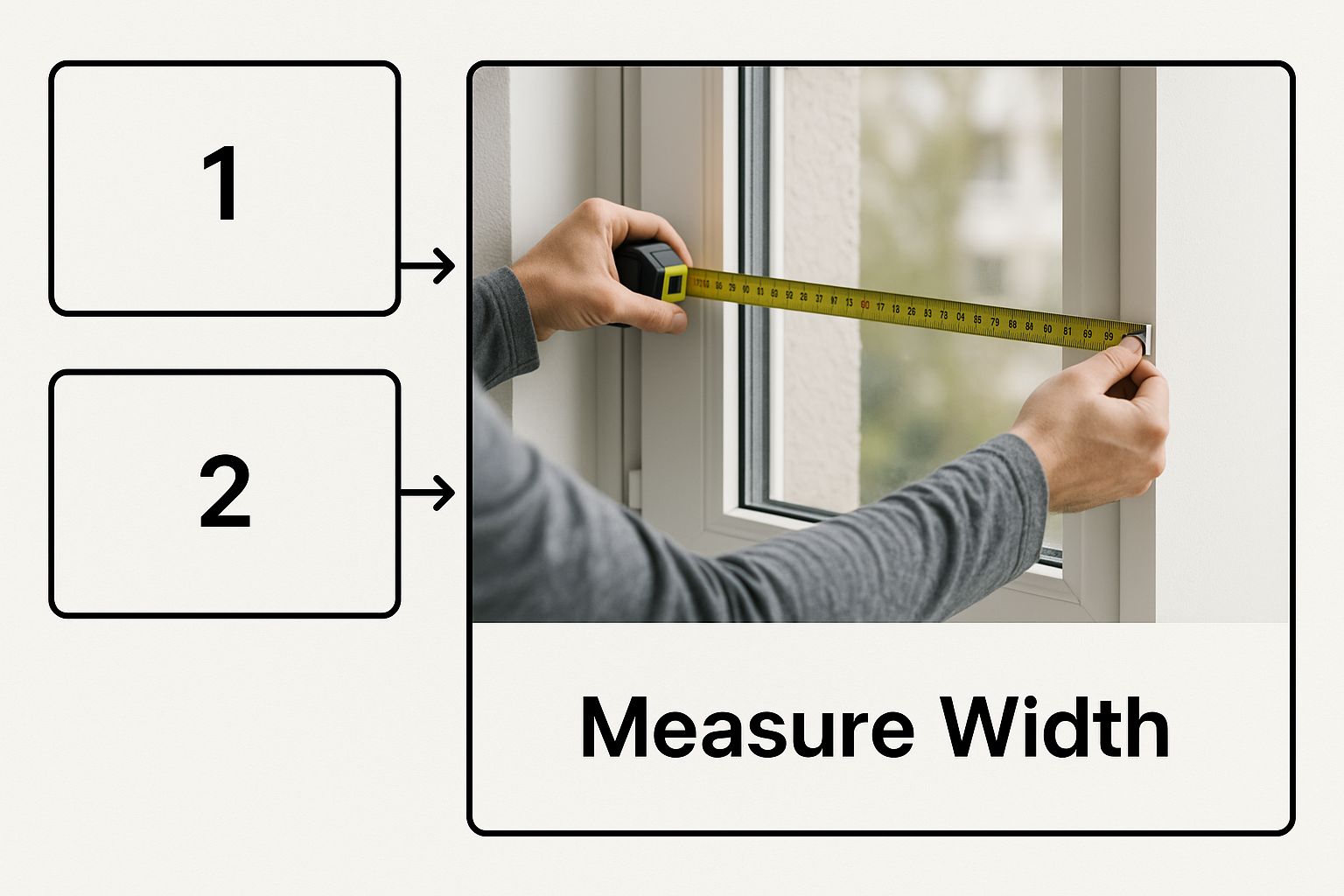
Window frames are rarely perfectly square, even in new homes. You must measure the width in three places.
Of these three numbers, record the narrowest measurement. This ensures your blinds won't scrape or get stuck on the sides. Measure to the nearest 1/8 inch and do not round your numbers.
You'll use a similar three-point method for the height.
For most blinds, like our popular faux wood or aluminum mini blinds, you’ll use the shortest height measurement. The only exception is for roller or solar shades, where using the longest measurement ensures full coverage.
Finally, measure the depth of your window frame, from the glass to the edge of the trim. Check the product specifications for the minimum depth required for the blinds you want. This step guarantees the headrail won’t stick out from the frame.
Insider Tip: When you order, provide the exact window opening measurements. The factory will automatically make the necessary small deductions (usually 1/4" to 1/2") to ensure a perfect fit. You don't have to do the math!
This multi-point method is vital for retrofit installations, which accounted for over 57% of the global blinds market, according to a detailed industry analysis from Grand View Research. It shows just how many homeowners are tackling this same challenge.
An outside mount is the perfect solution when a window frame is too shallow or your goal is maximum light blockage. This method is more forgiving, but correct measurements are still key to a polished, professional look.
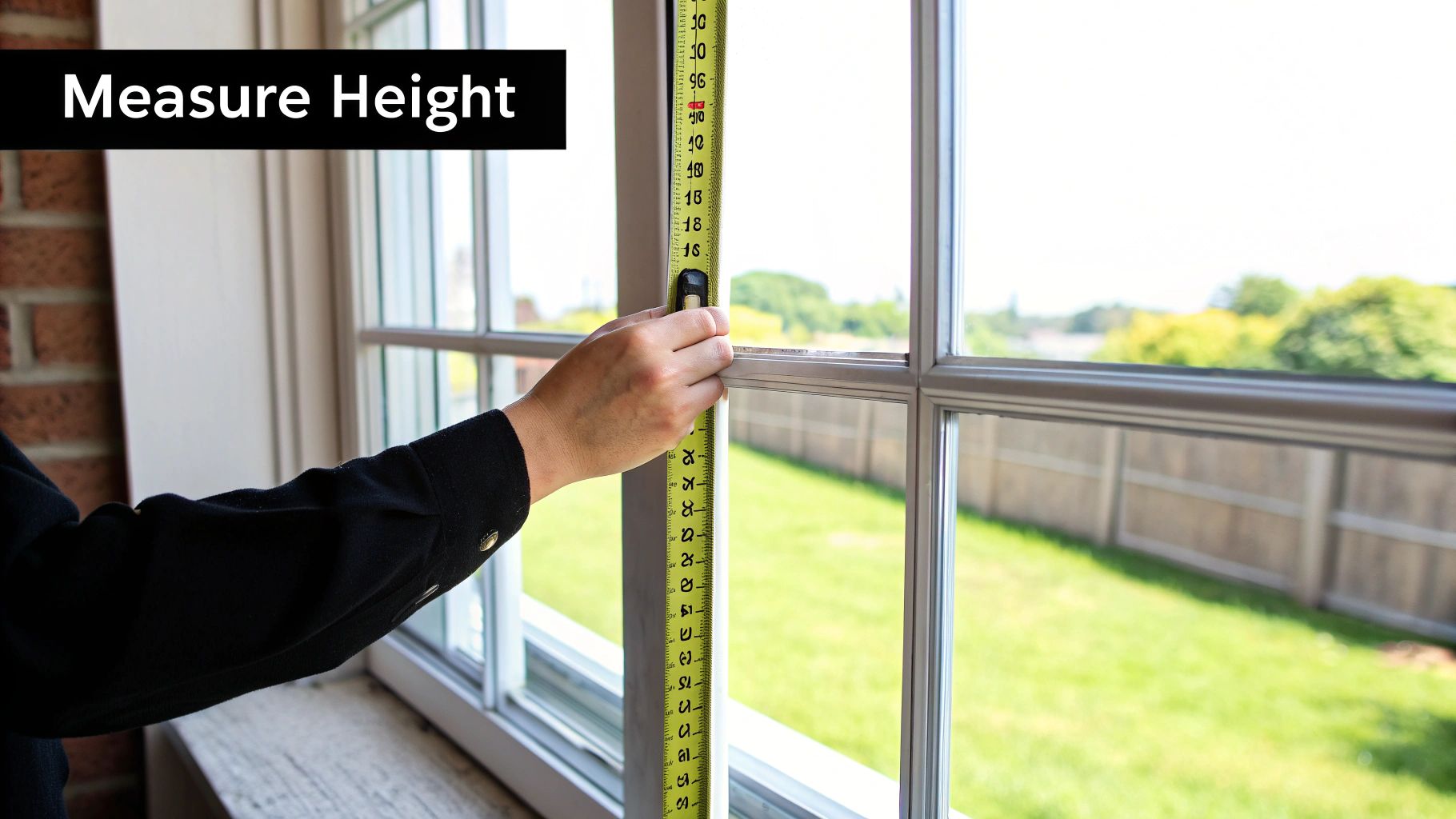
For an outside mount, you measure the area you want the blinds to cover, not the window opening itself. The overlap is what stops light from seeping in and hides any imperfections in the window frame.
Measure the entire width of your window, including the trim or molding. To ensure full coverage and eliminate light gaps, you need to add extra width.
The short answer is: add at least 2 to 3 inches to each side. For a 36-inch wide window frame, your final blind width should be between 40 and 42 inches.
Heads-Up: Before you settle on a width, check for obstructions like cabinets, adjacent walls, or doorknobs. Make sure your extra width won't cause the blinds to bump into anything.
Decide where the headrail will sit above the window. Mounting it 2 to 3 inches above the window frame makes the window look taller and keeps the stacked blinds from blocking your view when fully raised.
Once you've marked that top spot, measure from there down to where you want the blinds to hang. For complete privacy, I recommend extending the measurement 2 to 3 inches below the window sill. So, if your window is 60 inches high, adding 3 inches above and 3 inches below gives you a final height of 66 inches.
This overlap can completely transform a room. Certain styles, like our elegant Roman Shades, look especially fantastic with the added coverage of an outside mount.
Even the most careful DIYer can fall into a few common traps. Here’s how to sidestep the small mistakes that cause big headaches.
Inaccurate measurements are a major issue in the industry. Some reports, like this window blinds market report, show that a significant percentage of custom orders historically required rework due to simple errors. A second pair of eyes is a great way to catch a simple slip-up before it becomes a costly mistake.
Don't panic—this is very common! For an inside mount, always use the narrowest width measurement. This guarantees the blind will operate smoothly. For an outside mount, the overlap will easily hide any crookedness in the frame.
The required depth varies by product. Always check the "Product Specifications" or "Installation Requirements" for the specific blinds you want before you order. If your frame is too shallow, an outside mount is the perfect alternative.
No. Provide the exact, tight measurement of the window opening. The factory will make the necessary small deductions to ensure a perfect fit inside the frame.
No. We strongly advise against this shortcut. The old blinds may not have been measured or installed correctly. Always measure the window frame itself for a flawless fit. To learn more about different styles, check out our guide on why we adore mini blinds for windows.
Ready to put those perfect measurements to use? At Joey'z Shopping, we have a wide selection of beautiful, high-quality blinds to fit any window and style. Find your perfect match today at https://joeyzshopping.com.