
Join the Joey'z Family!

Your child wants rockets, rainbows, or dinosaurs on the windows. You want darkness at nap time, safe operation near the bed, washable fabric, and a style that won't look babyish next year. The best kids room curtain ideas solve those competing needs instead of treating curtains as decoration alone.
Start by checking sleep needs and sun exposure. Then assess cordless safety, fabric care, room scale, hardware, and how long the design needs to last. The ten options below compare real trade-offs, including blackout prints, DIY panels, thermal curtains, layered sheers, motorized systems, hybrids, canvas, glow accents, modular panels, and organic fabrics. For measuring, use this practical guide to how to measure curtain sizes.
Safety comes before theme. The U.S. Consumer Product Safety Commission's cord-safety guidance says about nine children age five and younger die each year from strangulation involving corded window coverings. NBC News, using CPSC data and federal records, reported at least 456 deaths of children age eight and under since 1973. Cordless curtains, shades, and inaccessible-cord treatments should be the default, particularly near cribs, beds, toys, and climbable furniture. Joey'z Shopping is a relevant place to browse curtains, blinds, and valances while you compare function and style.
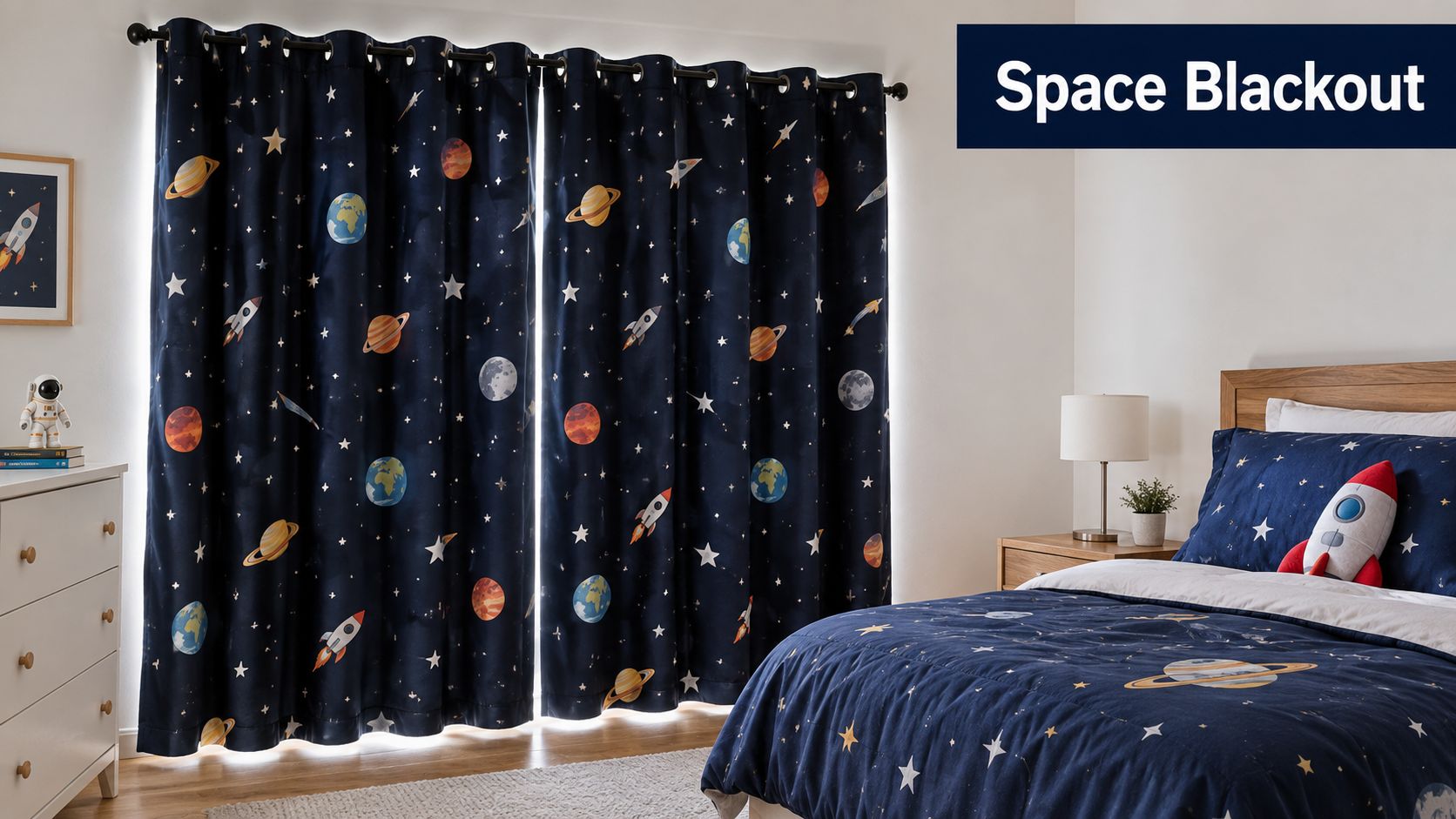
Blackout curtains are often the easiest answer for a bedroom with early sunlight, afternoon naps, or a child who treats dawn as an invitation to start the day. Space prints add personality without requiring a complete room makeover. Planets, rockets, stars, astronauts, and galaxy patterns can feel playful for a younger child and still work for an older one if the palette stays balanced.
The short answer is simple. Choose blackout panels when sleep and light control outrank daytime softness. Sleep guidance recommends dimming indoor light near bedtime and keeping bedrooms as dark as possible, making blackout-style curtains useful for supporting a consistent routine, as explained by the Sleep Foundation's guidance for children.
Practical rule: A curtain that stops at the window edge can still leave bright gaps. Extend the treatment beyond the opening and check the sides at bedtime.
Look for machine-washable fabric, especially in rooms where sticky hands and mystery smudges are part of the interior design. A separate sheer on another rod gives you daytime light without opening the themed panel completely.
Measure twice before ordering, and check the rod's capacity before hanging full panels. For more ideas on combining decoration with light blocking, see blackout curtains with print.
Plain panels can become the room's most personal feature with fabric paint, stencils, markers, and a willing small artist. This approach works well for renters and budget-conscious families because you can start with an affordable neutral curtain and change the design without replacing the entire treatment.
Pre-wash the fabric so it won't shrink beneath the artwork. Test the paint on an offcut first, then work on a flat table or clean floor rather than trying to decorate a hanging panel. Painter's tape creates crisp borders, while handprints, names, simple brushwork, and traced silhouettes make good age-appropriate projects.
A good DIY curtain should still look intentional from across the room. Keep a limited palette, leave breathing space between motifs, and repeat one shape rather than covering every inch.
Older children may enjoy constellation maps, geometric patterns, or a collaborative mural. Younger children can add handprints or broad strokes while an adult handles layout and finishing. Heat-set the paint according to its instructions, and let the panels dry fully before washing or rehanging.
DIY curtains are excellent for personalization and emotional value. They're less convincing when you need reliable blackout performance, exact color matching, or a perfectly smooth finish. Paint can also stiffen fabric, so keep designs light if you want the curtains to open and close easily.
Machine washing depends on the paint and fabric combination. Follow the specific product directions rather than assuming every formula behaves the same way.
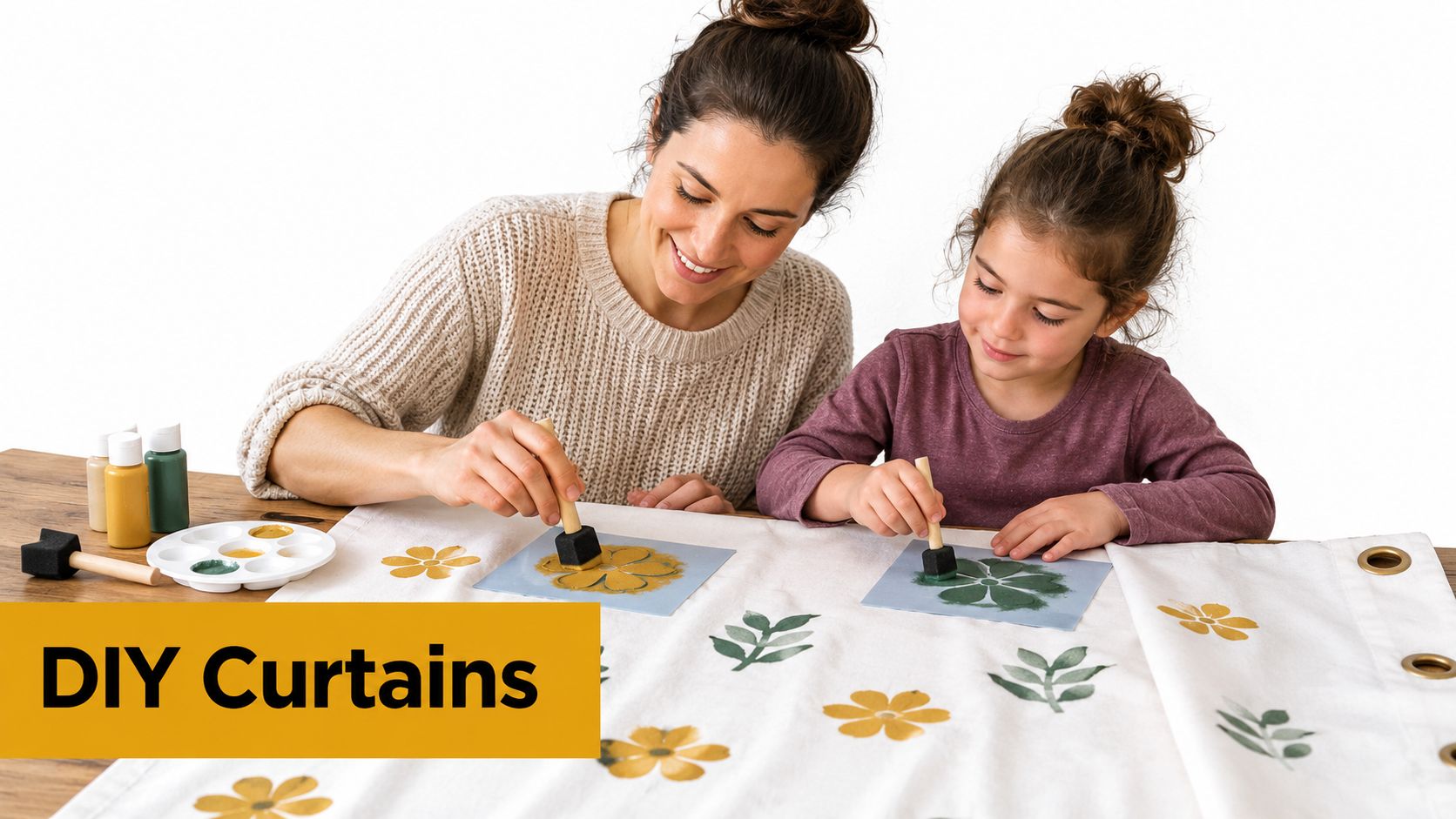
For a visual project prompt, this fabric-painting video can help families plan a simple design before committing to the panels.
A thermal curtain earns its place in a child's room when temperature swings are more annoying than the décor problem. Dense backing can help reduce heat transfer, while the front fabric brings in vehicles, safari animals, woodland scenes, planets, or cheerful geometric shapes.
These curtains tend to be heavier than ordinary panels, so the hardware matters. A lightweight tension rod may sag, pull away from the wall, or make opening the curtain frustrating for a child. Use sturdy brackets, position the treatment close to the window, and make sure the fabric can move without catching on furniture.
The trade-off is comfort versus bulk. Thermal panels can make a room feel cosier and may soften outside noise, but they can also look visually weighty in a small bedroom. Pairing them with a light sheer gives daytime flexibility without sacrificing the insulated layer overnight.
Wash according to the label, usually with a gentle approach that protects the backing. Don't assume a curtain is washable just because it looks like ordinary fabric.
For a practical explanation of seasonal performance, read whether thermal curtains work in winter. The most useful test is the room itself: note where cold glass, hot afternoon sun, or drafts affect the bed and play zone, then place the strongest coverage there.
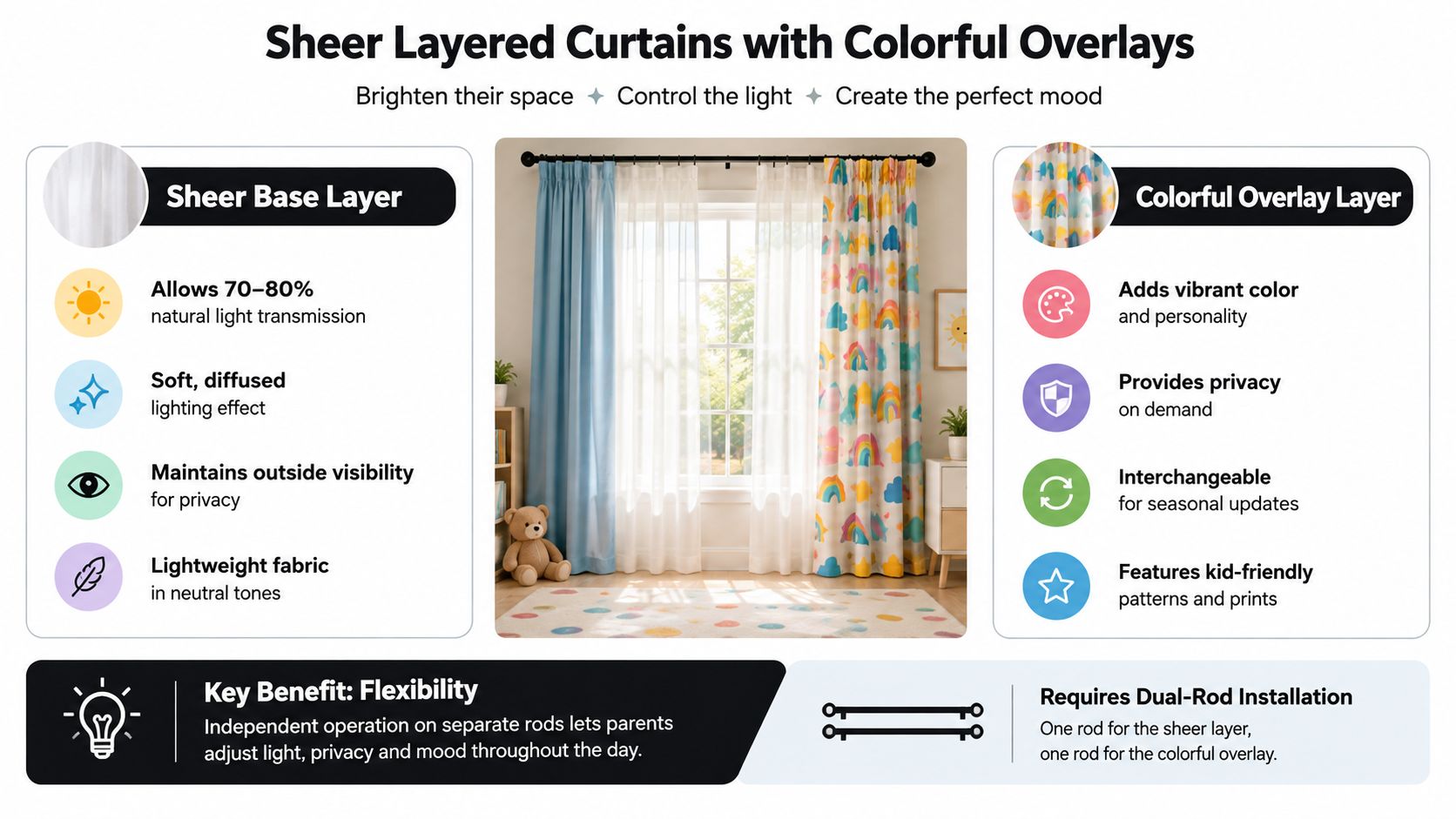
Layering works when a child's room has more than one job. A sheer panel can soften daylight and preserve an airy feel, while a colorful overlay adds privacy, pattern, and stronger light control when closed. It's a flexible arrangement for bedrooms that also serve as reading corners, playrooms, or homework spaces.
Hang the sheer nearest the glass and the more substantial panel in front. The two layers need separate, secure rods, and both should sit level. A white sheer with an animal overlay feels cheerful; a pale gray base with nautical or geometric panels reads calmer and more adaptable.
Layering isn't automatically elegant. Two competing prints can turn a small window into visual noise, while thick layers can make a compact room feel crowded. Test swatches in morning and evening light because colors can shift considerably between daylight and lamplight.
This idea is strongest when the family wants control without committing to one mood all day. Open both layers for maximum brightness, close only the sheer for privacy, or draw the overlay for naps and bedtime. If sleep is the priority, use a properly opaque outer layer rather than expecting a sheer to perform like blackout fabric.
Machine-washable panels make the arrangement less precious. Keep tie-backs out of reach, and don't add dangling decorative cords to an otherwise safer setup.
Motorized curtains remove the dangling operating cord and let parents schedule opening and closing from a control, app, or compatible smart-home system. That can be useful for a nursery, a high window, or a room where the child shouldn't operate the treatment independently.
Safety still requires a complete installation, not just a motor. The CPSC's federal window-covering requirements identify operating cords on custom coverings as an unreasonable strangulation risk for children age eight and younger. The agency recorded 209 reported strangulation incidents from January 2009 through December 2021, with nearly 48% fatal, and estimated about 7.6 medically treated nonfatal injuries per year during that period. Cordless or inaccessible-cord systems are the more defensible specification for a child's bedroom.
Before buying, check:
A smart schedule is convenient, but test it during the day before relying on it for wake-up routines. Read more about motorized cordless blinds when comparing automated options.
A curtain-shade hybrid combines the softness of fabric panels with the precise positioning of a shade. Depending on the design, the treatment may roll, fold, pleat, or gather upward, leaving less fabric around the window when the room needs more open floor space.
This is a practical choice for a small bedroom, a shared room, or a window beside a desk where long panels could get in the way. Roman-style treatments with a decorative valance can deliver a customized look, while cordless pleated systems provide a simpler profile. Top-down, bottom-up operation can offer privacy while preserving daylight, although the exact light-blocking result varies by construction.
A hybrid can look perfect in a product photograph and feel fiddly in daily use. Operate it repeatedly before final installation. Check whether the fabric folds evenly, whether the hardware stays secure, and whether a child can reach any control.
Choose cordless operation for a children's room. If a corded treatment remains in a rental, keep the crib, bed, toys, and climbable furniture away from the window. Texas Children's guidance recommends cordless coverings and warns against placing reachable furniture near corded treatments, as detailed in its window cord safety advice.
Mechanical treatments also need a maintenance plan. Dust can collect in folds and tracks, and repairs may depend on warranty coverage. For a rental or multi-unit property, simpler hardware may be easier to standardize than an elaborate custom mechanism.
Canvas panels bring durability and visual impact to a room that gets heavy use. A world map, underwater scene, enchanted forest, astronomical illustration, or fantasy castle can act as both window treatment and a large-scale focal point.
The fabric's stiffness is part of the appeal and part of the inconvenience. Canvas hangs with more structure than cotton, so it may need stronger hardware and enough room to stack at the sides. In a small bedroom, choose a broad, readable design rather than a busy print filled with tiny details that disappear from the doorway.
Educational artwork can age better than a narrow character theme. A world map may support conversations about animals and places, while an ocean scene can create a calm visual anchor without dictating the rest of the room. Personalized artwork with a name can be charming, but consider whether the child will still like that choice after a room update.
Check the cleaning instructions before purchase. Cold washing and gentle cycles can help protect the print, while hanging the panels to dry may reduce shrinkage. New canvas can feel stiff at first and usually becomes more flexible with use.
This option is a strong fit for families prioritizing durability, storytelling, and a finished look. It isn't the best choice for anyone wanting feather-light curtains or effortless daily opening. Confirm hardware capacity and panel fullness before buying, particularly over a wide window.
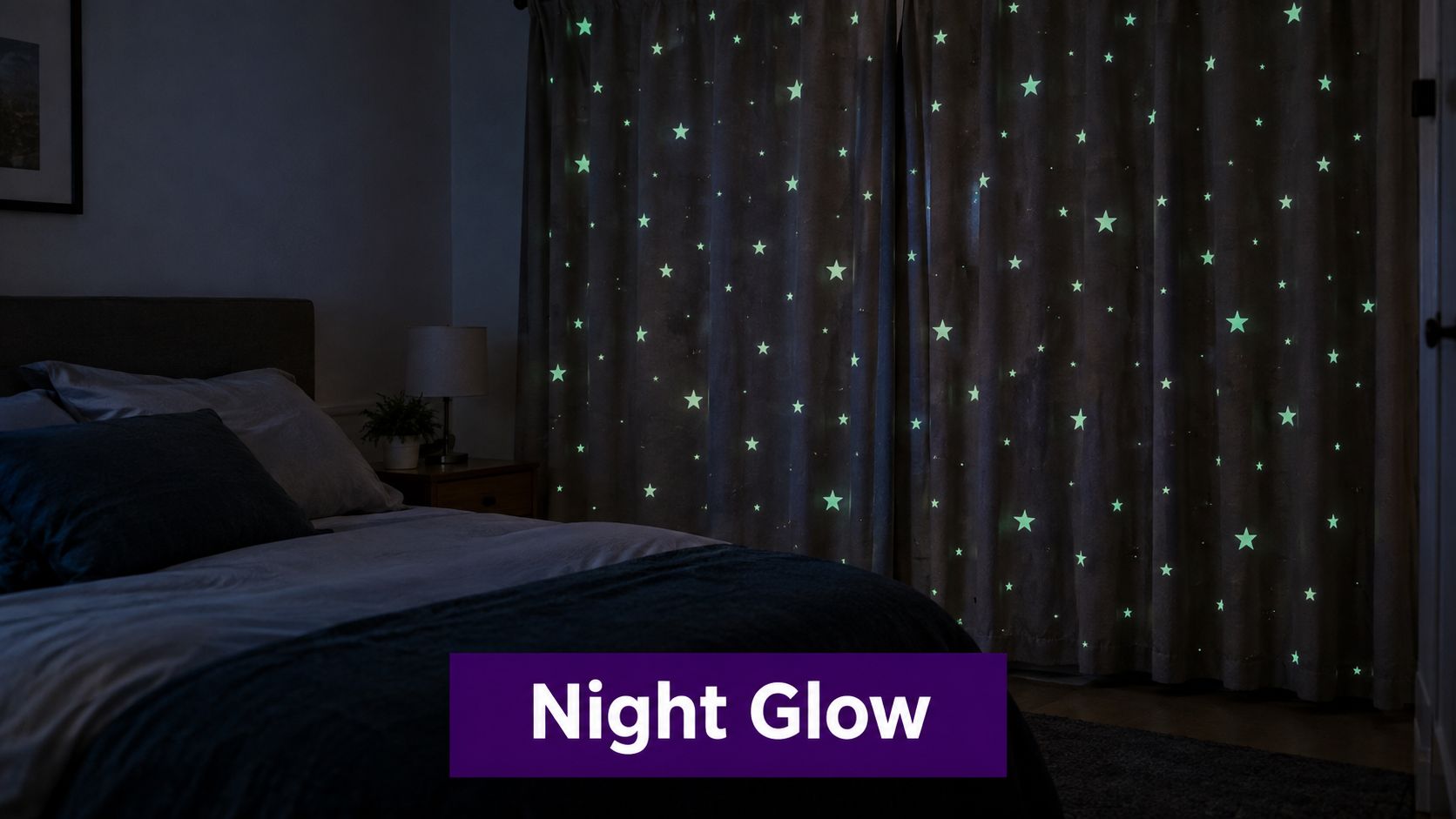
Glow accents turn the window into a quiet nighttime feature. Stars, moons, planets, jungle shapes, or galaxy swirls can provide a soft visual cue for children who feel uneasy in a completely dark room. The effect should be gentle, not bright enough to replace a lamp or interfere with settling down.
Daylight charges the luminescent elements, so placement matters. A window with useful daytime exposure will generally produce a more noticeable glow than a shaded opening. Pairing a glow panel with a blackout layer can create a dramatic bedtime effect, but test the arrangement before deciding whether the room feels reassuring or overstimulating.
The glow should support the bedtime routine, not become the bedtime event.
Talk about the stars while closing the curtains, then keep the rest of the room calm and dim. This makes the feature part of a predictable sequence rather than a novelty that encourages another round of questions when everyone is supposed to be asleep.
Wash gently and follow the care instructions to protect the finish. Glow coatings can fade over time, so treat this as an accent with a limited visual lifespan rather than a permanent investment. Keep the operating system cordless, and make sure decorative tie-backs or trims aren't reachable from the bed.
Modular panels give children a controlled role in decorating. Instead of handing over the entire room to an unpredictable combination of colors, start with a solid base and add interchangeable stripes, spots, florals, animals, or geometric sections.
The system works especially well when tastes change quickly. You can swap one panel rather than replacing the whole treatment, create seasonal arrangements, or move a favorite pattern to another window. It also suits shared bedrooms, where each child can have a little input without creating two unrelated schemes.
Three patterns are plenty for most windows. Combine different scales, such as one broad stripe, one medium geometric, and one smaller accent, then repeat the dominant color in bedding or a rug. The often-used 60-30-10 color balance can help, with a main shade, a supporting color, and a small accent, but the room should still feel like your family lives there, not like a color-wheel exercise.
Ask the child to choose between prepared combinations rather than starting with unlimited options. Photograph arrangements that work, label spare panels, and store them flat or folded according to the fabric's care needs.
This option prioritizes adaptability and participation over maximum blackout performance. If the room needs serious darkness, add a cordless blackout shade behind the decorative panels. Keep the system easy to clean, because modularity loses its charm when every piece requires special handling.
Organic cotton, linen, and hemp bring a quieter look to a children's room. Natural dyes often produce indigo blues, cream, tan, walnut browns, and other earthy variations that pair well with wood, woven baskets, and simple bedding. The result can feel calm without becoming bland.
Sustainability claims deserve careful checking. Look for certifications such as GOTS, OEKO-TEX, or Fair Trade, and read the care label before assuming a fabric is low-maintenance. Natural variation is normal with artisan dyeing, so order a sample when color accuracy matters.
Organic fabric can cost more, and premium construction doesn't automatically guarantee better light control. Linen may filter daylight beautifully but may need a lining for a bedroom that requires darkness. Hemp blends can feel substantial and durable, while lighter cotton may be easier to wash and replace.
Use cool water and an eco-conscious detergent when the care instructions allow it. Support smaller makers when the budget permits, but don't let the sustainability story obscure practical fit. A curtain that needs constant specialist cleaning or fails to cover the window properly isn't a responsible purchase.
For a baby's room or play space, cordless operation still comes first. The material can be natural, beautiful, and ethically sourced, but the window treatment must also keep cords and reachable hardware away from children.
| Option | Implementation complexity | Resource requirements | Expected outcomes | Ideal use cases | Key advantages | Main drawbacks |
|---|---|---|---|---|---|---|
| Blackout Curtains with Space-Themed Prints | Low, buy and hang (requires sturdy rod) | Moderate, heavy panels, robust hardware | ~99% light blocking, improved sleep, thermal insulation | Kids 2–12; rooms with strong afternoon sun | Strong light control, energy savings, kid-friendly designs | Heavy fabric needs strong rod; can feel dark or bulky; limited design rotation |
| DIY Personalized Fabric Paint Curtains | Medium–High, time and skill for painting and heat-setting | Low, plain panels, paints, stencils, time | One-of-a-kind, durable washable designs when properly set | Creative families on a budget; parent–child projects | Extremely customizable, low cost, sentimental value | Time-consuming; mistakes are permanent; results depend on skill |
| Thermal Insulated Curtains with Fun Patterns | Low, buy and hang (prefer professional-grade hardware) | Moderate, thermal-backed fabric, heavy-duty hardware | Reduces heat transfer (~25%), sound dampening, partial darkening (40–60%) | Energy-conscious homes; rooms needing noise/temperature control | Energy savings, quieter room, durable for active kids | Heavier/bulkier, not full blackout, longer drying/maintenance |
| Sheer Layered Curtains with Colorful Overlays | Medium, dual-rod installation and coordination | Moderate, two sets of panels and dual rods | Flexible light/privacy control, designer layered look | Growing children, rooms needing adjustable light & style | Maximum flexibility, easy seasonal refresh, soft daylight | Requires dual rods (cost/complexity), more dust/cleaning, can look busy |
| Motorized Smart Curtains with Safety Features | High, setup, electrical or battery, smart-home integration | High, motors, app ecosystem, possible pro installation | Automated schedules, cordless safety, remote/voice control | Tech-forward families; safety-conscious parents; mobility challenges | Automation, child-safe cordless operation, routine consistency | High upfront cost, maintenance/updates, privacy and repair concerns |
| Convertible Curtain-Shade Hybrids | Medium–High, mechanism install and alignment | Moderate–High, hybrid mechanisms, occasional pro install | Dual functionality (curtain + precise shade), space-saving | Small rooms needing precise light control; modern interiors | Versatile control, saves wall space, neat aesthetic | Mechanism reliability varies, fewer design options, repairs complex |
| Printed Canvas Curtains with Kid-Approved Artwork | Low, hang with sturdy hardware; heavier panels | Moderate, heavy canvas, strong rods, possible custom printing cost | Durable statement panels, semi-opaque light control (30–50%) | Design-focused parents; educational or statement rooms | High-quality prints, long-lasting durability, educational themes | Heavy, less light-blocking, initial stiffness, harder to clean |
| Glow-in-the-Dark and Luminescent Curtain Accents | Low, purchase and hang; position for sunlight | Low–Moderate, special coating prints, daylight exposure | Soft glow 4–8 hrs after charge, reduces nighttime anxiety | Kids afraid of dark; astronomy-interested children | Non-electric night glow, soothing effect, sparks imagination | Glow fades over years, needs daylight to charge, not task-bright |
| Patterned Mix-and-Match Modular Curtain Panels | Low–Medium, hang panels and plan combinations | Low–Moderate, multiple panels, matching collection | Highly customizable looks, seasonal swaps, child participation | Families valuing personalization and evolving tastes | Flexible updates, encourages creativity, cost-effective refreshes | Limited to collection palettes, risk of chaotic mixes if poorly planned |
| Eco-Friendly Organic Curtains with Natural Dyes | Low, buy and hang (may require sample checks) | High, certified organic fabrics, premium cost, longer lead times | Chemical-free, hypoallergenic textiles, muted natural palette | Eco-conscious families; children with sensitivities | Sustainable materials, non-toxic dyes, ethical manufacturing | Higher price, limited colors/patterns, batch color variation |
The best curtain isn't necessarily the most exciting one on the rack. It's the treatment that matches the room's actual work. A nursery with strong morning sun needs different coverage from a playroom that benefits from soft daylight. A shared bedroom needs flexibility, while a rental may reward simple installation and easy replacement.
Choose blackout or thermal panels when sleep, naps, drafts, or strong sun exposure lead the decision. Choose cordless systems whenever children use or sleep near the window. If you need changing light levels during the day, layered sheers or a curtain-shade hybrid offer more control than a single decorative panel.
Personalization has several levels. DIY painted curtains carry family meaning and can be inexpensive to refresh. Modular panels let children participate while keeping the overall scheme edited. Canvas makes sense when the room needs a durable focal point, while glow accents can provide gentle nighttime reassurance without turning the window into a glowing billboard.
Organic cotton, linen, and hemp suit families who prioritize material choices and long service life. Just remember that sustainable fabric still needs the right lining, hardware, and care routine. A natural curtain that wrinkles, stains, or fails to block enough light may create more frustration than value.
Before buying, confirm:
For existing corded blinds, the CPSC's GoCordless guidance says cord stops should sit about 1 to 2 inches from the head rail when the blind is fully lowered. Health Canada recommends replacing coverings with long accessible cords, prioritizing children's rooms and play spaces first when every window cannot be changed at once. Its guidance also recommends tension devices and cleats to keep cords high, taut, and out of reach, as explained in Health Canada's blind-cord safety guidance.
Make the final decision in three steps. Measure the window, rank the room's top two needs, then compare fabric, safety, and upkeep. You can also use Playz kids room inspiration to think about how curtains relate to beds, reading spaces, and play zones before you install anything.
Visit Joey'z Shopping at Joey'z Shopping to browse window treatments for children's rooms, including curtains, blinds, and valances. Compare light control, cordless operation, fabric care, and style before choosing the panels that will work hardest in your room.
Explore Joey'z Shopping's curtains, blinds, and valances to compare practical window treatments for nurseries, bedrooms, and playrooms. Visit Joey'z Shopping with your measurements and your top two priorities ready, then choose a safer, more adaptable solution for the room.