
Join the Joey'z Family!

A valance for blinds is a short decorative top treatment mounted across the headrail to hide brackets, screws, and the upper blind housing while giving the window a finished, custom look. Some valances also help cover the small opening above an inside-mounted blind, although the blind remains responsible for the main light and privacy control.
You've installed new cordless blinds, stepped back to admire the cleaner window, and then noticed the shiny headrail, metal brackets, and exposed hardware sitting above the slats. The blind works perfectly, but the window still looks a little like a piece of equipment rather than part of the room.
That's the problem a valance solves. In simple terms, it's a finishing layer for the top of a blind. The form has a long architectural history, but the modern version is practical, adaptable, and especially useful for renters, budget-conscious homeowners, property managers, and anyone updating several windows without replacing every blind.
The short answer is that a valance for blinds hides the headrail and mounting hardware while creating a cleaner horizontal line across the top of the window. It sits above or across the front of the blind assembly, so you still raise, lower, tilt, or motorize the blind underneath it.
A valance usually performs three jobs:
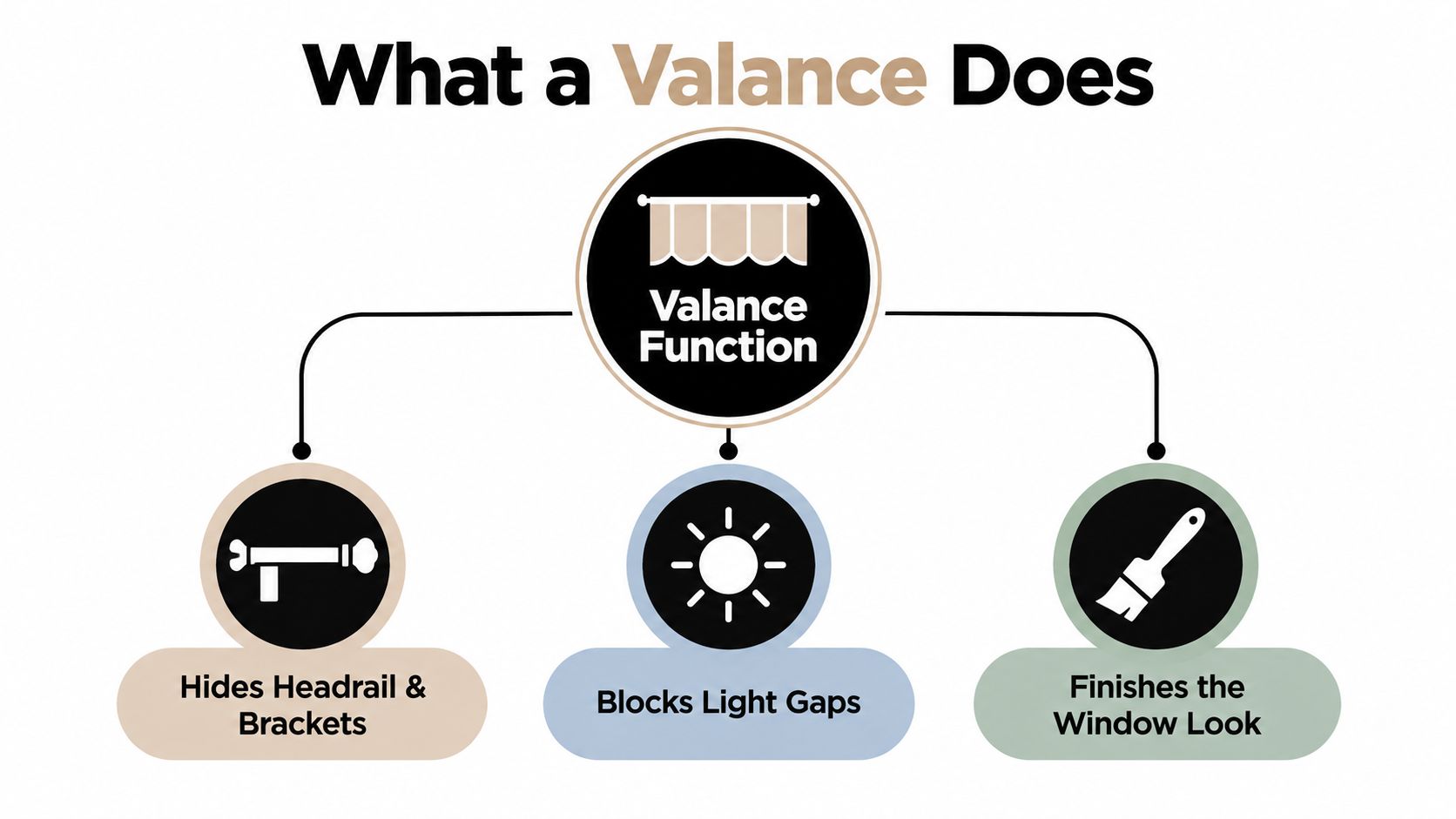
It's important to separate light-gap coverage from true blackout performance. A valance may block light entering at the top edge, but it doesn't seal the sides or control light passing through the blind material. If the room needs stronger darkness, pair the valance with a suitable blackout blind or shade rather than treating the valance as a replacement for one.
Practical rule: A valance improves the blind's appearance first. Any light-blocking benefit is a useful secondary effect.
The construction varies. Some valances are soft fabric panels, while others are made from wood, faux wood, metal, PVC, or a rigid wrapped material. In vertical-blind systems, clip-based mounting is common, with the valance attaching directly to the headrail through plastic or metal clips. For broader outdoor applications, shoppers may also find useful context in Outdoor Leisure Living outdoor blinds, where the hardware and weather exposure require a different approach.
Valances didn't begin as a purely decorative flourish. Reference material defines a valance as a short ornamental drapery placed across the top of a window or canopy to hide structural detail, a role that appeared in elite interiors long before modern blinds Dictionary.com's history and definition of valance.
In Renaissance Europe, designers used layered architectural and textile treatments to make windows look more finished. By the Baroque and early Georgian period, 1643 to 1730, window dressing had become highly elaborate, with cornices and pelmets helping conceal the upper edges of fabric and hardware Dictionary.com's account of the term and its history. The materials and silhouettes changed, but the design problem stayed familiar: the top of a window treatment often contains the least attractive functional parts.
Victorian rooms pushed layering further. One historical account describes most Victorian windows as using three layers of light protection, combining a cornice, a drapery or valance, and one or more curtains Dictionary.com's historical overview. That arrangement made the window feel substantial and helped manage daylight before modern blind mechanisms existed.
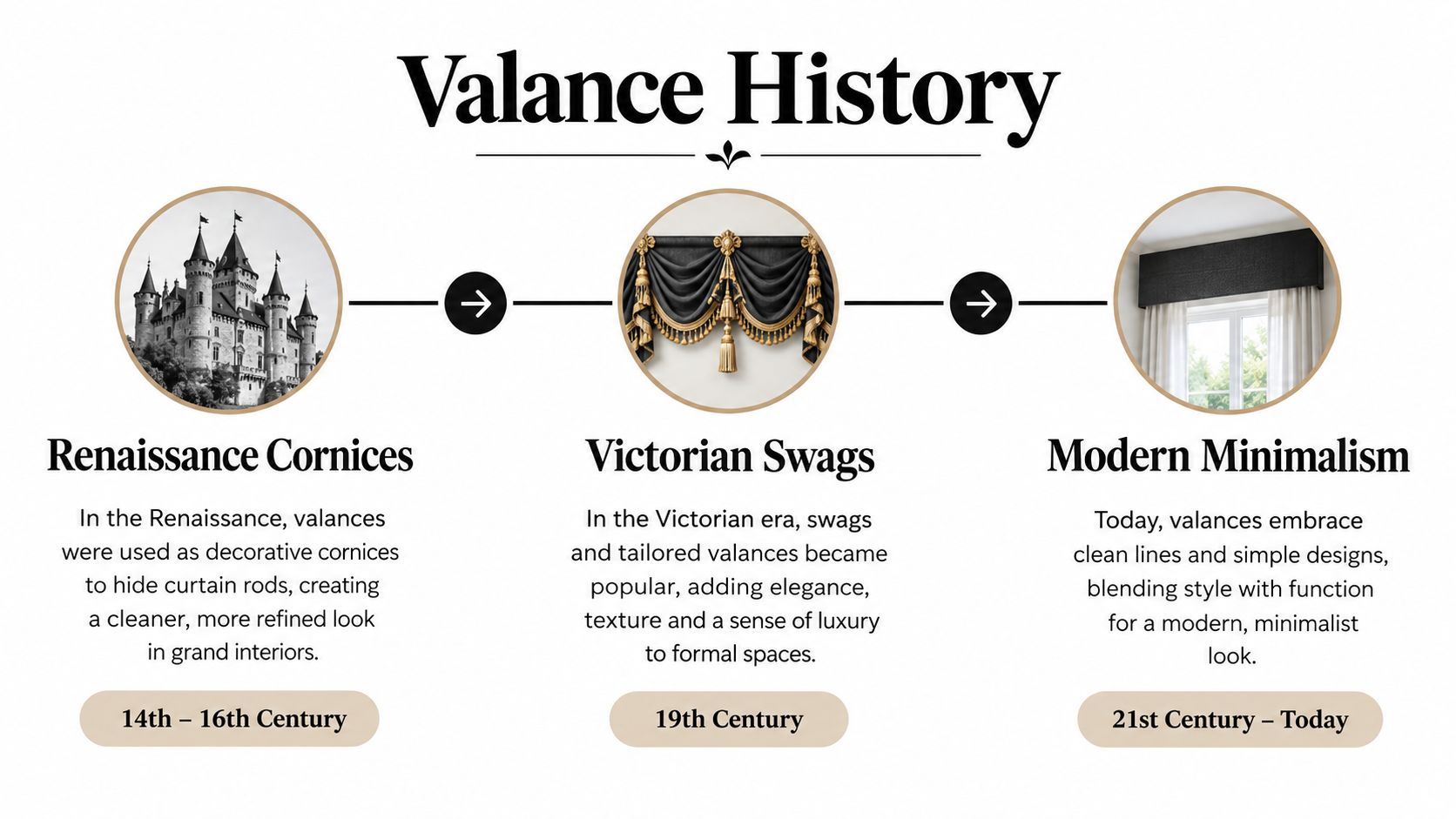
The modern valance is usually slimmer than its historical relatives. A wood or faux-wood version may echo the slat finish, while a fabric version softens a roller, cellular, or Roman shade. Contemporary architectural versions use clean channels and simple profiles rather than heavy swags.
The underlying logic hasn't changed. Earlier designers hid rods, pulley systems, and rough transitions. Today, a valance hides headrails, brackets, screws, and lift mechanisms. The accessory remains relevant because functional window hardware still needs a visually quiet finish.
The global scale of the surrounding market also helps explain its staying power. Reporting places the curtains and window blinds market at about $21.9 billion in 2025, with a projection of $33.68 billion by 2034 and a 4.9% compound annual growth rate over that period market overview and projections. Valances are a small part of that wider category, but they remain a practical way to make standardized systems look more considered.
A blind installation has a front profile, and the valance changes that profile. Instead of seeing the headrail and bracket edges, you see a continuous top element that visually caps the window.
The first job is hardware concealment. The valance face covers the headrail, while side returns, when included, wrap toward the wall to hide the depth of the brackets. This is especially helpful when the blind has a prominent cassette, clutch, or cordless lift mechanism.
The second job is profile consistency. In a room with several windows, the valance can create a shared horizontal finish even when the windows vary slightly in casing, height, or mounting arrangement. That consistency can make rental units, open-plan rooms, and multi-window walls feel more orderly.
The third job is top-edge light control. A valance can cover a visible opening above the blind, but the result depends on the blind, mount type, wall position, and valance fit. It won't automatically make a window blackout-ready.
| Blind Component | Typical Size | 2.5" Valance | 3.5" Valance | 4.5" Valance |
|---|---|---|---|---|
| Headrail face | Varies by system | Covers a shallow face | Covers a deeper face | Covers a deeper or layered face |
| Mounting brackets | Varies by system | May cover front projection | Better coverage with returns | Strongest coverage for bulky hardware |
| Lift or clutch housing | Varies by system | Suitable only when clearance is confirmed | More adaptable | Useful for larger assemblies |
| Top light gap | Varies by installation | Can cover a narrow gap | Offers broader visual coverage | May cover more, but needs careful placement |
| Blind slats or fabric | Main window area remains exposed | Leaves blind operation accessible | Leaves blind operation accessible | Leaves blind operation accessible |
The table is a planning aid, not a substitute for measuring the actual headrail. Technical guidance recommends leaving at least about 1/2 inch between the mounting surface and the outermost point of the blind or headrail so the valance won't rub during operation clearance guidance for blind valances.
Cordless and top-down bottom-up systems deserve extra attention because their internal hardware can make the headrail bulkier. Check the lift path, tilt movement, charging access, or control location before fixing the valance permanently.
The best style depends on whether you want the window to feel soft, coordinated, architectural, or almost invisible. A fabric valance can make a plain blind feel more domestic, while a matching hard valance can make the entire assembly look like one designed unit.
| Valance Style | Typical Depth | Best Blind Type | Best Room | Look |
|---|---|---|---|---|
| Fabric | Shallow to moderate, depending on board and returns | Roller, cellular, Roman, and simple mini blinds | Bedrooms, living rooms | Soft, layered, coordinated |
| Wood or faux wood | Sized to the slat and headrail profile | Real wood, faux wood, and some aluminum blinds | Studies, dining rooms, kitchens | Built-in, tailored, traditional |
| Cornice | Deeper rigid box profile | Vertical blinds, deep cassettes, layered shades | Statement windows and large openings | Structured, formal, architectural |
| Modern architectural | Slim channel profile | Cordless, roller, and low-profile blinds | Contemporary rooms, rentals, offices | Minimal, clean, unobtrusive |
Fabric styles include flat panels, pleated treatments, and softer gathered or ruffled designs. They work well when you want to coordinate the window with upholstery, bedding, or wall color without adding a rigid box.
A shallow fabric option is often a sensible choice for a rental bedroom or family room, especially when the existing blind already has a low-profile headrail. Keep the fabric away from moving parts and choose a construction that can be removed for cleaning.
A wood or faux-wood valance can match the blind's slat color and finish, producing a cohesive horizontal cap. Faux wood is a practical direction for kitchens and bathrooms because the material is generally easier to maintain than delicate fabric, but the product still needs to be compatible with moisture and the mounting surface.
A cornice is more rigid and box-like than a typical soft valance. It can conceal deeper headrails and create a stronger architectural statement, while a slim aluminum or PVC channel suits a minimalist room where the hardware should disappear rather than become a focal point.
For softer bedroom styling and layered treatments, see bedroom window valance ideas. The useful question isn't whether one style is universally fashionable. Ask whether its depth, material, and visual weight suit the blind already installed.
A valance looks custom when three measurements agree: width, return depth, and clearance. Measure the blind and its hardware, not just the glass or window opening.
For an outside-mounted blind, a practical starting point is the headrail width plus 1 inch on each side. For an inside-mounted installation, measure the inside opening and follow the product's fit instructions. A Bali measuring guide states that an inside-mount valance without returns is typically made about 3/8 inch longer than the headrail's finished measure Bali wood valance measuring guide.
Don't assume a wider valance is automatically better. Extra width can sometimes be trimmed, but a short face won't hide the brackets at the sides.
The return is the small side piece that turns from the front face toward the wall. It needs to clear the blind, bracket, and any projecting mechanism. Product specifications show some major-brand return depths in the range of roughly 3 5/8 inches to 5 1/4 inches, which demonstrates why window width alone doesn't determine fit blind valance clearance guidance.
A separate technical guide lists standard return values such as 2 3/4 inches to 3 1/8 inches, depending on valance style and whether the blind is real wood or faux wood valance measuring details.
Leave at least about 1/2 inch between the mounting surface and the blind's outermost point, and test the blind through its full movement before tightening everything installation clearance guidance. For an inside mount, one guide recommends measuring to the nearest 1/8 inch and reducing the result by another 1/4 inch to allow removal and refitting valance measuring details.
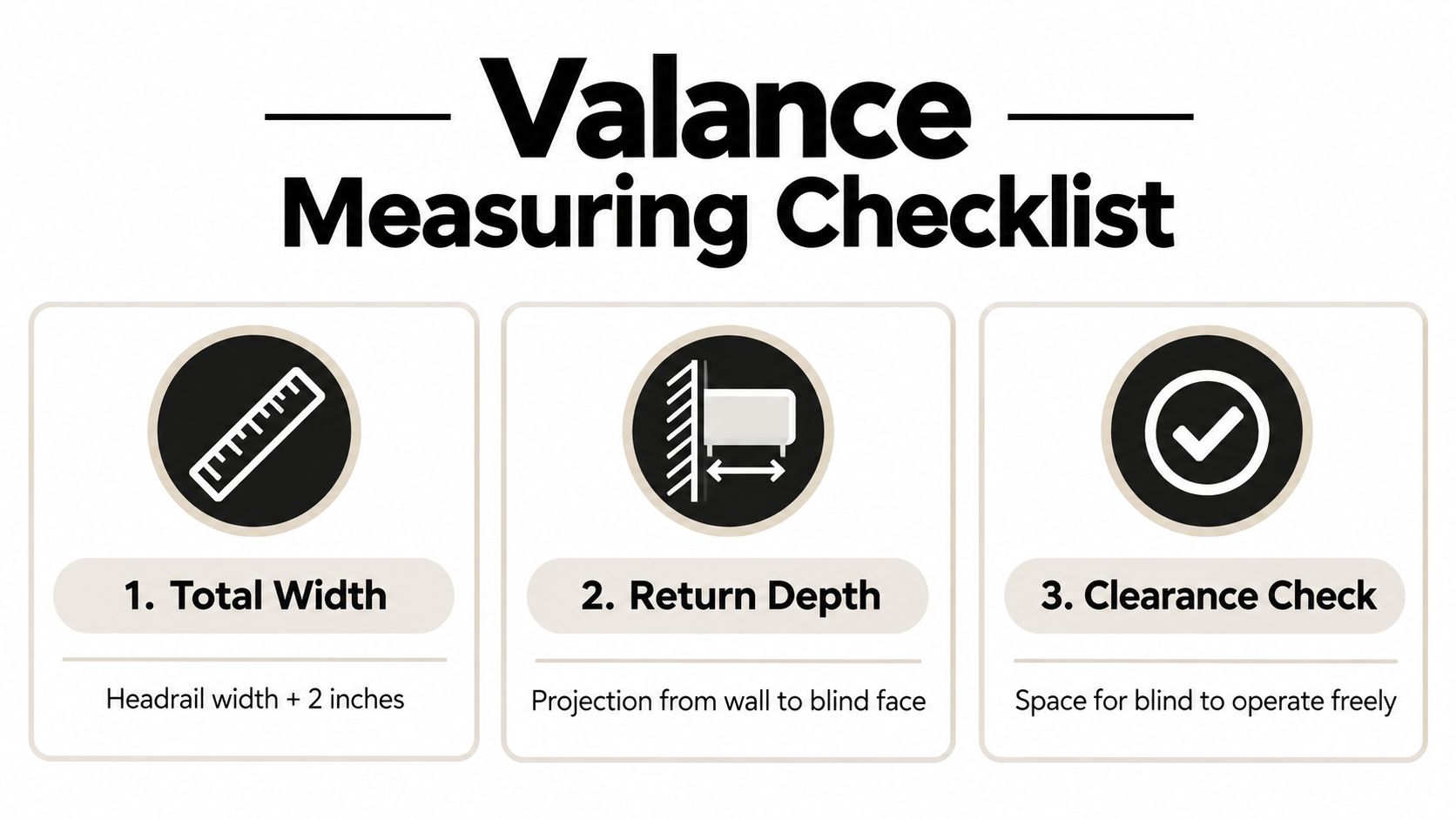
A useful mental model is simple: the face hides the front, the returns hide the sides, and the clearance protects operation. If any one of those three is wrong, the valance may look uneven, scrape the blind, or prevent access to the mechanism.
Installation method matters as much as style. Before drilling, hold the valance in position and operate the blind. Tilt the slats, raise and lower the blind, and check any cordless handle, motor, or charging access.
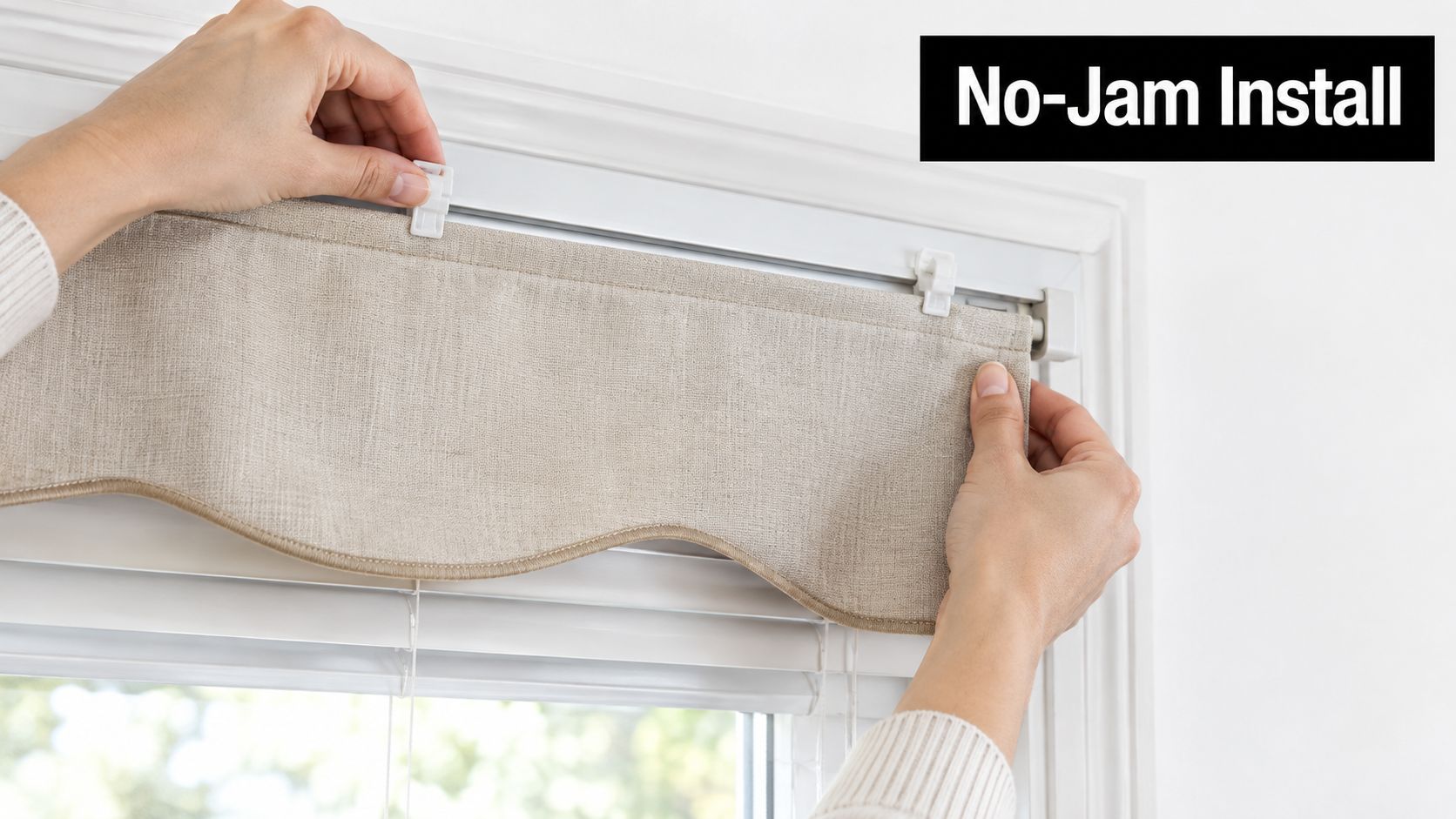
Clip-on valances attach to the headrail brackets or clips and suit lighter fabric and PVC styles. They install quickly, but the clip position can limit how much return depth you achieve.
Bracket-mounted valances use separate L-brackets above or beside the blind. This arrangement gives you more control over projection and is useful when the headrail or cassette is deep.
Cordless-compatible valances use a slim spacer or adjusted bracket position to keep the lift mechanism clear. Don't assume that a cordless blind automatically accepts every separate valance. Check the headrail shape and operating path first.
The guide to hanging valances can help you compare placement and fastening approaches before you start.
Use a level, suitable wall anchors, and a pilot hole when the material calls for it. Fasten firmly, but don't crush the valance against the bracket.
A visual walkthrough can be useful when the mounting method differs from your existing blind system.
A quick decision starts with three questions. How deep is the blind headrail? How important is top-edge light control? What style already exists in the room? Those answers narrow the choices faster than browsing by color alone.
For a rental or a low-profile cordless blind, a shallow fabric valance can add softness without making the window feel heavy. In a kitchen or bathroom, a faux-wood option may coordinate with the blind while offering a simpler surface to wipe clean. A deep architectural cornice makes more sense when the window is a focal point or the headrail needs substantial coverage.
Use this buying checklist:
For layered shade and blind combinations, shades with valance offers another way to think about the top treatment as part of a complete window design rather than an isolated accessory.
The wider market context supports this practical approach. Reporting estimates that blinds alone represented roughly USD 9.41 billion in 2025, or 29.0% of the broader market, according to the cited industry summary market overview. With so many standardized blind systems in homes and rentals, a compatible valance can provide a focused visual update without replacing the main treatment.
Sometimes. Clip-on models may use the existing headrail or bracket system, while rigid or deep valances usually need dedicated mounting hardware. Confirm the clip shape, headrail profile, and return depth before relying on a no-drill installation.
Measure the complete blind headrail and check whether the valance is available as one piece, multiple joined pieces, or a wider cut-to-size option. For a broad opening, keep the face level and make sure each section aligns without restricting the blind.
Many can, but compatibility depends on the cordless cassette, headrail depth, and mounting method. Leave room for the lift mechanism to travel and confirm that the valance won't block a motor control or charging point.
It can cover a top-edge gap, particularly above an inside-mounted blind, but it won't seal side gaps or replace a blackout shade. Treat it as a finishing and supplementary light-control component.
A rigid or securely mounted cordless-compatible valance is generally easier to manage than loose hanging fabric near a child's window. Keep all mounting secure and follow the safety guidance supplied with the blind and valance.
Dust wood, faux wood, PVC, or metal surfaces with a soft cloth and use the manufacturer's care directions. Vacuum fabric gently with a brush attachment or remove it for laundering only when the product allows it.
For shoppers ready to match a style to actual window measurements, Joey'z Shopping offers valances and related window-treatment options in an online catalog.
Visit Joey'z Shopping to compare valance styles for cordless blinds, layered shades, and practical rental-friendly installations. Measure the headrail width, return depth, and operating clearance first, then choose the finish that makes your window look intentional without replacing the blind underneath.