
Join the Joey'z Family!

About 9 children under age 5 die each year from strangulation involving corded window coverings, according to the U.S. Consumer Product Safety Commission. That figure changes how shoppers should view window blinds cordless designs. The missing pull cord isn't merely a clean decorating detail. It reflects a fundamental change in how a blind lifts, lowers, tilts, and protects the people around it.
Cordless blinds use concealed lift components, a hand-operated bottom rail, a wand, or a motor instead of an exposed hanging cord. The right choice depends on the window's size, the room's light needs, who uses the space, and whether you want simple manual control or smart-home convenience.
Cordless window blinds raise, lower, or tilt without an external pull cord. Depending on the style, an internal spring, roller, concealed cord path, or motor holds the covering in position while you operate it by hand or with a remote.
That distinction matters. A blind can look cord-free while still containing inaccessible lift cords inside the headrail, tube, or fabric structure. The important question isn't whether every internal component has vanished. It's whether the operating parts remain inaccessible and can't create a hazardous loop.
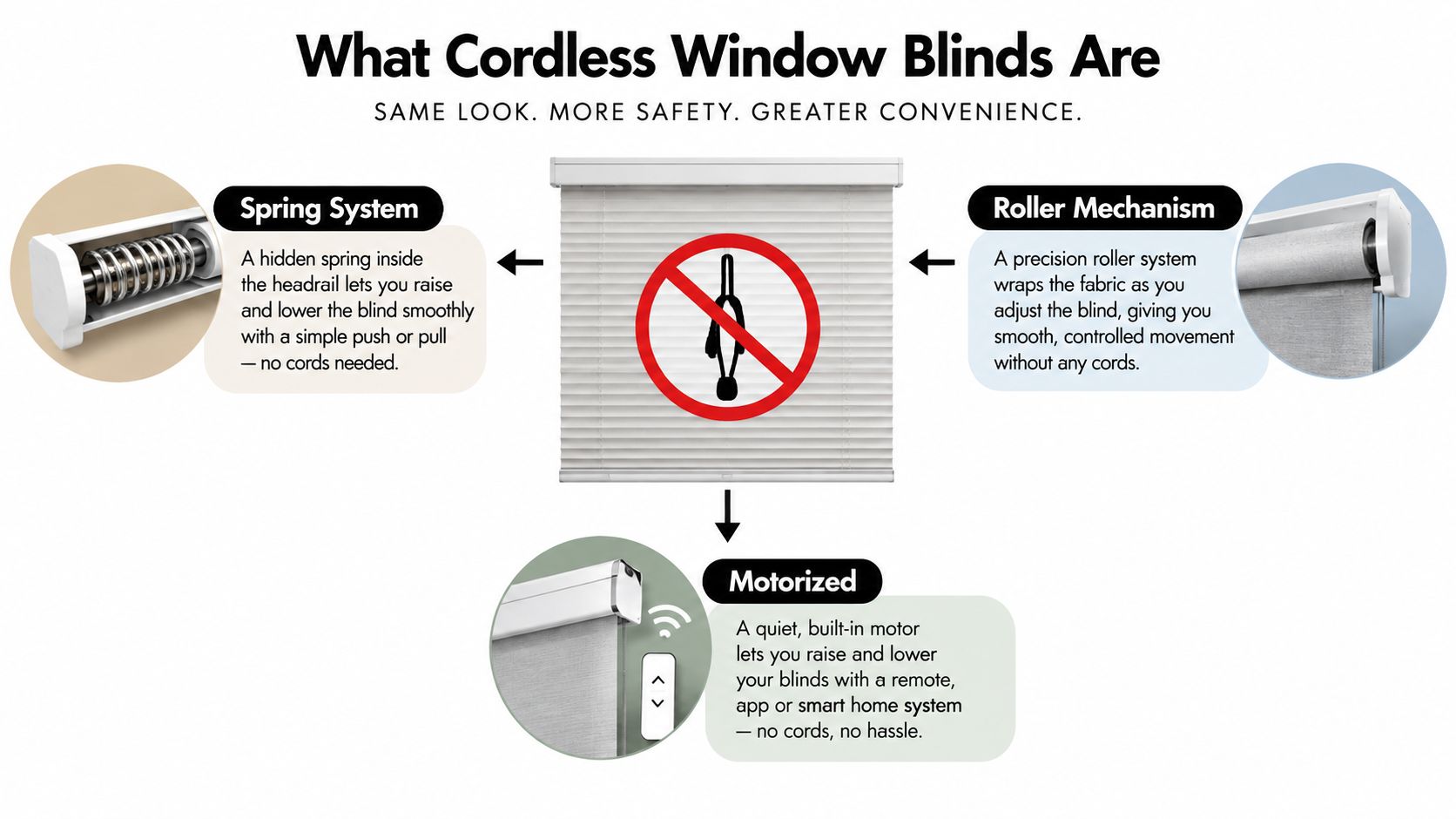
With a manual cordless roller shade, you generally guide the bottom rail to the desired height, and a tensioned tube keeps the fabric there. A cellular shade may use a concealed lift arrangement inside its honeycomb construction. Faux wood and Venetian-style blinds often use a tilt wand for the slats, while a motorized model uses a battery-powered or wired drive.
The same label covers several families:
Practical rule: “Cordless” describes the control design, not one specific look or operating feel.
A roller blind and a cellular shade can both be cordless, yet they won't behave the same way in your hand. Start by identifying the lift mechanism, then assess safety, light control, measuring, installation, and automation. That sequence makes product pages much easier to interpret.
About 9 children under age 5 die every year from strangulation involving corded window coverings, according to the CPSC reports. From January 2009 through December 2021, the agency recorded more than 200 incidents involving children up to age 8, and a child died in 48% of those incidents. The hazard is the accessible loop or pull cord, which can act like a tightening rope if a child becomes entangled.
Separate injury tracking from Nationwide Children's Hospital found that nearly 17,000 children under 6 received emergency-department treatment for window blind-related injuries from 1990 through 2015, averaging almost 650 injuries per year, or about two per day. These figures make cord safety especially relevant in nurseries, bedrooms, family rooms, and rental homes where children may visit.
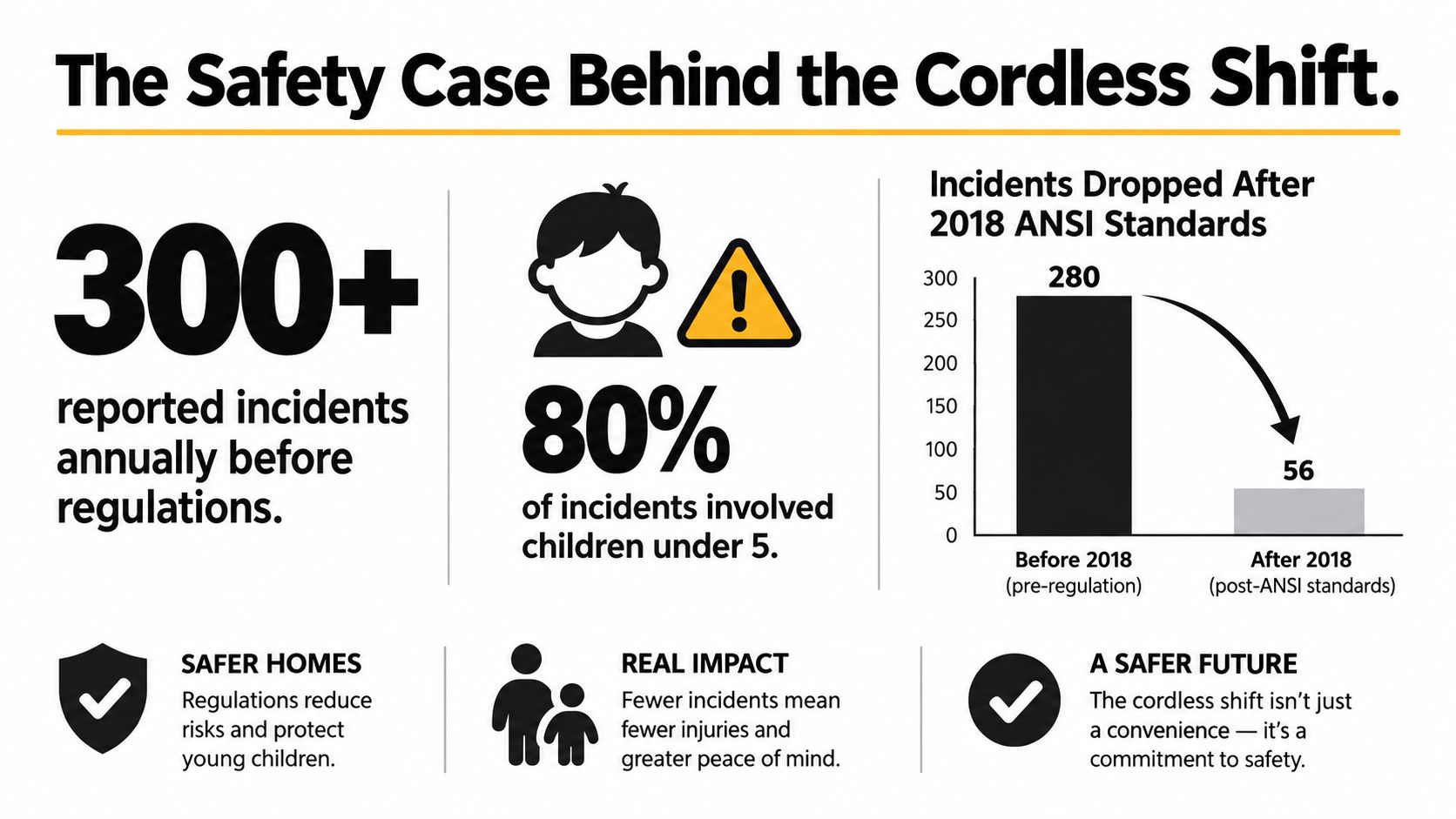
On December 15, 2018, a revised voluntary safety standard took effect in the United States. Stock window coverings sold in stores or online had to be cordless or use inaccessible cords. The CPSC announcement describes the change as a major shift for manufacturers and retailers.
A consumer explanation of the window-covering rule notes that the standard became mandatory for all stock window coverings in 2022. Existing blinds in older homes or hotels may still have exposed lift cords, and adding a retrofit device does not automatically make an outdated product equivalent to a newer design.
Read product pages by checking the control system, not just the word “cordless.” A bottom rail may operate a spring-assisted lift, internal cords may remain enclosed inside the shade, and a motorized model may replace manual pulling with a battery-powered or wired drive. For room-darkening needs, a nursery blackout roller blinds guide can help compare fabric and installation details.
For a buyer-friendly explanation, see window shades without strings.
“Cordless” doesn't tell you how a blind feels to use. The mechanism does. A small roller shade may glide with a light pull, while a wide cellular shade needs an even touch across the bottom rail. Motorization removes manual lifting but introduces batteries, charging, or smart-home setup.
| Mechanism | How It Works | Common Blind Styles | Daily Feel |
|---|---|---|---|
| Spring-assist roller | A tensioned tube supports the fabric and holds it at the selected position | Roller and solar-style shades | Quick, quiet, and direct |
| Concealed lift system | Internal components move the shade while keeping operating cords inaccessible | Cellular, pleated, and Roman shades | Controlled movement through the bottom rail |
| Wand tilt | A rigid wand rotates slats instead of using an exposed tilt cord | Wood, faux wood, and Venetian-style blinds | Precise slat adjustment, with separate lift control |
| Motor drive | A battery-powered, wired, or connected motor moves the covering | Roller, cellular, Roman, zebra, and selected slatted blinds | Button, remote, app, or voice operation |
A cordless roller usually has a fabric sheet wrapped around a tube. Pull the bottom bar down, stop at the preferred height, and the internal tension holds the roll in place. These shades suit ordinary windows where you can comfortably reach the bottom rail and want a straightforward operating routine.
The trade-off is control style. A roller gives you vertical movement, but it doesn't provide the slat-by-slat light adjustment available from a Venetian blind.
Cellular and pleated shades use their structured fabric differently from rollers. The lift parts remain inside the shade assembly, and the bottom rail guides the movement. These styles are useful when you want a softer appearance or a shade that can support strong light filtering and insulation goals.
A Roman shade adds folded fabric, so its internal construction must support the folds as they stack. Read the product description for the exact lift method rather than assuming every cordless fabric shade operates identically.
Slatted blinds commonly separate two tasks. A wand rotates the slats for privacy and glare control, while the cordless lift raises or lowers the entire blind. That separation helps you understand why a product can be cordless without being motorized.
Motorization replaces the hand-operated lift with a drive. It's particularly sensible for high, wide, or hard-to-reach windows, but you'll need to check the power and control details before ordering.
Measure first. An undersized blind can leave unwanted light gaps at the edges, weaken privacy, and reduce the performance you expected from the covering. For an inside mount, record the window width and height carefully and check whether the frame has enough depth for the headrail. For an outside mount, plan the overlap around the opening so the blind covers the frame rather than stopping at the glass.
Then work through five practical questions.
Light control should come before color. Sheer fabrics soften daylight but leave the room bright. Light-filtering materials reduce glare while preserving a daytime atmosphere. Room-darkening fabrics block more light, and blackout construction is the stronger choice for sleep-focused rooms or media spaces.
| Opacity Level | Best Rooms | Light Control | Privacy |
|---|---|---|---|
| Sheer | Living areas and bright decorative spaces | Softens daylight | Limited, especially at night |
| Light-filtering | Kitchens, offices, and family rooms | Reduces glare while admitting light | Moderate |
| Room-darkening | Bedrooms and television rooms | Blocks substantial light | Strong |
| Blackout | Nurseries and sleep-focused bedrooms | Minimizes incoming light | Strongest when the fit is close |
Privacy changes with direction and time. A translucent shade may feel private during the day but reveal silhouettes after sunset when interior lights are on. If privacy is a priority, examine the fabric description and consider how the room looks from outside at night.
Cellular, or honeycomb, shades are the energy-focused option because their cells trap air between the room and the glass. That construction can help reduce heat transfer, although the result still depends on the window, fit, fabric, and installation.
Color changes the room's visual balance. Lighter finishes bounce daylight farther into the space, while darker slates can reduce perceived screen glare and create a more grounded appearance. Order samples when possible, because a shade can look warmer, cooler, or more reflective beside your wall paint than it did on a product page.
A useful checkout test: Confirm the finished width, mounting type, opacity, lift method, and operating instructions before you compare decorative details.
A cordless blind isn't automatically a smart blind. The word cordless describes the absence of an exposed operating cord. Automation is a separate feature that may use a motor, remote, app, hub, or voice assistant.
Automation is helpful for inaccessible windows, tall openings, and rooms where you want scheduled light control. It can also simplify operation for people who find lifting difficult. The added hardware means you should verify battery access, charging, pairing, reset procedures, and local control before purchasing.
For a broader introduction to planning connected devices, automating your home step by step offers useful context beyond window coverings.
Joey'z Shopping's motorized cordless blinds explain the distinction between cordless construction and motorized control. Product pages should tell you whether a specific blind ships with a motor or supports a retrofit, so don't assume the collection label applies to every individual model.
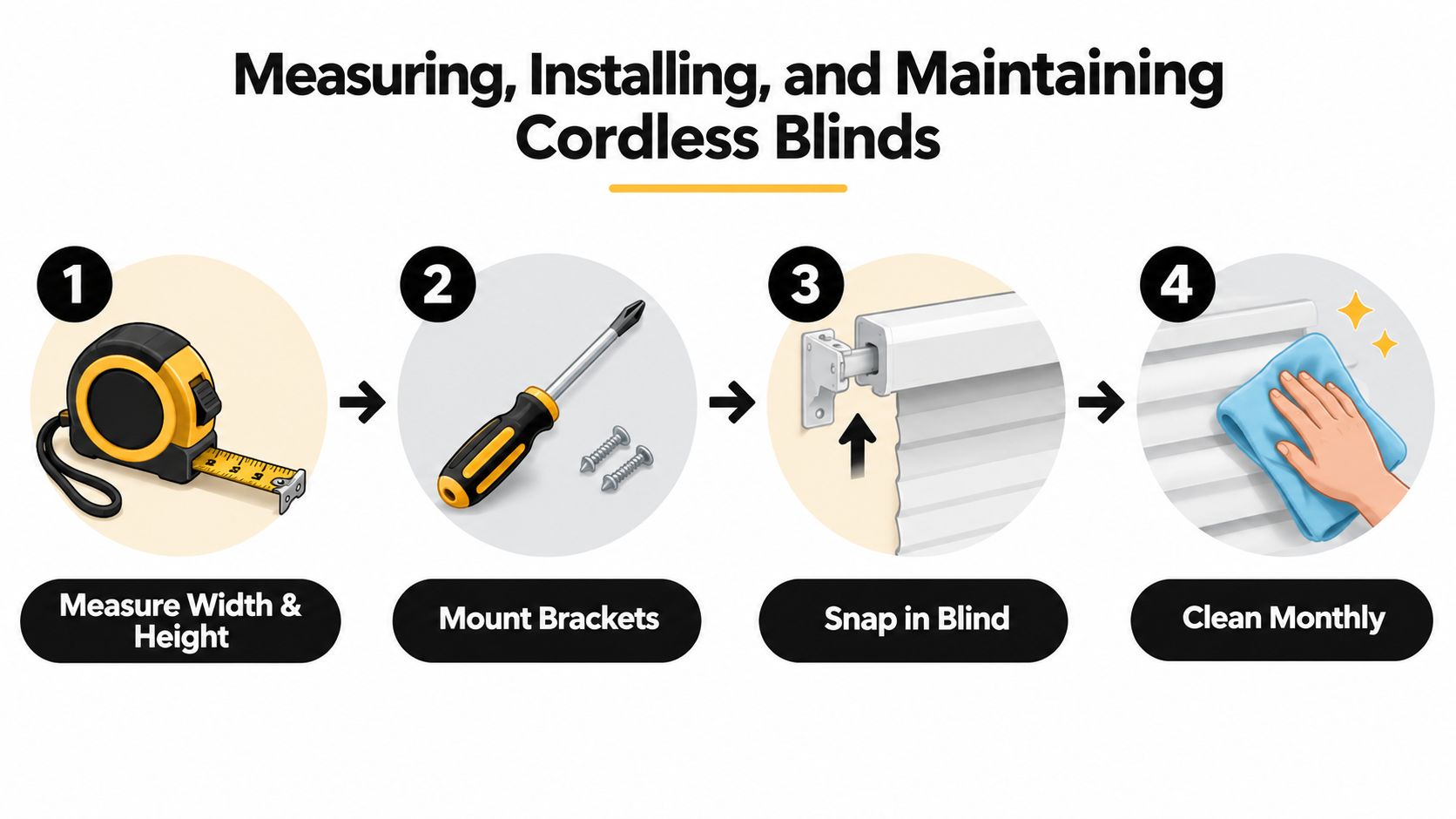
Good installation begins with a pencil, tape measure, and patience. For an inside mount, measure the width at the top, middle, and bottom of the recess, then measure the height. For an outside mount, measure the opening and decide how much frame overlap you need. Manufacturers may apply small deductions to the ordered width so the headrail clears the frame, so check the product's measurement instructions before entering final dimensions.
Mark bracket positions carefully and use anchors when screws don't land in solid framing. A common DIY mistake is tightening a screw into drywall without support, then wondering why the headrail loosens. Wider blinds may need more brackets, and the manufacturer's spacing diagram should take priority over a guessed layout.
Snap or clip the headrail into place without forcing it. Once mounted, raise and lower a spring-assist blind with even pressure across the bottom rail. Pulling from one corner can skew the rail or slats. Motorized models need a separate setup step for travel limits, pairing, and stop points.
For a visual demonstration of installation and operation, use this cordless blind installation video.
Use a soft brush for cellular cells and low suction for pleated fabrics. Wipe faux wood with a slightly damp cloth, and keep harsh chemicals away from vinyl and aluminum because they can cloud the finish. Dusting the headrail and bottom rail also helps preserve smooth movement.
If a blind needs adjustment or shortening, review how to shorten cordless blinds before cutting anything. A mistake near the lift mechanism can affect operation, and some custom products aren't designed for homeowner modification.
The easiest decision rule is simple: match the room's job to the material and the lift mechanism. A nursery needs a safety-first design and controlled light. A media room needs glare management and darkness. A high window needs reachable control, which often points toward motorization.
| Buyer Priority | Recommended Cordless Type | Joey'z Shopping Collection |
|---|---|---|
| Child and pet safety | Light-filtering cordless cellular shade | Child Safe Cordless Cellular |
| Sleep and darkness | Blackout cordless roller or Roman shade | Designer Blackout Cordless Roller |
| App and voice convenience | Motorized cellular or zebra blind | Smart Motorized Cordless |
A family-focused household may prefer a light-filtering cellular shade in a nursery or playroom. Its structured fabric supports a soft appearance while the cordless design removes the exposed pull cord from the room's everyday reach.
A design-led buyer may choose a blackout roller or Roman style for a bedroom, guest room, or media area. The decision then turns to fabric texture, edge coverage, mounting style, and whether the clean roller profile or folded Roman shape suits the decor.
A technology-focused shopper should confirm hub and voice-assistant compatibility before choosing a motorized cellular or zebra blind. If the window sits above furniture or outside comfortable reach, automation can be more practical than a manual lift.
The product name isn't enough. Check the actual specifications for the lift type, opacity, measurements, power arrangement, and mounting requirements.
The short answer is that a cordless product can meet the standard, but the label alone isn't proof of compliance. U.S. guidance says stock products must use operating cords that are cordless, motorized, shorter than 8 inches, or inaccessible, while inner cords must be inaccessible or too short to form a hazardous loop under the applicable testing procedures. Review the compliance statement and look for concealed lift paths rather than relying on a “cordless-looking” photograph.
Their service life depends on construction, window size, frequency of use, installation, and maintenance. Spring systems have fewer electronic parts, while motorized systems add a drive, power source, and possible connectivity components. Compare the manufacturer's warranty, battery policy, replacement-part availability, and repair process instead of assuming that every cordless mechanism has the same coverage.
Some products are available in custom widths, while others are made in fixed sizes that may be trimmed only by the manufacturer or an approved service. Don't cut the headrail or fabric unless the instructions specifically allow it. Custom orders can also have different return conditions, so confirm the finished dimensions, deductions, and mounting method before submitting the order.
Sometimes, but compatibility depends on the blind's headrail, weight, width, and internal construction. A retrofit may replace the operating mechanism, while another solution may require a complete cordless blind. If an existing product has accessible cords or damaged components, replacement is often the clearer path for a safety-focused room. Review the product specifications and installation guidance before treating a retrofit as equivalent.
Joey'z Shopping offers cordless blinds and shades for practical room updates, including the Cordless Veranda Vinyl Roll-Up Blind and collections with cordless operating options. Visit Joey'z Shopping to compare manual, blackout, cellular, and motorized window treatments, then check each product page for measurements, lift mechanics, and installation details before ordering.