
Join the Joey'z Family!

Getting your curtain width right is the single most important step to achieving that lush, professionally styled look. The secret isn't just covering the window; it's about using the right amount of fabric. The magic formula is surprisingly simple: (Curtain Rod Width x Fullness Ratio) = Total Curtain Width.
This guide on calculating the width of curtains will walk you through every step. We'll start with the basics of why window size alone isn't enough, help you choose the right tools, and break down the math with real-world examples.
Beautiful, functional curtains are not about perfectly matching your window's dimensions. The key concept designers use is fullness, which creates an illusion of grandeur. Buying a curtain panel that’s the exact width of your window will cause it to hang taut like a bedsheet when closed—not the elegant, flowing look you're after.
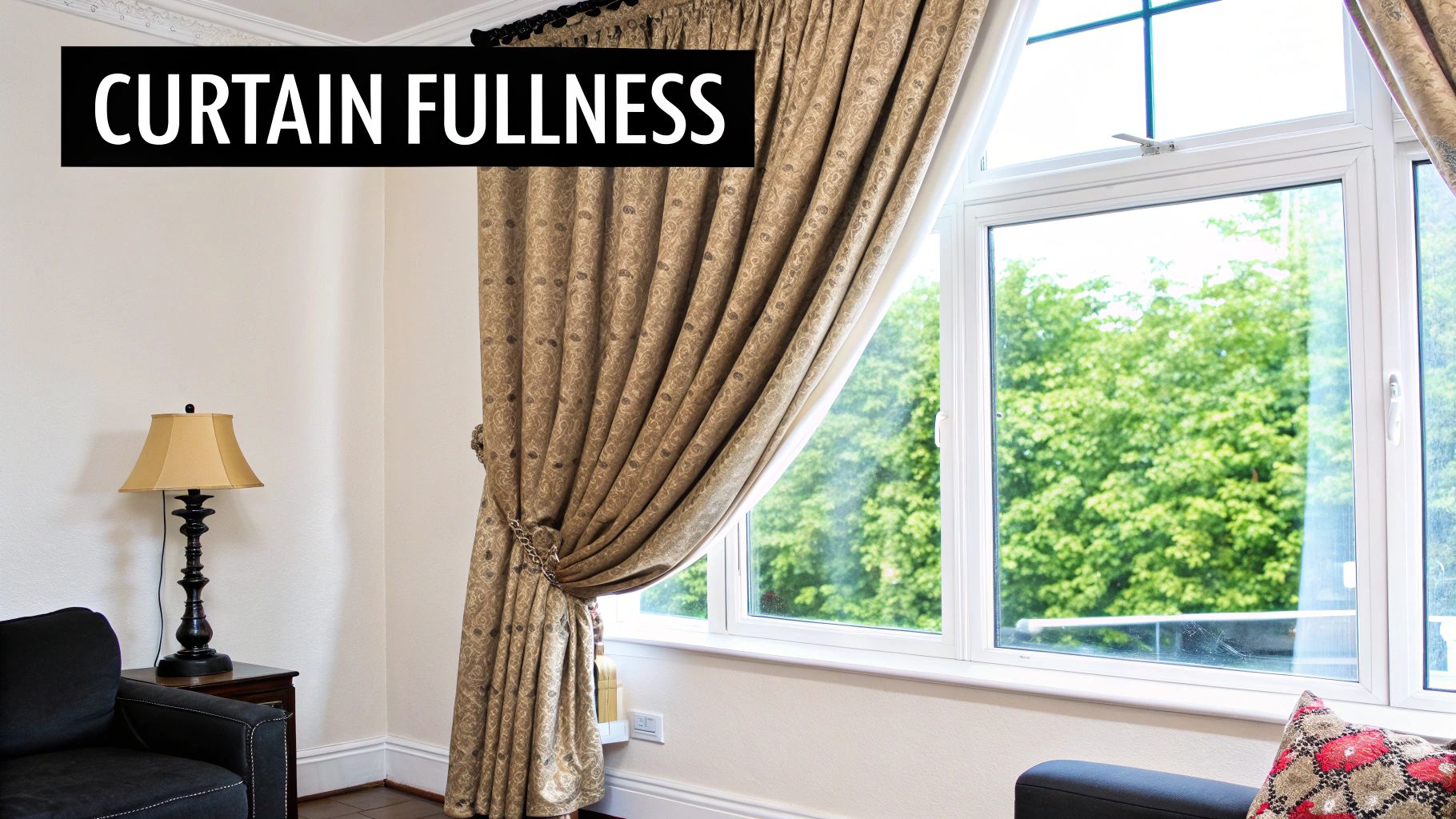
The trick is to shift your mindset from simply covering glass to dressing the entire window area. This involves a few professional concepts that make all the difference.
Before pulling out the tape measure, let's define the terms that will guide your calculations. Nailing these will set you up for success with any window in your home.
The design industry gold standard is achieving perfect fullness. Most designers agree that the total curtain width should be at least 1.5 to 2 times the width of your window or rod to create visually pleasing gathers. For more inspiration, explore our guide on design standards for curtain measurements.
Insider Tip: Always install your curtain rod before finalizing your curtain width. The rod's placement—not the window frame's size—is the true foundation for all width calculations.
The fullness you choose directly impacts the curtain's style. Breezy sheer curtains might look fantastic with lighter fullness (1.5x), while heavy blackout curtains benefit from denser fullness (2x to 2.5x) for maximum light-blocking.
Before we talk fabric and style, let's get the numbers right. Even the most gorgeous curtains can look off if the initial measurements are wonky. The good news? You only need a couple of basics and the right approach.
First, grab a steel tape measure. Avoid soft, flexible ones; they can stretch and give inaccurate readings. You'll also want a pencil and notepad (or a notes app) to track everything. Always measure twice to be sure.
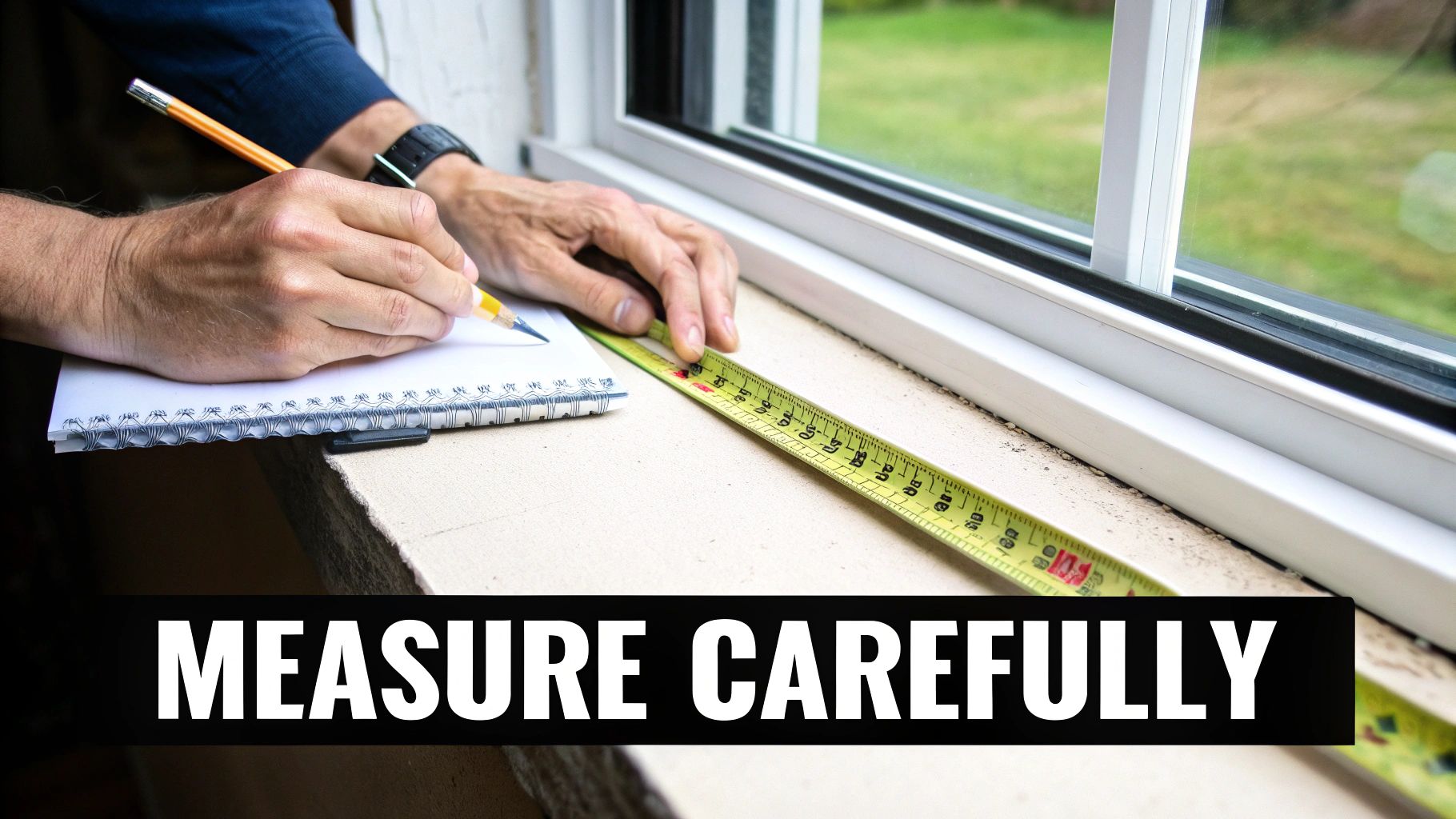
The first number to get is the width of the window frame itself. Measure from the outside edge of the trim on the left to the outside edge on the right. This is your starting point. For example, a standard bedroom window might be 48 inches wide.
But here’s the pro-tip: the most important measurement isn't the window, but the curtain rod. A common mistake is buying a rod that’s barely wider than the window, which makes the setup feel cramped and blocks light.
Key Takeaway: Your curtain rod should extend 6 to 12 inches past the window frame on each side. This extra room is for "stackback," letting your curtains frame the window beautifully instead of smothering it.
So, for that 48-inch window, you’d add at least 6 inches to each side (12 inches total), making your ideal rod width 60 inches. This 60-inch measurement is the number you’ll use for calculating fullness. Check our complete curtain rod size chart to find the perfect match for any window.
Ever wonder what gives curtains that lush, flowing look with deep, elegant folds? The secret is fullness. It’s the magic ingredient that transforms a flat piece of fabric into a luxurious drape.
So, what exactly is curtain fullness? It's the ratio of your total fabric width to the width of your curtain rod. For example, a 2x fullness ratio means your curtains are twice as wide as the area they're covering. All that extra material is gathered into beautiful waves and pleats, adding texture, depth, and a high-end finish.
The right fullness depends on the mood you want to create and your chosen fabric. There’s no single correct answer, but these guidelines will help you nail the look.
This idea of using generous fabric has roots in Victorian homes, where multiple layers of heavy curtains were used for both insulation and decoration, as documented by sources like The Victorian Emporium.
Expert Tip: Your curtain's heading style (the way it attaches to the rod) also plays a role. A classic pinch pleat heading needs a standard 2x fullness to look right, while a simple rod pocket is more forgiving.
For a deeper dive, check out our guide on what defines a drapery panel.
Once you have your total required width, the next step is turning that number into actual curtain panels. Whether you choose a single panel or a classic pair, a few extra calculations are needed for a polished, professional look.
This is where we account for two crucial details: overlap and returns. Overlap is the extra fabric ensuring a pair of curtains meets perfectly in the middle, while returns are the bits of fabric needed to wrap around the bracket to the wall, blocking light from the sides.
Let's use a 60-inch rod and a standard 2x fullness. Your total required curtain width is 120 inches. If you're using a classic pair of curtains, divide that total by two.
This means each of the two panels needs to be at least 60 inches wide. Most off-the-shelf panels come in standard widths like 50 inches. In this case, you'd need four standard 50-inch panels (two on each side) to get the lush fullness you're after.

This diagram shows how moving from a sheer 1.5x fullness to a luxurious 3x option creates deeper, richer folds.
For a truly light-proof seal, add a bit more width to your plan. These details elevate the result from good to great.
Insider Tip: For most standard windows, adding a total of 12 inches to your overall width calculation is a safe bet. That covers about 6 inches for overlap and 6 inches for returns, giving you a seamless, gap-free look.
Patterned curtains and non-standard windows require a little extra thought.
Thinking about window treatments early in a renovation can save headaches. Insights on choosing the right windows and doors during renovation can give you a major head start.
Let's see how these rules for calculating curtain width play out in a real home. Walking through a few common scenarios will help you see how the measurements all come together.
This repeatable process works for any window in your house.
You have a 60-inch-wide bedroom window and want maximum light control with blackout curtains.
Next, a large 100-inch-wide living room window. The goal is a soft, airy feel with sheer curtains that filter light.
A Quick Tip: With lightweight fabrics, it's always better to go slightly over on fullness than under. A little extra fabric ensures the drapes don't look sparse.
Let's tackle a corner window by treating it as two separate but connected treatments.
This table breaks down our three scenarios, showing how the same steps apply to different situations.
| Measurement Step | Scenario 1: Bedroom Blackout | Scenario 2: Living Room Sheers | Scenario 3: Corner Window |
|---|---|---|---|
| Window Width | 60 inches | 100 inches | Window A: 40", Window B: 50" |
| Add for Stackback | +16 inches (8" per side) | +20 inches (10" per side) | +6 inches per outer side |
| Final Rod Width | 76 inches | 120 inches | Rod A: 46", Rod B: 56" |
| Choose Fullness | 2x (for light blocking) | 1.5x (for an airy feel) | 2x (for a classic look) |
| Total Fabric Width | 76" x 2 = 152 inches | 120" x 1.5 = 180 inches | Side A: 92", Side B: 112" |
| Plan Your Panels | 2 panels of 76" each (or 4 x 50" panels) | 2 panels of 90" each (or 4 x 50" panels) | Side A: 2x 50" panels, Side B: 3x 50" panels |
No matter the window, the logic is the same: measure, plan your rod, pick a fullness ratio, and multiply.
Even with the formulas down, a few questions always pop up. Let's tackle the most common ones.
The short answer is your curtains should be between 168 and 224 inches wide in total. First, determine your rod width. For a 100-inch window, the rod should extend 6-12 inches past the frame on each side, for a total rod width of 112-124 inches. Then, multiply that rod width by a fullness ratio of 1.5x to 2x for a standard look.
Yes, a 2x fullness ratio is the industry standard for a classic, full look. This means the combined width of your curtain panels should be twice the width of your curtain rod. This ratio provides beautiful gathers and a professional appearance for most fabric types. For a lighter, more modern look, a 1.5x ratio is also acceptable, especially for sheer curtains.
The fundamental formula is: Curtain Rod Width x Fullness Ratio = Total Curtain Width Needed. First, measure your curtain rod (not the window frame). Then, choose a fullness ratio (typically 1.5x for a light look, 2x for standard, or 3x for luxe). Multiplying these two numbers gives you the total fabric width required for full coverage and elegant folds.
Always use the width of the curtain rod for your main calculation. Do not include the decorative finials at the ends. Your rod should always be wider than the window frame, usually extending 6 to 12 inches on each side. This ensures your panels completely cover the window and have enough space to stack back neatly when open.
Ready to put this know-how to good use? Find your perfect curtains at JoeyzShopping.com and discover a beautiful collection for your perfectly measured windows.