
Join the Joey'z Family!

Figuring out how to close blinds is usually simple once you know the type you're dealing with. Whether it's a pull cord, a twist wand, or a modern cordless system, mastering this small action is key to managing privacy, blocking sunlight, and even boosting your home's energy efficiency. It's a daily task that, when done right, protects your investment for years.
In this guide, we'll walk through the exact steps for every common blind type, from Venetian to vertical, and share expert tips to fix stubborn blinds that won't cooperate.
You just want your blinds closed, and you shouldn't need a manual to do it. The method comes down to the style of blinds in your window. From classic Venetian blinds to modern cordless designs, each has its own simple control mechanism.
Think of this as your cheat sheet for instant light control. Once you get the hang of the right motion, you'll avoid putting unnecessary stress on the slats and internal parts, helping your window treatments last longer.
This table provides a simple reference for the most popular blind styles. Just find your blind type below to see exactly what to do.
| Blind Type | Control Mechanism | How to Close | Pro Tip |
|---|---|---|---|
| Venetian | Cord & Wand | Pull one side of the lift cord to lower the blinds fully, then twist the wand to rotate the slats until they're shut. | For maximum privacy, twist the wand so the slats point upwards with the curved side facing out. |
| Vertical | Wand or Chain/Cord | Use the wand or cord to draw the slats across the window, then twist the wand or pull the chain to rotate them closed. | Always rotate the slats to the open position before drawing them across the track. This prevents stress on the clips. |
| Roller Shades | Cordless or Loop | For cordless styles, just pull the bottom rail down. If you have a looped cord, pull one side of the loop in a steady motion. | A slow, steady pull is much better for the mechanism than a quick, jerky one. |
| Cellular Shades | Cordless or Cord | With cordless models, simply push down on the bottom rail. For corded styles, pull the lift cord and angle it to release the lock. | If your cellular shade ever hangs unevenly, just raise it all the way to the top. This usually resets the internal cords. |
While a quick pull or a twist is usually all it takes, truly understanding how to close blinds means getting familiar with their mechanics. Each style, from the classic Venetian to sleek roller shades, has a certain way it likes to be operated. Getting the technique right not only makes your life easier but also helps you avoid the wear and tear that leads to stuck slats and frayed cords.
When you learn these little nuances, a simple daily task becomes a smooth, satisfying action. It's the difference between yanking on a cord and giving it a gentle, controlled pull that protects all the small internal parts. This kind of know-how is what keeps your window treatments working perfectly for years.
The image below shows the three main actions you'll use to close most blinds.
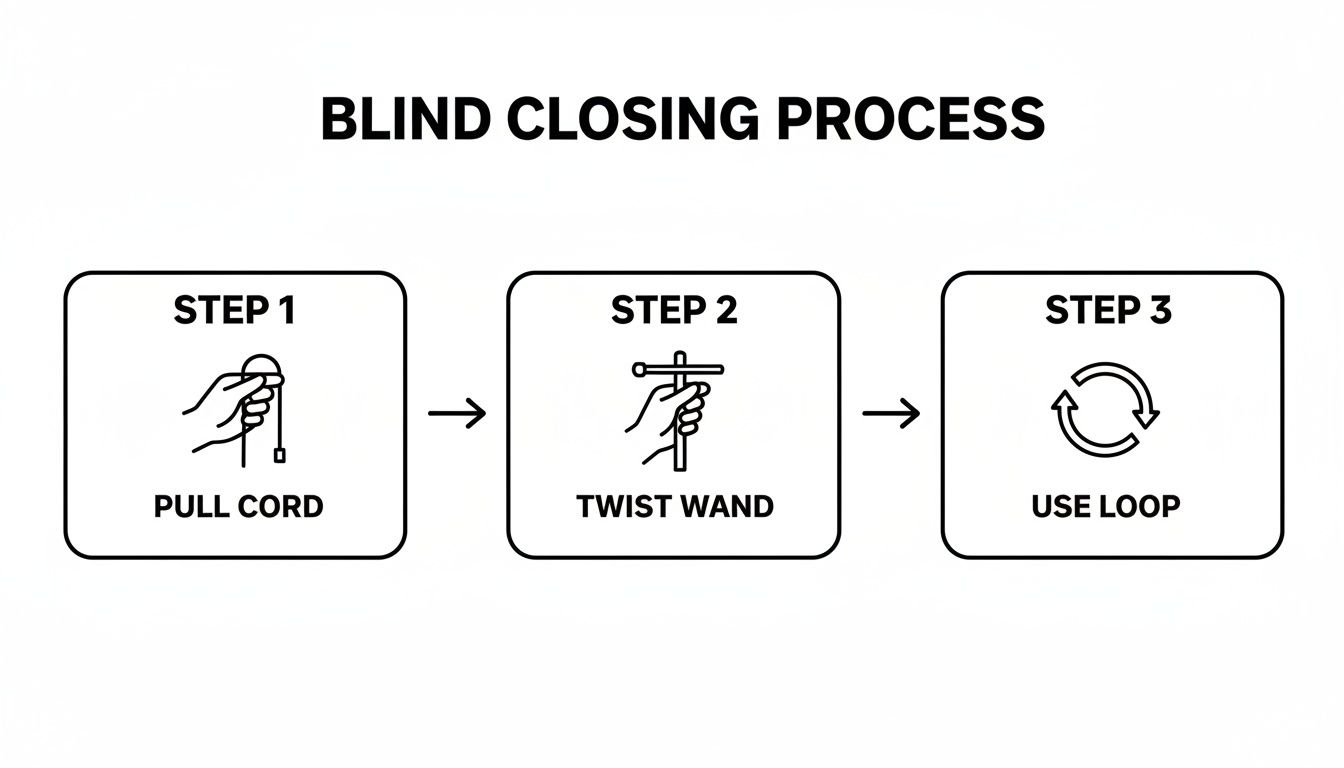
This visual guide breaks it down to the core movements, showing that whether you have cords, wands, or loops, the goal is always a smooth, deliberate motion.
Venetian blinds are what most of us picture, with their distinct lift cord and tilt wand. To close them for the night, first use the lift cord to lower the slats all the way down. A common mistake is trying to tilt them while they're halfway up, which can cause them to close unevenly and strain the mechanism.
Once fully lowered, grab the wand and twist. For the best privacy, always turn the wand so the slats point upwards, with the rounded edge facing the outside. This simple trick creates a much tighter seal against prying eyes than tilting them downwards does.
Vertical blinds, often seen on patio doors and large windows, have a two-step closing process. If you rush it, you can easily pop a slat out of its small plastic clip—a super frustrating, but thankfully fixable, problem.
Expert Tip: Always opening the slats before you draw the blinds across is the single most important habit for keeping your vertical blinds in good shape. This tiny step takes a huge amount of pressure off the clips holding each slat.
Modern styles like roller and cellular shades usually have simpler, more intuitive controls. Many of these are cordless, which is a fantastic safety feature.
To close a cordless roller shade, just pull down on the bottom rail or handle. The key is a steady, even motion—a sudden jerk can sometimes cause the spring mechanism to lock up unevenly. If you have a continuous loop cord instead, a consistent pull on one side of the loop will lower the shade smoothly.
Cellular shades work in a similar way. If a cordless one gets stuck or starts hanging crooked, just push it all the way back up to the top. This little trick usually resets the internal tension cords and fixes the problem.
Roman shades add a touch of luxury, gathering into soft, horizontal folds as they ascend. These typically use a cord lock system. To close them, pull the cord away from the shade at a slight angle to release the lock, then let the cord slide through your hand as the shade descends. To lock it, just move the cord back toward the center.
Deciding between these elegant styles can be tough, but you can learn more about the differences in our guide comparing Roman and roller shades.
Motorized blinds are the peak of convenience. You can close these with the press of a button, a tap in an app, or even a voice command. The motor handles everything, ensuring a perfectly smooth and even closure every time without any risk of human error, which is especially handy for high, hard-to-reach windows.
We've all been there. You go to close your blinds, and they refuse to budge. A stubborn blind is incredibly frustrating, whether it’s jammed, hanging crooked, or won’t retract properly. The good news is that most of these issues are minor fixes you can handle yourself.
Before you get too worked up, take a deep breath. Most blind mechanisms are simple, and a little patience is usually all you need to figure out what’s wrong and get it working again.
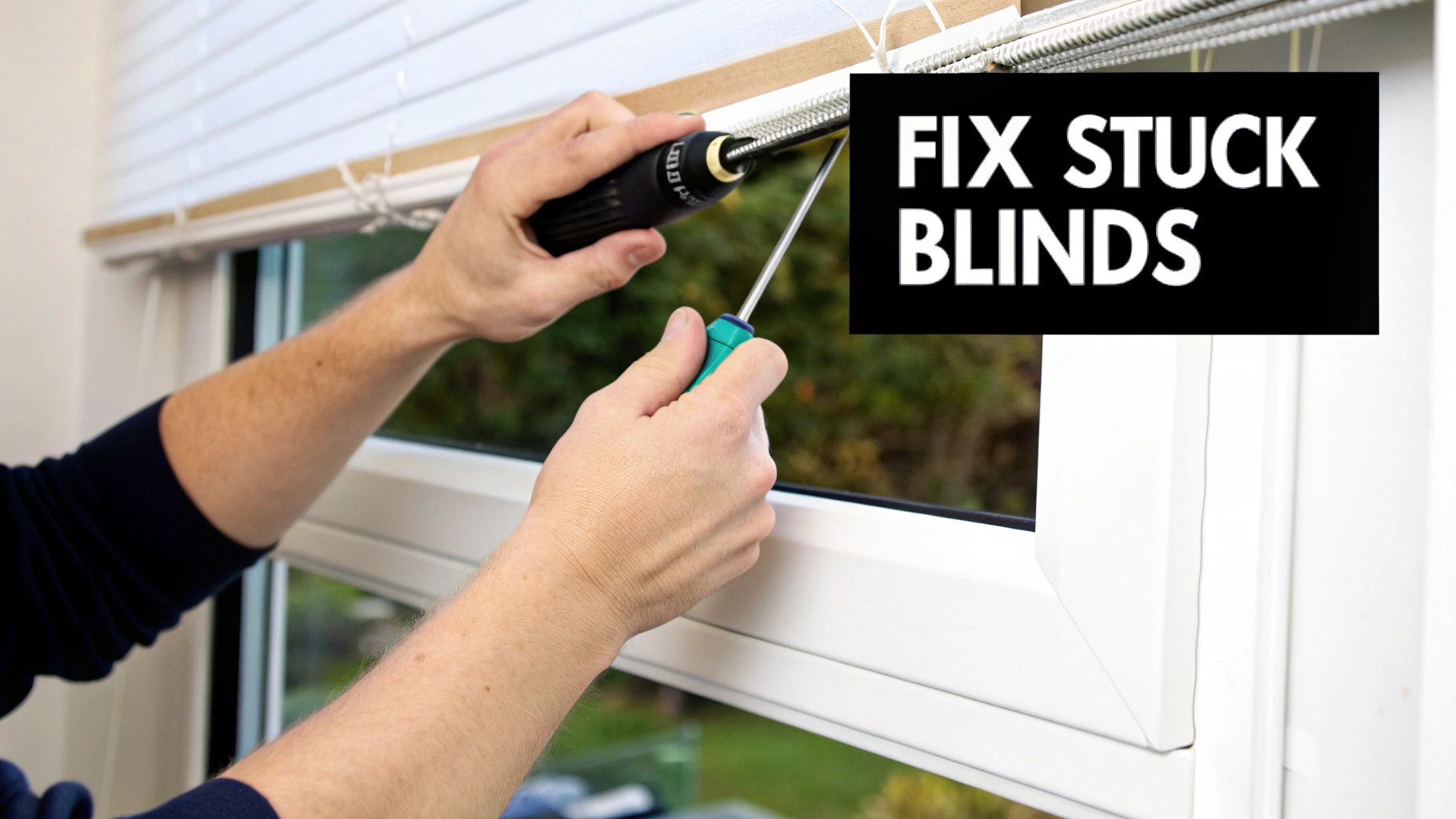
More often than not, the culprit behind a stuck blind is a fussy cord lock mechanism inside the headrail. This usually happens when the cords get tangled or the lock is jammed with dust.
First, try gently jiggling the cords from side to side to free the lock. If that doesn't work, raise the blinds all the way to the top to reset the cords. From there, give the lift cords a firm but gentle tug at about a 45-degree angle. This specific motion is often the key to releasing the internal lock.
Insider Tip: Sometimes, the problem isn't the lock but the slats themselves. Before you start yanking on cords, make sure all the slats are lying flat and haven't gotten snagged on the window frame or sill.
If your blinds look lopsided when you close them, it's almost always because the lift cords have gone out of sync. This is a common issue with horizontal and cellular shades, but thankfully, it’s one of the easiest to fix.
Here’s the simple reset process:
Lower them again, and they should hang straight. You might need to repeat this process a couple of times to work out any stubborn imbalances.
Vertical blinds come with their own unique quirks. Most of the time, the issue is a single slat that has popped out of its clip or refuses to rotate with the others.
If a slat falls out, you can usually snap it right back into its plastic clip at the top—be gentle but firm. If the clip itself is broken, you can typically find cheap replacements at any local hardware store.
For a slat that won't turn, check if the small stem it connects to is misaligned. You can often rotate it back into place with your fingers to sync it up with the others. Dirt and grime can also cause sticking; for more on that, check out our guide on how to properly clean vertical blinds.
Knowing how to operate your blinds is one thing, but ensuring they are safe for everyone in your home—especially children and pets—is paramount. Traditional blinds with long, dangling cords pose a serious entanglement risk. This critical safety issue has thankfully pushed the industry toward much safer designs.
Today, you'll find innovative solutions that eliminate these hazards without compromising on style or function. This shift is a direct response to homeowners demanding safer products. The global window blinds market is even projected to grow, partly because consumers are focusing more on safety, smart home integration, and energy efficiency.
The easiest and most effective way to eliminate cord dangers is to choose cordless blinds. These designs have become the gold standard for home safety.
Cordless window coverings are the safest choice you can make for a home with kids and pets. Their simple, intuitive operation removes the number one hazard of traditional blinds.
Making the switch to cordless blinds is a straightforward upgrade that offers immediate peace of mind. If you're curious about how they work, we break it all down in our guide on what cordless blinds are.
If replacing all your blinds isn't an option right now, you can still take crucial steps to make your existing corded blinds much safer.
Your first line of defense is a cord cleat. These are small, inexpensive hooks that mount to the wall or window frame. After raising the blinds, wrap the excess cord tightly around the cleat to keep it taut and out of a child's reach.
Another solution for larger blinds is a continuous cord loop. To be safe, this must be installed with a tensioner. This device anchors the cord loop to the window frame, keeping it tight so it can’t form a dangerous loop. These small steps are a huge part of creating a safer home environment. For more comprehensive tips, learning how to childproof your home is a great place to start.
The next evolution in window treatments is automation. Smart blinds, once a high-end luxury, are becoming a more affordable and practical choice for everyday homes. These systems transform the simple act of closing your blinds into a seamless part of your daily routine.
At their core, smart systems run on remote controls, smartphone apps, or voice commands via smart assistants like Alexa or Google Home. It's a new level of convenience and a smarter way to manage your home's environment.
The true benefit of smart blinds isn't just about skipping a manual task—it's about improving your home's privacy, security, and energy efficiency. Imagine your blinds automatically closing at sunset each evening, providing instant privacy without a second thought.
Then there are the energy savings. You can schedule your blinds to close during the hottest part of a summer afternoon, which dramatically reduces solar heat gain and eases the strain on your air conditioner. In winter, you can program them to open and let in natural sunlight to help warm your home. This growing interest in smart, eco-friendly solutions is a major reason the window blinds market is projected to hit US$72.3 billion in 2025. You can discover more insights about these market trends and how they're shaping our homes.
Smart blind systems are straightforward, involving a few key components that work together.
This one-time investment pays dividends in daily convenience and long-term efficiency. Automating how you close your blinds adds a layer of intelligent management to your home that works for you around the clock.
This integration opens the door to sophisticated scheduling and creative automations, such as having all your blinds close the moment you lock your front door. It’s a smart upgrade that enhances both your lifestyle and your home’s security.
Even with the best blinds, a few questions are bound to pop up. Here are direct, clear answers to some of the most common dilemmas.
For maximum privacy with horizontal blinds, you should close them with the slats pointing upwards, so the rounded side faces outwards. This creates a tighter seal between each slat, making it extremely difficult for anyone to see in from the outside, especially from a lower vantage point.
An uneven blind is usually caused by out-of-sync internal lift cords. The fix is simple: first, lower the blinds all the way down. Next, manually adjust the bottom rail with your hands until it is perfectly level. Finally, raise the blinds all the way back to the top to allow the cords to reset and realign inside the headrail. Lowering them again should solve the problem.
Yes, in many cases you can convert existing manual blinds to motorized ones using a retrofit kit. These kits typically include a motor that handles the tilt or lift mechanism, a power source (like a battery wand or plug-in adapter), and a remote control. It's crucial to find a kit that is compatible with your specific style and size of blinds.
If you're dealing with hard-to-reach windows, motorizing is just one part of the challenge. You might find some helpful cleaning tips for tall windows and high shelves to make life even easier.
At Joey'z Shopping, we believe beautiful, functional window treatments should be accessible to everyone. From cordless designs for safety to elegant shades that transform a room, we’re here to help you find the perfect solution for your home. Explore our collection at https://joeyzshopping.com.