
Join the Joey'z Family!

Getting your window curtain measurement right is the most important step to achieving that polished, professional look. But let's be honest, it can feel intimidating. The good news? The secret isn't spending a fortune—it's precision.
In this guide, we'll walk you through a simple, step-by-step process. You'll learn how to measure like a pro, avoid common mistakes, and choose curtains that will transform your space.
Think of perfectly hung curtains like a well-tailored suit—the fit is everything. A poorly fitting curtain can make a room feel smaller and just a little 'off.' By planning your approach first, you can skip the usual frustrations.
This first part is all about strategy. It’s where you decide how high and wide to mount your curtain rod, a decision that affects every other measurement. A few minutes of planning here will save you hours of headaches later.
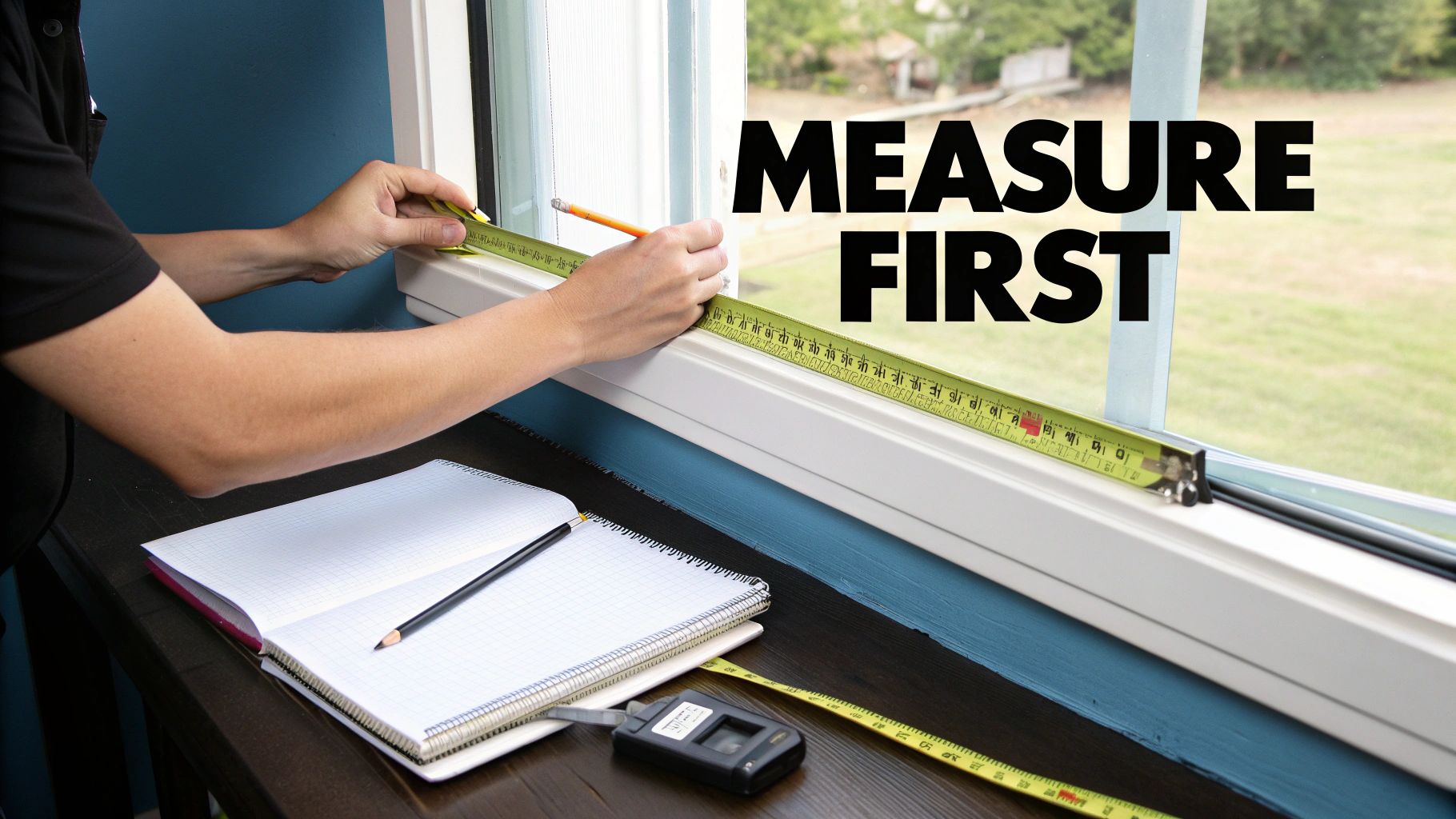
Before we dive in, let's make sure you're set up for success. Having the right tools and knowing the lingo is half the battle. This quick-reference table breaks down what you'll need.
| Item or Term | What It Means | Why It Matters for Your Project |
|---|---|---|
| Metal Tape Measure | A rigid, retractable measuring tool. | It won't stretch or sag like a fabric one, ensuring your measurements are dead-on accurate. This is non-negotiable! |
| Pencil & Notepad | For writing down your numbers. | You'll be taking multiple measurements. Writing them down immediately prevents mix-ups. |
| Step Ladder | A sturdy ladder for reaching high spots. | Safety is key. It allows you to measure above the window frame without stretching or guessing. |
| Fullness | The extra fabric width that creates gathers or pleats. | This determines how lush and voluminous your curtains look when closed. Too little, and they look flat. |
| Stackback | The space curtains take up on the sides when fully open. | You must account for this to ensure your curtains don't block the window and your view when open. |
With these tools and terms in your back pocket, you’re already on your way to measuring like a pro.
Pro Tip: "Fullness" is how much fabric creates those wavy folds. "Stackback" is the space your curtains occupy on the wall when pushed open. Getting these right is the difference between custom-looking drapes and ones that scream "off the shelf."
Not enough fullness, and your curtains will look like a sad, flat sheet. Not enough stackback, and your curtains will block precious natural light even when open. The design experts at Architectural Digest often recommend extending the curtain rod 6-10 inches beyond the window frame on each side. This trick maximizes light and makes windows feel much larger.
Getting the width of your curtains right is more than just covering the window—it's a design secret that makes a room feel bigger and more polished. The goal is to create fullness, the fancy term for those lush, elegant folds.
This process starts with the curtain rod, not the window frame. A common mistake is buying a rod that's the exact width of the window. To get that high-end look, your rod needs to extend well beyond the frame on both sides.
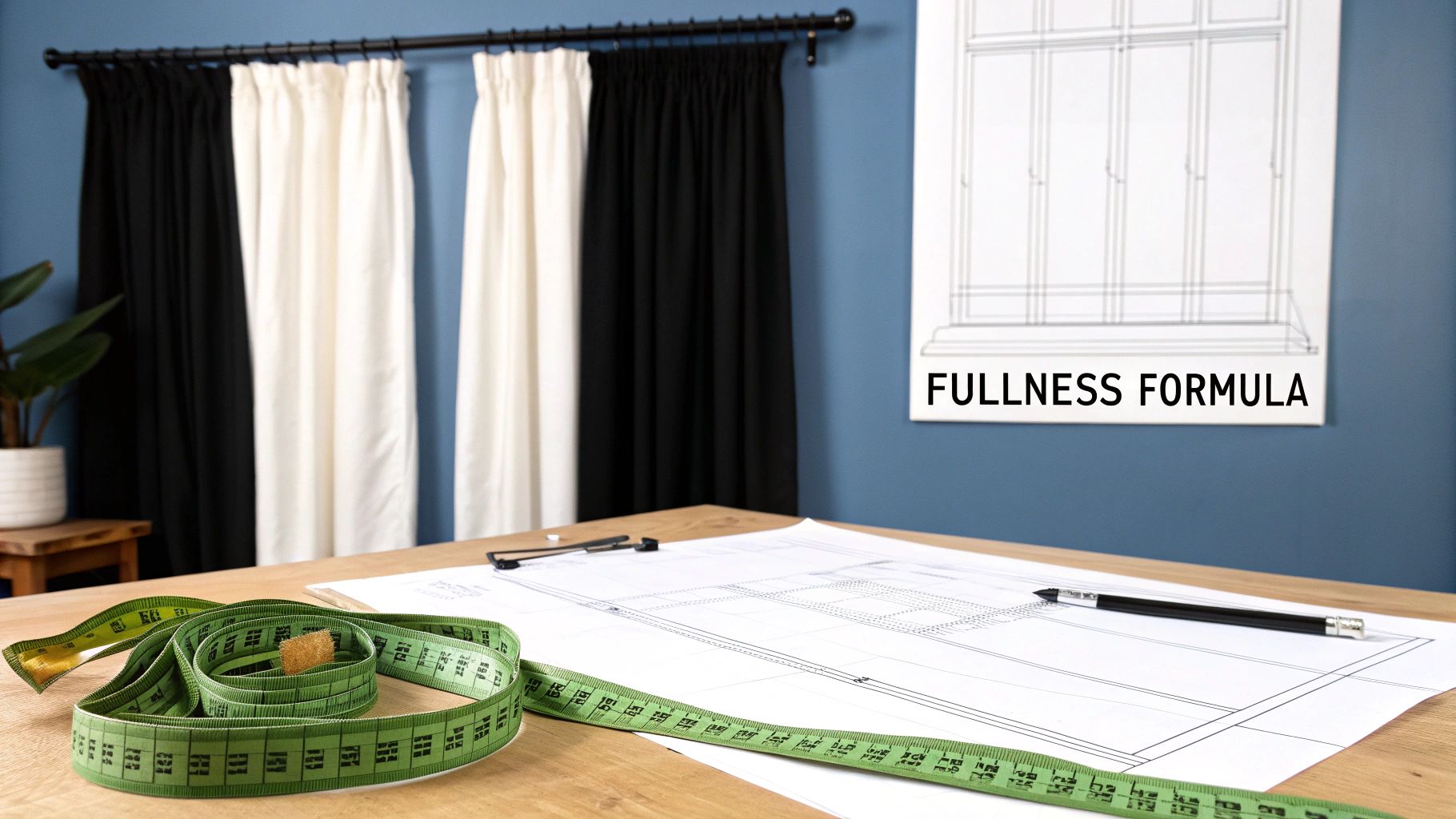
A longer rod is the foundation for a proper window curtain measurement. It gives your curtains a place to live when they're open—the stackback. Without it, your curtains will always cover part of the window, making the space feel smaller.
Here’s the simple step-by-step process:
This extra width makes all the difference, ensuring that when your curtains are open, they frame the view beautifully instead of cutting it off.
What is the curtain fullness formula? The short answer is: your total curtain panel width should be 1.5 to 3 times the length of your curtain rod. This creates the gathered or pleated look.
Once you have your rod length, you can figure out the total width your curtain panels need to be.
As a rule of thumb, a fullness of 2x the rod width is a great starting point. For a 60-inch rod, you’d want a total of 120 inches of curtain panel width (two 60-inch panels work perfectly). This creates deep, satisfying folds without looking too heavy.
Your choice of fullness depends on the fabric and vibe:
For a more detailed breakdown, check out our guide on calculating the width of curtains.
Getting the curtain length right can completely change a room's feel. It’s the difference between a custom look and one that just feels… off. The perfect length can make a room feel taller, more formal, or delightfully casual.
Before you choose a style, here's a pro tip: always measure for length in three different spots. Measure from your rod down to the floor (or sill) on the left, in the middle, and on the right. Floors and sills are rarely perfectly level.
Always use the longest of the three measurements as your final number. This simple trick prevents your curtains from hanging awkwardly short on one side, ensuring a clean, straight line.
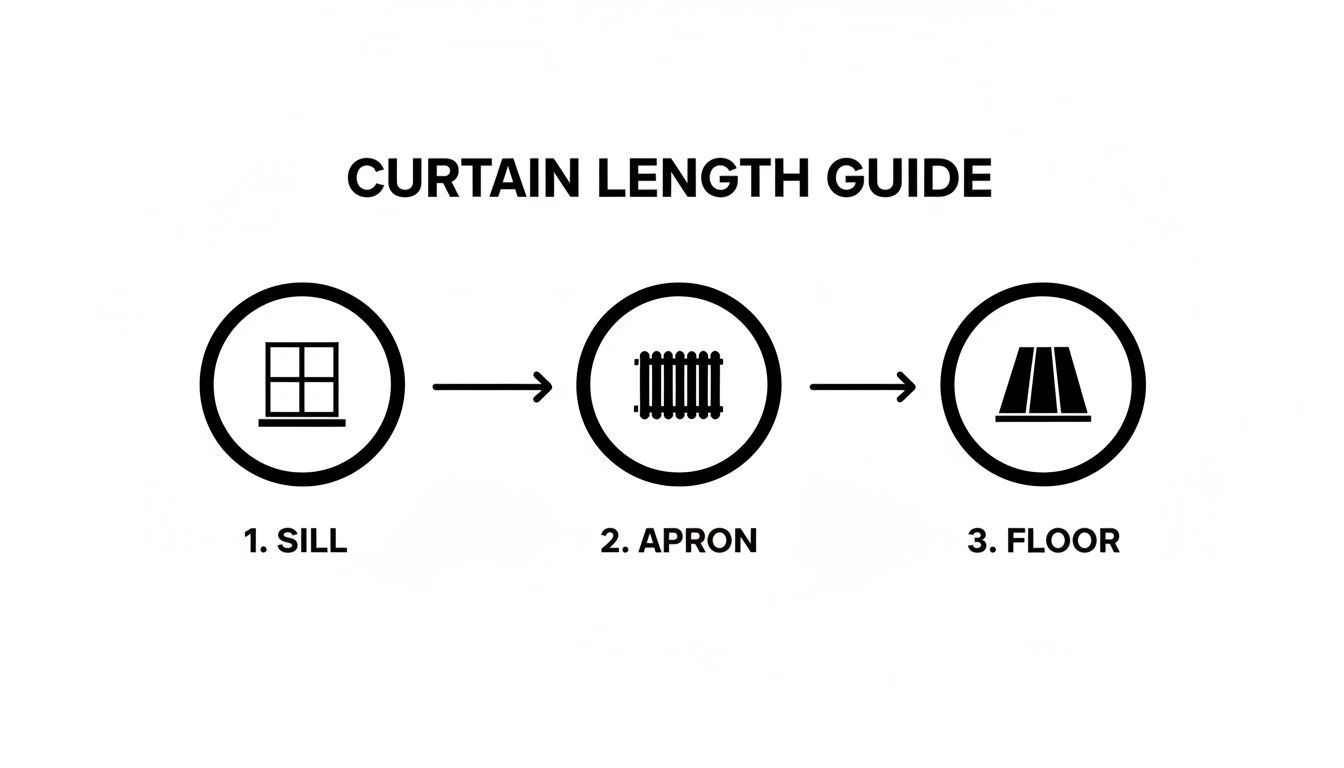
Sill length curtains have a hem that just skims the top of the windowsill. This is the shortest, most practical option, creating a crisp, clean look.
This style works best in specific situations:
To measure, go from the top of your curtain rod down to the windowsill. Subtract about 1/4 to 1/2 inch from this measurement so the fabric "floats" just above the sill.
Apron length curtains fall a few inches below the bottom of the window frame (the "apron"). This look offers more softness than sill-length curtains without the formality of floor-length drapes.
It’s an excellent choice for kids' rooms or casual living areas. Apron-length curtains are also practical—they stay clear of floor dust, vents, and curious pets.
To measure, go from your curtain rod to the bottom of the window frame, then add 4 to 6 inches.
Floor-length curtains are the most popular and versatile style. They create a sophisticated, elongating effect that makes ceilings feel higher. The hem can either "kiss" the floor or "float" slightly above it.
For a more luxurious feel, you can add extra length to create a "break" or a "puddle."
A slight break is created by adding 1 to 3 inches to your floor-length measurement. This creates a subtle, stylish fold where the fabric hits the floor.
A puddle is your most dramatic option. Add 6 to 16 inches to your floor-length measurement for a lavish pool of fabric on the floor. This looks incredible with heavy materials like velvet and is best for formal spaces.
For more visual examples, check out our complete guide to curtain lengths.
Not all windows are simple rectangles. Architectural features like bay windows and sliding glass doors bring character but can make window curtain measurement feel like a puzzle. The key is to treat them as a series of smaller, manageable measurements.
Bay windows, with their angled segments, are a common source of measurement anxiety. The secret is to measure each section individually.
For sliding glass doors, the goal is functionality. Your curtain measurement strategy should honor easy access and beautiful light. The biggest mistake is not extending the curtain rod far enough past the door frame.
My go-to rule for sliding doors: extend the curtain rod at least 12 to 15 inches past the frame on each side. For a standard 72-inch door, you should look for a rod that is at least 96 to 102 inches long. This gives your curtains plenty of room to "live" on the wall when open.
For length, you'll almost always want floor-length curtains. Measure from where you'll install the rod down to the floor, then subtract about half an inch for a clean float.
For corner windows that meet at a right angle, specialized hardware is your friend.
For more inspiration on unique windows, exploring window treatment ideas for large windows can provide creative solutions.
Getting your window curtain measurement just right means sidestepping a few common pitfalls. Think of this section as your final checklist to save you time, money, and disappointment.
Using a soft, fabric sewing tape is a recipe for inaccuracy. These tools can stretch or sag, throwing off your numbers.
The Fix: Always use a sturdy, metal retractable tape measure. It provides a straight, rigid line, ensuring your measurements are precise.
This is the most common mistake. Measuring from the window frame itself is a critical error, as the final length and width depend entirely on the curtain rod's placement.
The Fix: Your rod should be installed 4 to 6 inches above the window frame to create a sense of height. Install your hardware first, then take your final, accurate measurements from the rod itself.
Your curtain rod's position dictates every other measurement. Measuring from the window frame first will almost always result in curtains that are too short.
The "return" is the curved part of the bracket that connects the rod to the wall. It creates a small gap, allowing the curtain to wrap around the side and block light leaks.
The Fix: When calculating rod width, account for this. If a rod is listed as 72 inches, that measurement typically doesn't include the returns. Factor in an extra inch or two on each side for a complete, light-blocking fit.
You’ve got your numbers. Now for the fun part—turning those measurements into beautiful, perfectly hung curtains.
First, pay close attention to our product descriptions. A dimension like "52 inches W x 84 inches L" is for one single curtain panel laid out flat.
To get a full, professionally styled look, the combined width of your panels needs to be 1.5 to 2.5 times the length of your rod. This is the golden rule of fullness.
For our popular JoeyzShopping blackout curtains, an exact length and proper width are key to eliminating light leaks and unlocking their energy-saving benefits. According to the U.S. Department of Energy, well-fitted curtains can reduce heat loss by up to 25%.
For lighter fabrics like our breezy sheer curtains, you'll want to aim for a total panel width closer to three times your rod length. This generous gathering creates soft, elegant folds.
Key Takeaway: Always shop based on your calculated fullness, not the raw width of your window. For a 60-inch rod, two 52-inch panels give you a combined width of 104 inches—a fullness of nearly 2x, which provides that lush, intentional look.
Understanding how to apply your numbers to product listings is a skill that empowers you to shop with confidence, whether you're buying curtains or need to refer to a comprehensive size guide for sofa covers.
Even with a guide, questions can pop up. Let's clear up some of the most common ones.
For a modern look that makes ceilings feel taller, mount your curtain rod about 4 to 6 inches above the top of the window frame. Hanging it right on the frame is a common mistake that can make a window feel small.
Yes, always. Houses settle over time, and even new construction can have slight variations. Measuring each window individually is the only way to guarantee a perfect fit for every curtain.
Stackback is the space your curtains occupy on the sides of the window when fully open. To maximize natural light, you need to account for this so the "stacked" curtain rests against the wall, not the glass. A good rule of thumb is to plan for the stackback to be about 15-20% of your window's width.
Yes. The final length depends on where the fabric begins.
Ready to put those expert measurements to use? At Joey'z Shopping, we have a curtain style for every window you've just measured.
Explore our full collection of curtains and find your perfect match today!