Join the Joey'z Family!

You're standing in a living room with harsh afternoon sun, three windows that don't quite match, and a budget that won't stretch to custom treatments. Online, every bamboo roman shade looks warm, polished, and expensive. The cheapest listings can tell a different story once the sun goes down, the weave starts to shift, or two shades refuse to hang at the same height.
That's the question behind cheap bamboo roman shades. Not whether the price is low, but whether the shade delivers enough privacy, light control, smooth operation, and visual consistency to justify buying it. This guide filters the attractive bargains from the frustrating ones, with practical advice on material, lining, measuring, installation, and where spending slightly more prevents an entire room from looking improvised.
A low-priced shade can solve one problem beautifully and create three others. In a sunny living room, an unlined woven shade may soften glare while keeping the room bright. At night, though, interior light can turn the weave into a silhouette, especially when the window faces a sidewalk or a neighboring home.
That doesn't make bamboo a bad choice. It means the shade has to match the room. A renter may want a removable treatment that adds warmth without drilling into expensive trim. A parent may care more about cordless operation than a perfect fold. A landlord outfitting several units needs shades that look consistent from window to window, not a slightly different tan on every order.
Practical rule: Save on the decorative texture, not on the details that control privacy, safety, and installation.
One inexpensive shade can look charming even when its valance is slightly uneven. Three shades mounted side by side expose every mismatch. Small differences in dye, weave direction, fold depth, or headrail alignment become part of the room's architecture.
That's why I treat bamboo roman shades cheap as a buying problem, not a product category. Before ordering, ask four questions:
For readers who are still learning the language of window coverings, 3 Blind Mice explained offers useful background on common blind and shade types. You don't need a custom treatment for every window, but you do need to know what you're compromising before you click “buy.”
The recommendations ahead are deliberately practical. Use unlined bamboo where its filtered glow is an advantage, add lining where privacy matters, measure twice, and never assume a low price includes a finished look across multiple windows.
Bamboo roman shades are woven natural-fiber window coverings that gather into horizontal folds when raised. They combine the texture of a woven wood shade with the stacked profile of a Roman shade. The result feels softer and more architectural than a basic roller shade, but less formal than a fabric Roman treatment.
The material may include bamboo slats, reeds, jute, grasses, or other woven fibers. Some products also use bamboo-look synthetics, which imitate the color and texture while offering a more uniform surface. Read the material description carefully. “Natural woven” can describe several fibers, and the appearance of a listing photo won't tell you whether the weave is tight, irregular, smooth, or heavily textured.
A roller shade travels around a tube and presents a flat surface when lowered. A faux-wood blind uses separate horizontal slats that tilt for light control. A standard fabric Roman shade folds into soft or structured pleats, often with more predictable privacy because the fabric forms a continuous panel.
Bamboo Roman shades sit between those options:
The category belongs to a mainstream window-treatment market, not a tiny decorating niche. One market report estimates the global blinds and shades market at US$10.7 billion in 2024, with a projection of US$13.7 billion by 2030, representing about 28% growth over the period at a 4.1% CAGR. That market estimate helps explain why shoppers can find bamboo, woven wood, vinyl, and faux-wood options at many price levels.
For a closer look at the material language and styling possibilities, Joey'z discussion of bamboo woven wood shades is a useful companion. My view is simple: cheap bamboo works best when you want a premium-looking texture without paying for custom drapery, but it shouldn't be expected to behave like a blackout fabric or an engineered insulation product.
A cheap bamboo Roman shade can look right in a listing photo and still miss the privacy or light-control needs of the room. Unlined bamboo shades filter light, but they do not reliably eliminate it. Tight-weave unlined shades typically filter about 60–85% of incoming light, depending on weave density and fiber spacing, according to this woven wood shade guide. Daylight becomes softer, yet indoor lamps and ceiling lights can make the weave glow at night, leaving silhouettes or room activity visible.
Lining determines whether the shade functions mainly as decoration or as practical window coverage. A privacy liner blocks transmission through the weave while preserving some of its texture. A blackout liner goes further, producing near-room-darkening or near-blackout performance. Light can still enter through side gaps, so mounting and window fit matter alongside the fabric.
| Lining Type | Daytime Glare | Nighttime Privacy | Approx. Added Cost |
|---|---|---|---|
| Unlined | Softens glare while preserving a filtered glow | Limited, because silhouettes and interior light can remain visible | No liner charge |
| Privacy-lined | Reduces transmitted light and keeps the woven texture visible | Much stronger privacy than an open weave | Varies by retailer and shade |
| Blackout-lined | Delivers near-room-darkening performance | Strong privacy, with possible edge glow from mounting gaps | Varies by retailer and shade |
Do not assume the cheapest listing offers every lining option. Prices vary by retailer, size, material, and construction. Compare the lined shade price with the cost of adding curtains later, especially for bedrooms and street-facing windows.
Bamboo offers modest thermal help, not engineered insulation. Its woven structure creates an air buffer between the glass and room, while its low thermal conductivity keeps it from behaving like a heat-radiating metal blind, as explained in this overview of bamboo blinds and heat control. Treat that as a bonus. For darkness, privacy, and consistent coverage across rooms, choose the lining first, then compare the shade's color and weave.
Low-priced bamboo Roman shades often look convincing in a product photo because the photo shows one shade, one window, and carefully controlled light. Daily use is less forgiving. Cheaper products may sit unevenly, operate less smoothly, shed fibers, or arrive without meaningful warranty support. Review-based coverage also flags inconsistent valance alignment across side-by-side windows, a problem for decorators and landlords trying to outfit several spaces consistently.
Humidity is another quiet troublemaker. Woven natural fibers can respond to moisture, and direct water exposure can damage or distort a budget shade. A steamy kitchen with poor ventilation may be manageable if the window is away from the sink and the shade stays dry. A bathroom window beside a shower is not the place to test the limits of untreated bamboo.
| Problem | Typical Cause | How to Spot It |
|---|---|---|
| Uneven stacking | Inconsistent cord tension or headrail assembly | Folds don't align when the shade is raised |
| Rough operation | Lightweight hardware or poorly aligned lift components | Shade catches, jerks, or needs uneven pressure |
| Fiber shedding | Loose ends and lower-grade woven material | Fibers appear on the sill or floor after handling |
| Mismatched valances | Batch variation or inconsistent assembly | Side-by-side tops sit at noticeably different heights |
| Color variation | Different dye lots or material batches | Shades ordered separately don't share the same tone |
| Warping or expansion | Humidity, direct water, or weak finishing | Slats bow, weave shifts, or edges curl |
The hidden cost: Replacing one mismatched shade can be more annoying than buying a slightly better set at the beginning.
Request a material or color sample when the retailer offers one, and examine the weave against a bright window. A dense, even weave usually gives a more finished appearance than a loose surface with visibly irregular gaps. Ask whether several shades will come from the same production batch, especially if you're covering a bank of windows or ordering for multiple rental units.
Look for clear information about care, warranty coverage, and returns. The absence of a warranty doesn't automatically make a shade unusable, but it shifts more risk onto you. I'd also avoid vague claims about UV protection unless the retailer explains the finish and care requirements. Natural fibers can fade, and a low price doesn't guarantee a protective coating.
For multiple windows, order together whenever possible. Compare the valance width, fold alignment, and side edges before installing every bracket. If one shade looks wrong straight out of the box, stop there and resolve the order instead of completing the room and discovering that the entire batch has the same defect.
Accurate measuring is the cheapest insurance against returns. Budget shades often come in standard widths, so a small mistake can leave you with an awkward gap, a shade that rubs against the frame, or a treatment that collides with a crank or handle.
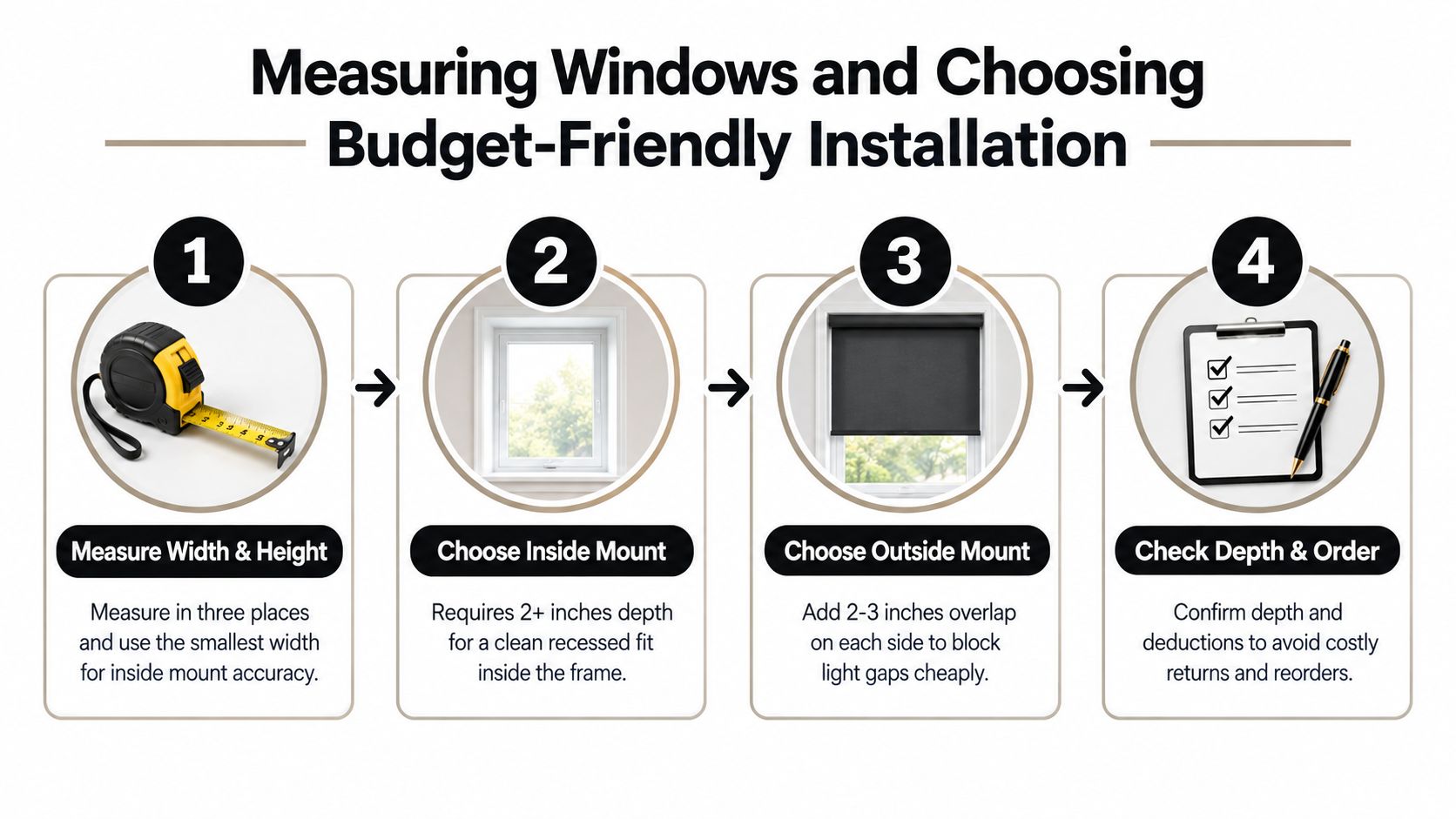
For an inside mount, measure the window opening's width in three places and use the smallest measurement. Measure height as well, then verify that the shade's required recess depth fits the frame. The supplied guidance calls for 2+ inches of depth for a clean recessed fit, while budget products can have their own hardware requirements, so the product specification wins.
For an outside mount, measure the area you want the shade to cover rather than relying only on the glass size. Add 2–3 inches of overlap on each side when you need to reduce light gaps, as recommended in the supplied installation visual. Confirm that the headrail and stacked folds won't obstruct the window handle when raised.
A steel tape measure, pencil, paper, and step ladder are enough for most installations. Before drilling, raise the shade by hand and check that it stacks cleanly at the top. Also check handle protrusions, crank clearance, uneven sills, trim thickness, and whether the window opens inward.
Installation instructions vary by hardware system. Joey'z guide to Roman shade installation can help you understand the general sequence before you commit to a mount. If the shade is wide, heavy, or positioned above a child's reach, don't improvise with a bracket that wasn't designed for the load.
Here's a visual walkthrough of the installation process:
Cheap doesn't have to mean flimsy. The best savings usually come from reducing customization, shipping complexity, and unnecessary features, not from choosing the loosest weave or weakest hardware.
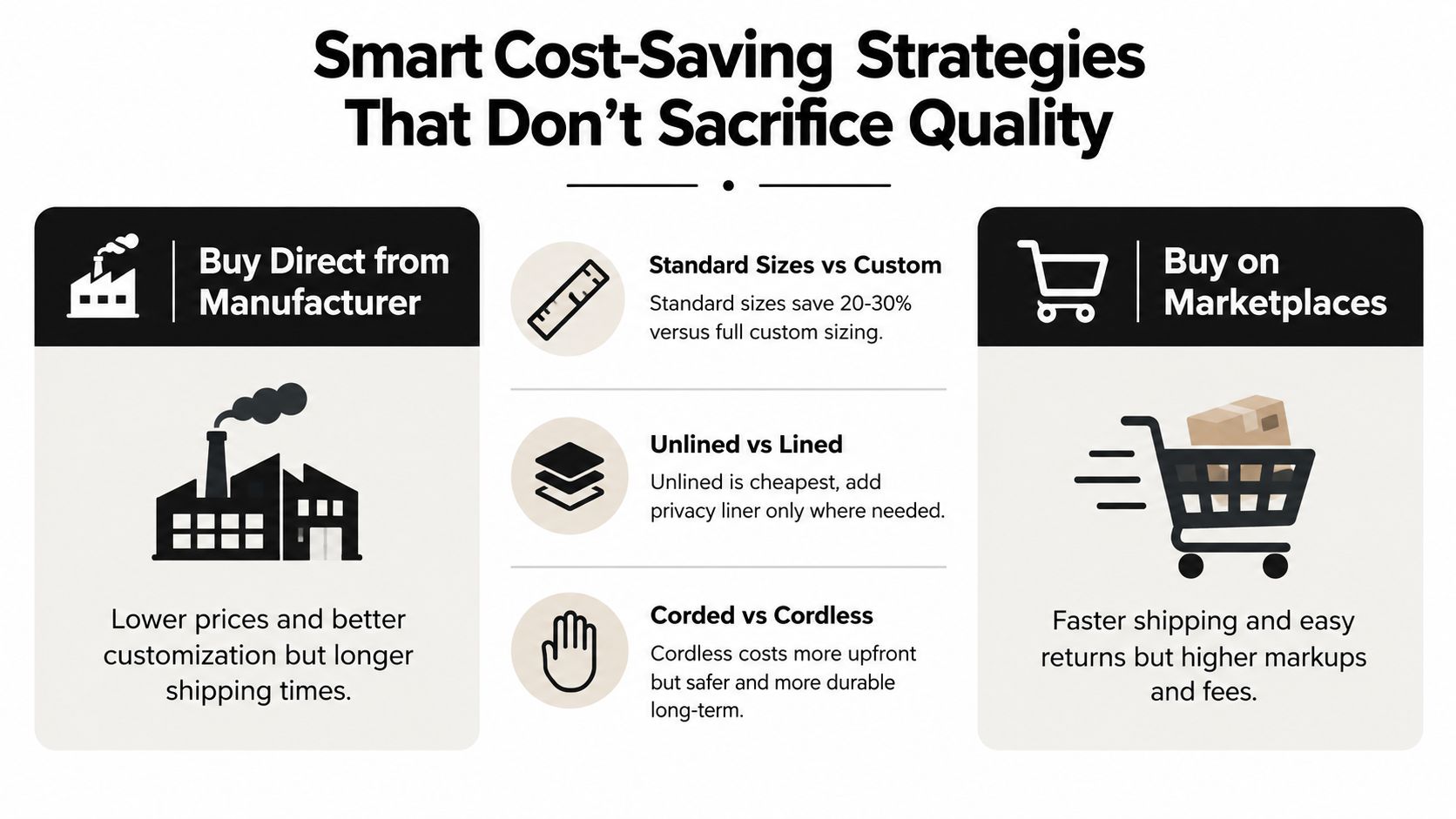
Buying direct from a manufacturer may offer lower prices and more control over materials or sizing, but shipping can take longer and returns may be less convenient. Marketplaces often offer quicker delivery and simpler returns, but marketplace fees and markups can raise the effective price.
Open-box inventory, last-season colors, and overstock can be worthwhile when the windows are low-risk and the order can be placed all at once. Don't use a discontinued color for a room where you may need a replacement later. Batch consistency matters more than a small initial saving when several windows must match.
Standard sizes are usually the strongest budget lever. Custom sizing can make an awkward window work, but custom fees may multiply the cost of a lower-priced shade. Two narrower panels can sometimes be easier to handle than one oversized shade, and they may fit separate window openings more naturally, but they also create an additional center gap and another set of hardware to align.
| Your situation | Best saving approach | What to protect |
|---|---|---|
| One standard window | Buy a standard size | Return policy and weave density |
| Several matching windows | Order together | Batch consistency and valance alignment |
| Rental installation | Choose reversible or simple brackets | Safe operation and easy replacement |
| Bedroom or nursery | Buy standard size with needed lining | Darkness, privacy, and cordless operation |
| Tight deadline | Use a retailer with clear stock status | Delivery timing and returns |
| Whole-home project | Ask about bundles or loyalty pricing | Consistent color and warranty support |
The supplied buying visual identifies a useful quality split: standard sizes save 20–30% versus full custom sizing, while an unlined shade costs less than a lined one. Those figures are planning benchmarks shown in the visual, not guarantees for every retailer or product.
Cordless systems may cost more upfront, but they remove dangling lift cords and can be easier to operate when children or pets use the room. Don't pay for cordless everywhere automatically. Prioritize bedrooms, play spaces, and accessible windows, then compare the hardware and safety information before choosing.
For broader guidance on evaluating construction and retailer details, Joey'z resource on quality window coverings gives you another practical reference point. The right discount is the one that leaves the shade functional after installation.
Usually not when unlined. Tight weaves filter much of the incoming light, but the shade can still glow at night and leave light around the edges. Choose a privacy liner for discretion, or a blackout liner when sleep and media viewing require a darker room.
They tolerate ordinary kitchen conditions when kept dry. Direct water and sustained humidity shorten their useful life, so skip them beside a shower or within a sink splash zone, especially without a moisture-resistant finish.
Do not assume you can. Cutting a woven shade may damage its edges, headrail, lift system, or finished valance. Buy a model designed for width adjustment, or use an outside mount that covers the opening without risky modification.
Neither position is automatically cheaper. Inside mounting needs sufficient recess depth. Outside mounting may require more material and overlap. Choose the mount that fits the window and privacy goal, then compare the complete shade, brackets, and installation cost.
There is no dependable universal average for cheap bamboo Roman shades. Width, height, weave, lining, lift mechanism, retailer, and standard or custom sizing all affect the total. Compare delivered cost, hardware, liner, and return terms instead of judging the listing price alone.
Yes, but availability and pricing vary. Check the specifications rather than relying on the product photo. Before fitting several shades, confirm that the lift operates smoothly and that the stated safety details match the room.
They provide modest insulation, not cellular-shade performance. The woven structure can create an air buffer that reduces convection at the window, while bamboo has low thermal conductivity, as explained in this bamboo shade heat-control explanation. Treat insulation as a supporting benefit, not the main reason to buy.
Cheap only works when the shade still performs its job. Check privacy, light control, hardware, and finish across every room. A low listing price is a poor deal if mismatched weaves, replacement brackets, or a liner upgrade appear after ordering.
A good budget purchase starts with a clear job description. If the shade only needs to soften afternoon glare in a hallway, don't pay for blackout hardware. If it faces a street or sits in a bedroom, don't let a beautiful open weave talk you into skipping privacy.
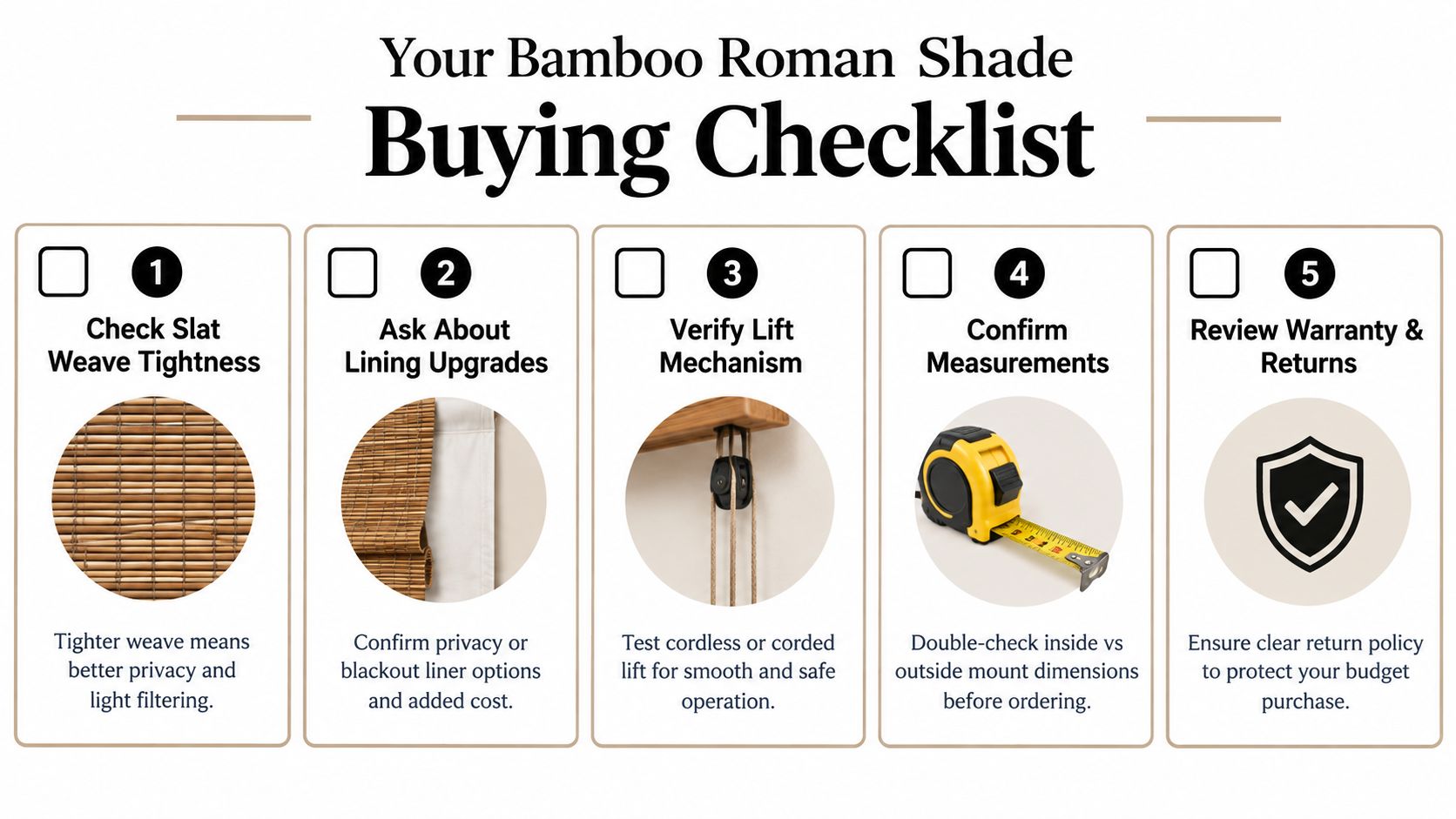
The smartest bamboo roman shades cheap purchase isn't the one with the lowest sticker price. It's the shade that arrives level, fits the opening, gives the room the privacy it needs, and still looks intentional beside the next window.
Joey'z Shopping offers Roman shades, woven window-treatment information, and installation guidance for shoppers comparing affordable options. Visit Joey'z Shopping to compare shades and window coverings, then order only after checking the weave, lining, mount, measurements, and return terms.