
Join the Joey'z Family!

You've ordered a Roman shade that looked perfect on the screen, only to discover that it leaves a bright strip along the frame, collides with the window handle, or refuses to sit neatly inside the opening. That usually isn't a fabric problem. It's a measurement or mounting problem.
A Roman shades custom size order succeeds when you decide the mount first, measure the opening in several places, confirm who handles deductions, and check the shade's depth, stack, and control options before ordering. The process is learnable, even with an older out-of-square window, shallow trim, or an opening that doesn't match standard sizes.
A Roman shade is a custom-fit window treatment. Its folds, edges, and lining remain visible when the shade is raised or lowered, so a poor fit is harder to disguise than it is with a basic roller shade. A ready-made product may leave gaps at the sides, force you to accept an awkward overlap, or tempt you to trim a finished shade that was never designed to be cut.
I've seen a shade look acceptable from across the room but fail at the window itself. The fabric covered most of the glass, yet the frame showed through at one side because the opening was slightly narrower at the bottom. Measuring the opening at only one point would have missed that problem.
Custom sizing helps you match the shade to the actual opening, rather than asking the opening to tolerate a convenient product size. That matters for privacy, glare control, and the finished appearance, particularly when the window is a focal point.
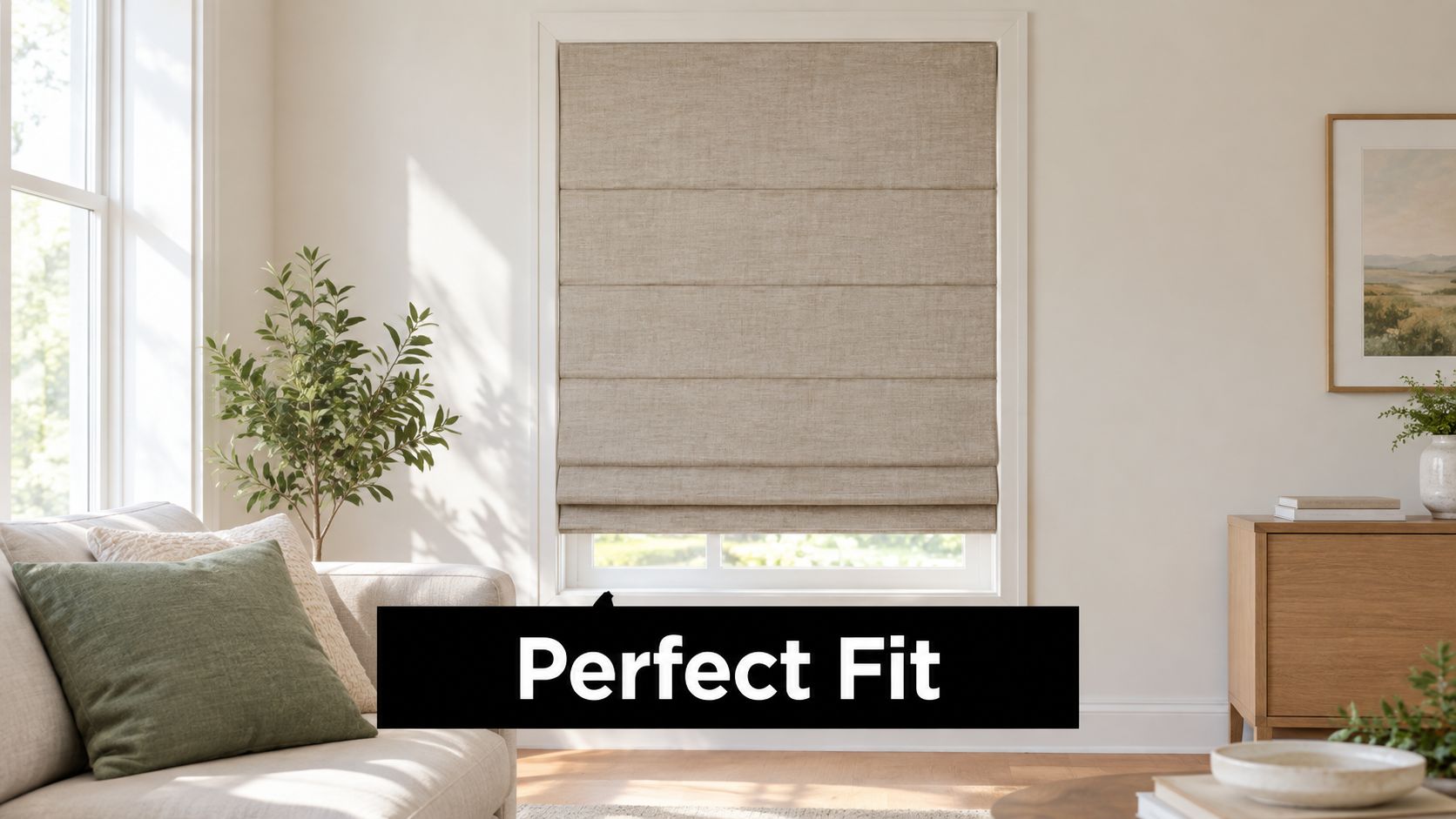
Roman shades aren't a fringe product category. One independent market report estimates the global Roman shades market at $3.8 billion in 2025, with a projection of $6.2 billion by 2034 and a 5.6% CAGR (Dataintelo Roman Shades Market report). The same report estimates that flat Roman shades held 38.4% of product-type share in 2025, which points to strong interest in structured, custom window treatments.
That category position makes custom sizing more than a premium extra. Roman shades are meant to fit exact openings, and flat styles make clean edges especially important. A narrow gap can interrupt the symmetry, while an oversized shade may scrape trim or prevent smooth operation.
You'll need to settle four practical questions:
Get those decisions right and the ordering process becomes controlled rather than mysterious.
A shade can look perfectly sized on paper and still fail at installation. The recess may be too shallow for the headrail, a handle may block the fabric, or an uneven frame may leave an unwanted strip of light. Choose the mount after checking those physical conditions, not from appearance alone.
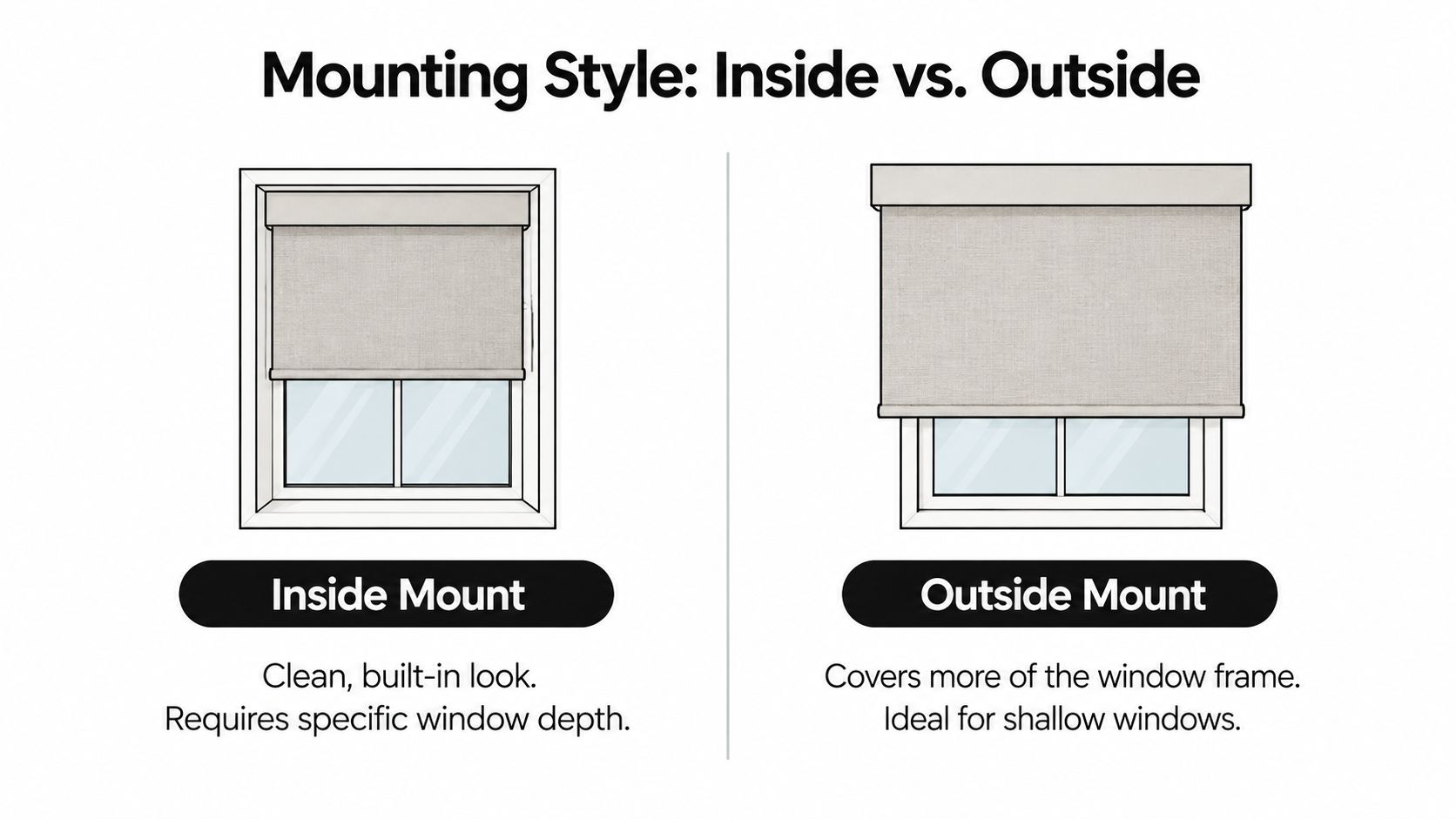
An inside mount places the shade within the recess. It keeps decorative casing visible, gives the window a compact appearance, and works well when the opening is deep, square, and free of obstructions.
Coverage is the trade-off. Light can show around the edges, particularly when the shade sits close to the glass. Handles, locks, screens, and inward-opening hardware may also contact the headrail or fabric.
The Shade Store's guide specifies at least 3/4 inch of inside-mount depth for some Roman shade installations (The Shade Store's Roman shade guide). Treat that measurement as product-specific. Confirm the required depth for the exact shade, along with the space needed for its raised stack.
An outside mount sits above or beyond the recess and overlaps the frame. Choose it for shallow openings, uneven trim, or windows where an inside mount would leave too much exposed glass at the sides. Extending the shade past the recess can also give a small window more visual weight.
Check the wall or trim above the window for bracket space and stack clearance. The fabric must pass handles, molding, and other obstructions throughout its travel. Outside mounting can improve coverage, but it may hide trim you wanted to display and requires careful placement to avoid nearby doors or casings.
Joey'z guide to how to measure blinds for inside mount provides further detail on checking the recess before ordering.
| Decision Factor | Inside Mount | Outside Mount |
|---|---|---|
| Appearance | Recessed and integrated | More prominent, with frame overlap |
| Window depth | Requires adequate product depth | Better for shallow openings |
| Trim condition | Shows the existing frame | Can conceal uneven or unattractive trim |
| Light control | May allow edge leakage | Broader overlap can reduce edge leakage |
| Hardware | Must clear handles and locks | Usually easier to position around obstructions |
| Cordless compatibility | Check that the recess accommodates the product | Often allows more flexible headrail placement |
| Best use | Deep, neat openings | Shallow, irregular, or privacy-focused openings |
Recent design coverage describes Roman shades remaining strong in 2026, with interest in softer fabrics, natural materials, and cordless mechanisms (Peggy O'Mara's Roman shade coverage). Fabric weight and fold style affect stack depth, so include the raised shade in your clearance check. The right mount must support the fabric, operation, safety setup, and coverage you need.
A shade can look correctly sized on paper and still bind, expose trim, or collide with a handle. Prevent those problems with a rigid steel tape measure, pencil, paper, and a step stool when needed. Photograph the opening, hardware, sill, and trim before ordering so the installation conditions remain clear.
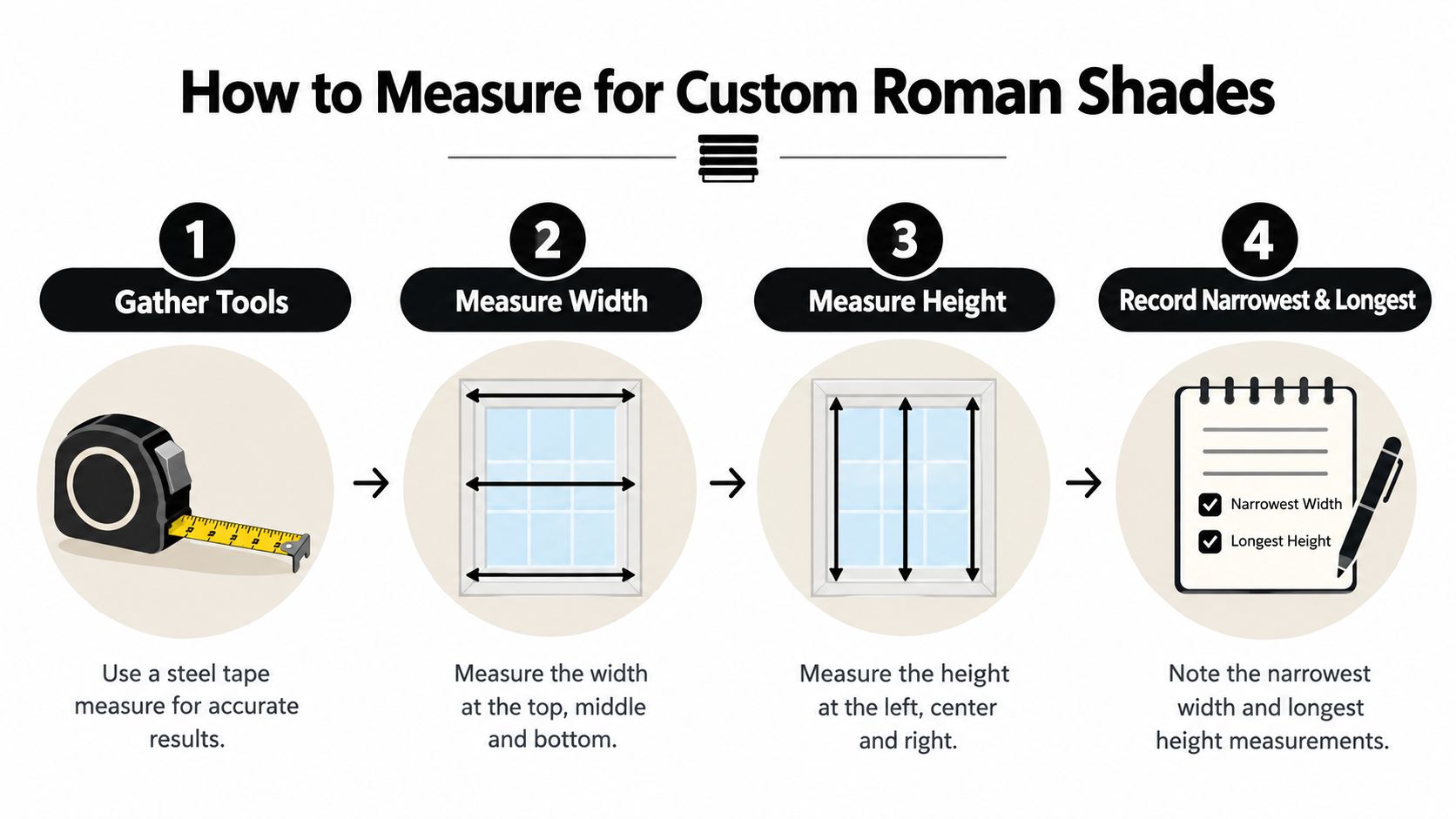
For an inside mount, measure the actual recess, not the visible glass.
Do not round because two readings look nearly identical. Small differences show that the opening is out of square, and the narrowest width is the measurement that controls fit.
Installer's rule: Measure twice, write down all six readings, then mark the narrowest width and tallest height before opening the order form.
An outside mount is sized for the coverage you want. Start with the visible opening, then plan how far the shade will extend over each side, above it, and below it. About 2 to 3 inches of overlap per side can improve coverage and reduce light seepage, though the manufacturer's instructions take priority (Blinds Galore Roman shade measuring guidance).
Inspect the surrounding conditions before finalizing the order:
Custom sizing also affects the room around the window. If furniture will sit beneath the shade, use this practical guide to measure furniture before you buy and check delivery paths, handles, and operating clearances.
Joey'z Shopping offers a window measurement guide for additional reference. Keep your written readings beside the product page, because an order form may use terms such as finished width, opening width, or coverage width differently.
A measurement can be accurate and still produce the wrong order size. The difference usually comes from the shade's mounting system and the seller's instructions. Some manufacturers make the deduction before production. Others expect you to enter an adjusted width yourself. Treat those as separate ordering methods.
Deduction rules vary by product. Instructions may require a 1/8 inch, 3/8 inch, or 1/2 inch reduction, while another product may calculate the finished size from the opening you enter. These figures are product instructions, not a universal Roman shade formula. Never transfer a deduction from one brand to another.
Follow this sequence before entering a width at checkout:
This decision tree resolves the common conflict between measured width, finished width, and coverage width. The checkout terminology still matters, so compare the form with the product instructions before submitting payment.
A bracket layout can reduce the usable recess or change where the headrail sits. Review the installation details in Joey'z guide to Roman shade brackets before finalizing an inside-mount order.
Measure depth from the front edge of the frame to the nearest obstruction. Do not rely on the deepest part of the sill. A handle, latch, vent, or projecting trim can prevent the headrail from sitting correctly even when part of the recess appears deep enough.
Fabric selection changes the shade's working space. Heavier or lined material can create a fuller raised stack, while lighter fabric may occupy less room. Light-filtering and blackout fabrics also create different priorities. Blackout lining improves darkness, but bright light can make edge coverage and side gaps easier to see.
Before ordering, confirm:
The tape measure records the opening. The product instructions determine how that opening becomes the order size. When those instructions are incomplete, get the seller's answer in writing before ordering.
Custom sizing affects more than appearance. A narrow opening may limit which lift system fits, while a deeper shade may require a different bracket position. Before choosing fabric, ask whether the requested width supports cordless operation or motorization and whether the raised stack will block the view you want to preserve.
For households with young children, control type deserves priority. The U.S. Consumer Product Safety Commission identifies cordless window coverings as the safest option for homes with young children and says cordless coverings are the only option that eliminate the strangulation hazard posed by cords (CPSC GoCordless safety guidance).
A cordless shade is often the straightforward choice for children's rooms, play areas, and spaces where pets can reach the window. Motorization can help with accessibility, high windows, and routines that involve frequent adjustment, but availability may depend on product width, shade weight, power method, and mounting configuration.
Ask the seller these questions before you order:
The U.S. window-covering safety standard has also introduced requirements for stock products sold off the shelf, including cordless construction, operating cords limited to 8 inches, or inaccessible cords protected by a safety device such as a rigid covering (NBC News coverage of the window-covering standard). Custom products can have different ordering details, so verify the control design rather than assuming every corded shade follows the same setup.
Request fabric samples when color and texture matter. Review lead time, warranty terms, cleaning instructions, and return conditions, especially because made-to-measure treatments may have restricted returns. For comparing window-treatment options, Joey'z Shopping's shades and blinds collection includes customizable width options described for adjustable shade applications.
A correct order starts with the mounting decision, not the product color. Confirm that you're measuring an inside recess or planning an outside overlap, then check the opening at all three width points and all three height points.
Use this final checklist:
If a measurement falls between product limits, don't force it into the nearest option without checking the specifications. Photograph the window, keep the measurement notes, and contact the seller when the deduction or mechanism rules aren't explicit. A few minutes of verification now is cheaper and less frustrating than reinstalling a shade that binds, gaps, or fails to clear the frame.
Once the order arrives, compare the package dimensions and hardware with the product instructions before drilling. Install carefully, operate the shade slowly at first, and keep the fabric clean according to its care guidance.
Joey'z Shopping offers window treatments with customizable width options and practical Roman shade guidance for inside- and outside-mount installations. Review the available choices, compare the mounting requirements, and visit Joey'z Shopping when you're ready to order a shade sized for your window.