
Join the Joey'z Family!

Sunroom feeling more like a sauna? You're not alone. The perfect solution is a set of solar shades for your sunroom. Think of them as sophisticated sunglasses for your windows—they cut the intense glare, block heat, and protect against UV rays, all without sacrificing your beautiful view. This simple upgrade can transform an overheated, unusable space back into your favorite year-round retreat.
This guide will walk you through everything you need to know, from choosing the right fabric to measuring for a perfect fit.
A sunroom should be a peaceful escape, but harsh afternoon sun can quickly turn it into the hottest room in the house. This is precisely where solar shades come in. Unlike heavy drapes that block your connection to the outdoors, solar shades are crafted from a special woven fabric that filters sunlight while preserving your view.
What problems do solar shades solve? They directly address the biggest sunroom headaches:
The benefits are clear. According to the U.S. Department of Energy, window treatments like cellular solar shades can reduce unwanted solar heat gain by as much as 60%. For a sunroom, that's a massive improvement in comfort and efficiency.
If you're exploring different window treatment styles, be sure to check out these other curtain ideas for sunrooms to see how they can complement your new shades.
| Benefit | Key Feature | Impact on Your Sunroom |
|---|---|---|
| View Preservation | Woven, semi-sheer fabric | Enjoy the outdoors without obstruction, even when shades are down. |
| Glare Control | Light-diffusing material | Makes using screens (TVs, laptops) comfortable at any time of day. |
| UV Ray Blocking | UV-inhibiting properties | Prevents fading and damage to floors, furniture, and valuables. |
| Heat Reduction | Solar energy absorption/reflection | Creates a cooler room and can lower your energy costs. |
Ultimately, choosing solar shades isn't just about covering a window—it's about reclaiming your favorite room.
By effectively managing sunlight, solar shades don't just cover your windows—they enhance your home's energy efficiency and protect your interior investments.
Ready to see what's out there? You can browse through various solar shades products to get a feel for the different styles and find the perfect match for your home.
What is the openness factor? It's the single most important decision you'll make when choosing solar shades for your sunroom. This percentage (from 1% to 14%) tells you how tightly the fabric is woven, determining the balance between light control, view clarity, and privacy.
The short answer is: a lower number means a tighter weave, blocking more light and offering more privacy. A higher number means a looser weave, letting in more light and preserving the view.
This decision tree can help you visualize the path to a more comfortable sunroom.
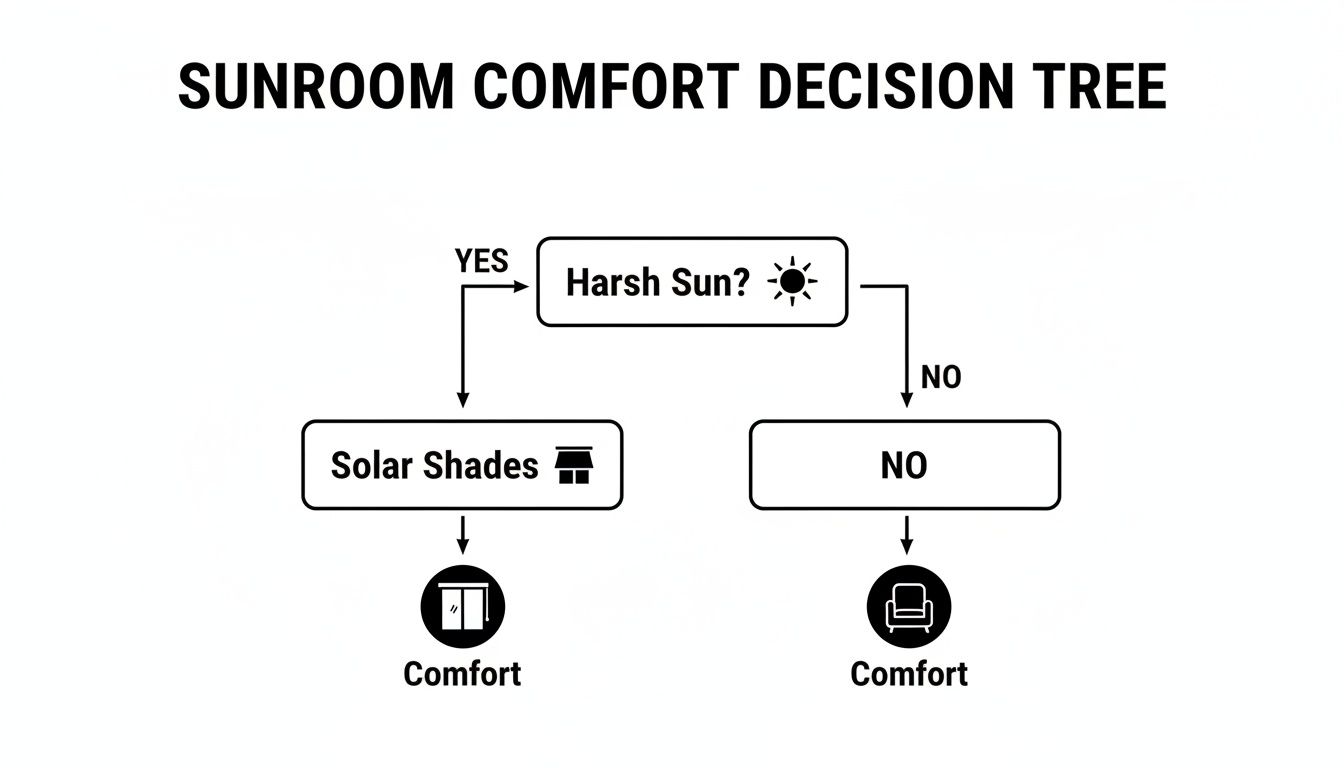
As the chart shows, solar shades are the most direct path to a comfortable, usable space when dealing with harsh sun. Let's break down what those percentages mean for your room.
The right choice depends on your sunroom’s unique challenges and how you use the space. There’s no single “best” option—only what’s best for you.
1% to 3% Openness: This is your best choice for maximum glare and heat control. If your sunroom gets blasted with intense sun (especially south or west-facing), a low openness factor is a lifesaver. It blocks the most heat and UV rays but offers a more limited view.
5% Openness: The most popular and versatile choice. It strikes a fantastic balance, significantly cutting glare and heat while maintaining a good view of your backyard. For most sunrooms, a 5% shade is the perfect middle ground.
10% to 14% Openness: If your top priority is preserving a panoramic view with just a touch of light filtering, this is for you. It’s ideal for north-facing sunrooms or spaces without harsh, direct sun. These shades soften light and reduce glare but provide less heat control.
Insider Tip: Lower percentages provide better daytime privacy. You can see out clearly, but people can't easily see in. This effect reverses at night when your interior lights are on.
Always consider which direction your sunroom faces. An east-facing room needs help with bright morning light, while a west-facing one needs serious protection from intense afternoon heat. Knowing when glare is the biggest problem will steer you toward the right openness factor. If glare is your main enemy, our guide on how to reduce glare from windows has extra tips.
The right openness can also create a perfect environment for shade loving plants, giving them the diffused light they need to thrive.
Still not sure? This simple table compares how different openness factors perform in a typical sunroom.
| Openness Factor | Best For | View Clarity | Glare Reduction | Heat Control |
|---|---|---|---|---|
| 1%-3% | Intense, direct sun (South/West facing) | Most Obscured | Excellent | Excellent |
| 5% | Balanced performance (All-purpose) | Good | Very Good | Very Good |
| 10%-14% | Preserving views (North facing) | Excellent | Good | Moderate |
Choosing the right solar shades comes down to your priorities. Decide if your main goal is UV protection, a crystal-clear view, or a happy medium. Once you know that, you’ll find the perfect openness to transform your sunroom.
Does the color of solar shades matter? Yes, it has a huge impact on performance. The choice between light and dark fabrics comes down to managing heat versus preserving your view. Knowing the difference is key to getting it right.
Light fabrics act like a mirror, bouncing heat away. Dark fabrics act like a sponge, absorbing intense light to cut glare. What you value most—a cooler space or a clearer view—will point you to the right choice.
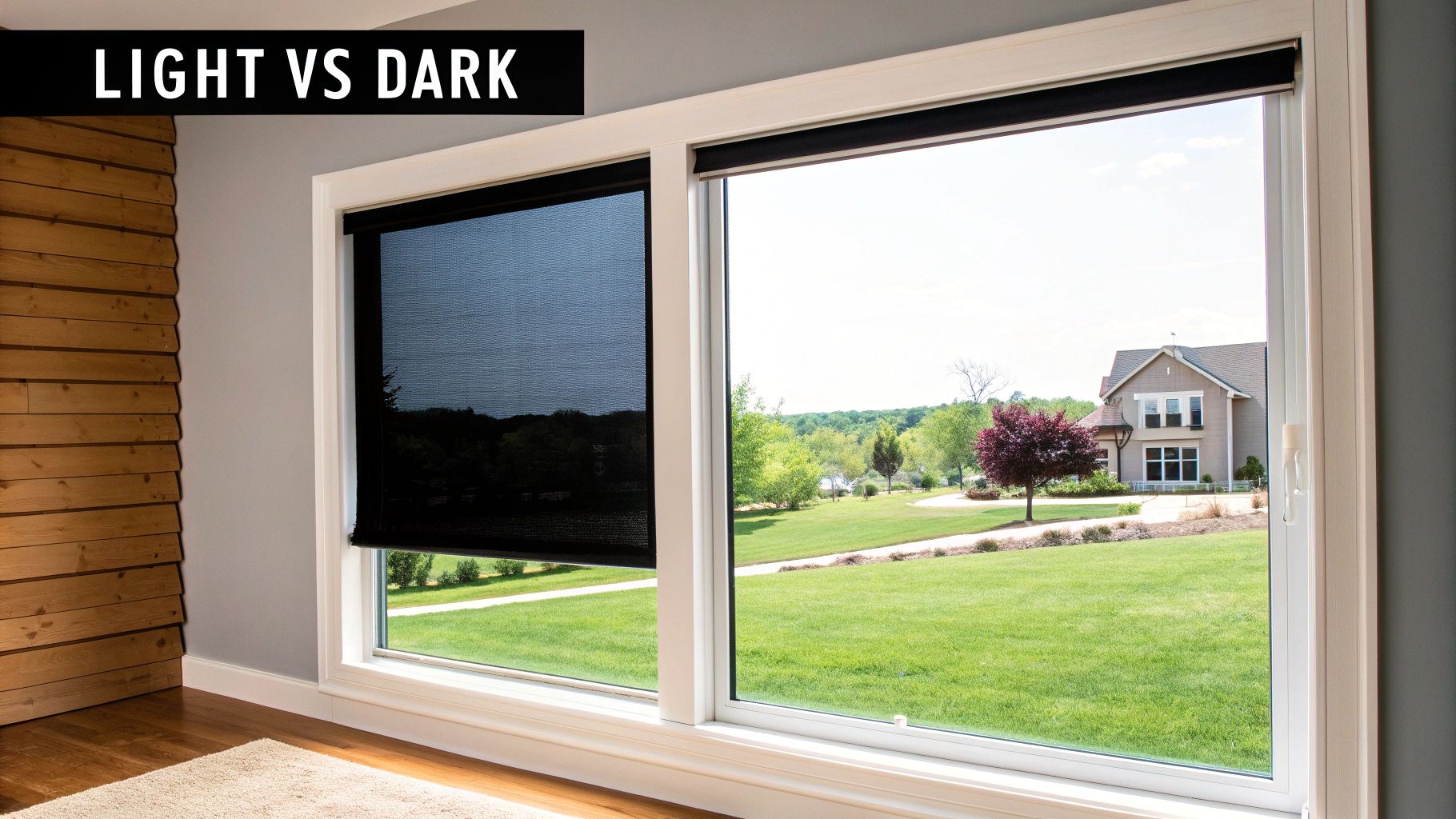
This picture says it all. The dark shade offers a perfectly clear, defined view, while the open window shows just how intense that sun can be.
Think of dark-colored solar shades—charcoal, black, bronze—as high-end sunglasses. They absorb sunlight rather than reflect it, which has a massive impact on glare. By soaking up bright light, dark shades reduce reflections, making screens easy to see. The view becomes incredibly crisp and clear, as if the harshness is filtered out.
The physics is simple: dark colors excel at absorbing light. This gives them an edge in controlling glare and providing a more transparent, unfiltered view, much like looking through tinted glass.
The trade-off is that some of that absorbed solar energy can radiate gently into the room as heat.
Light-colored shades—white, cream, or soft gray—operate on a different principle: reflection. They bounce a significant amount of the sun's energy back outside before it can heat up your sunroom. This makes light shades the clear winner for maximum temperature control. If your sunroom feels like a sauna, a white shade offers the best heat-blocking power.
The U.S. Department of Energy notes that even medium-colored draperies can reduce heat gain by 33%; light-colored reflective shades are even more effective. The trade-off here involves the view. Light shades diffuse sunlight, creating a soft glow, but this can also create a whitish haze that makes the view less sharp.
Let's put the core differences in a head-to-head comparison to help you decide what matters most for your sunroom.
Light vs. Dark Solar Shade Performance
| Feature | Light-Colored Shades | Dark-Colored Shades |
|---|---|---|
| Primary Function | Heat Reflection | Glare Reduction & View Clarity |
| Temperature Control | Excellent – Reflects solar energy away from the window. | Good – Absorbs solar energy, which can radiate some heat. |
| Glare Reduction | Good – Diffuses light, creating a soft glow. | Excellent – Absorbs light, providing a crisp, clear view. |
| View Clarity | Fair – Can appear hazy or washed out. | Excellent – Acts like sunglasses, preserving detail. |
| Energy Savings | Best for lowering cooling costs in hot climates. | Best for visual comfort and preserving the outdoor view. |
If keeping the room cool is your number one goal, lean toward lighter colors. If preserving that beautiful view without squinting is what you're after, dark shades are the undisputed champion.
Imagine adjusting every shade in your sunroom with a single tap. Motorization brings this modern convenience home, offering a practical and easy-to-use upgrade for your solar shades for sunroom windows.
Beyond the "wow" factor, motorization solves common sunroom headaches. It creates a cleaner look by eliminating dangling cords—a huge safety advantage for homes with children and pets.
Motorized shades open up a world of control options that fit your lifestyle, making your sunroom more comfortable and efficient.
The best part of motorization isn't just convenience—it's effortless energy management. Automated shades work 24/7 to keep your sunroom at an ideal temperature, actively cutting your cooling costs.
While motorized shades have a higher upfront cost, the long-term benefits in energy savings and home value often make them a worthwhile investment. Automated systems can dramatically reduce solar heat gain, taking a significant load off your air conditioner. This technology is becoming a standard feature in modern homes, with the market for smart solar tracking shades projected to grow to $2.76 billion by 2030. You can discover more insights about these smart systems.
The most important advantage of motorized shades is the elimination of cords. Dangling cords are a recognized hazard in homes with small children.
Going cordless provides several key benefits:
If you're curious about what installation involves, check out our guide to motorized shades DIY options.
Ready for a hands-on transformation? Measuring and installing your new solar shades is a straightforward project. With a few basic tools and a bit of patience, you can achieve a professional-looking fit that completes your space.
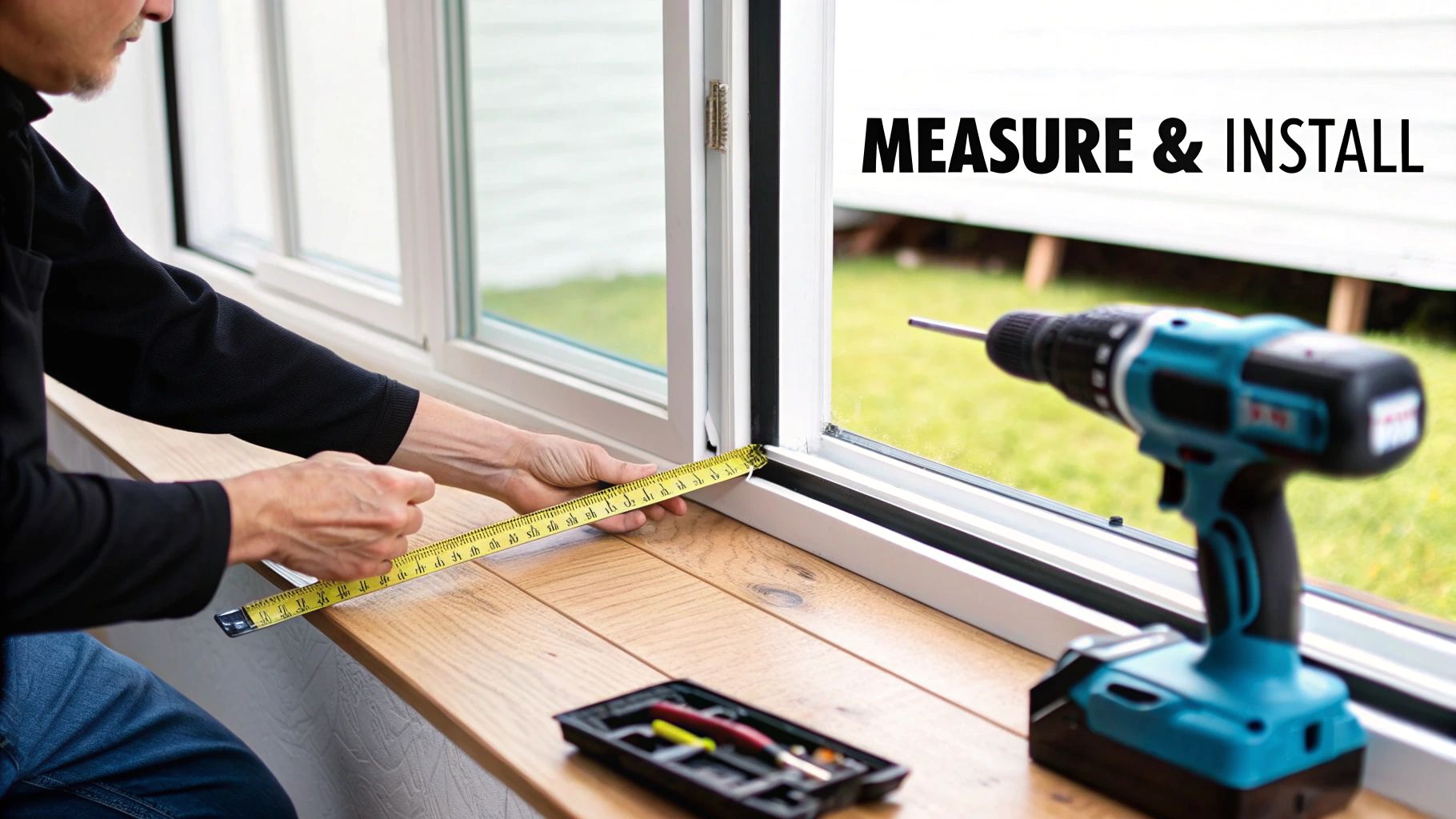
We'll walk you through the essential steps and share our best tips to help you get a flawless finish.
Accurate measurements are critical. An error of even a quarter-inch can ruin the fit. Remember the classic rule: measure twice, order once! Use a steel tape measure for the best accuracy.
First, decide if you want an inside mount or an outside mount.
Pro Tip: For an inside mount, measure the width at the top, middle, and bottom of the window frame. Record the narrowest of these three measurements to ensure your shade operates smoothly.
For that sleek, recessed look, follow these steps with precision.
If an outside mount is better for your sunroom, the goal is to create an overlap for full coverage.
Once your custom shades arrive, it’s time to install. Unpack everything and ensure all parts—brackets, screws, and the shade—are present.
Your shade will come with specific instructions, but the general process is universal:
And that's it! You've successfully installed your new solar shades. For more ideas, explore our diverse collection of curtains and blinds.
The great news is that maintaining your new solar shades is surprisingly simple. A little routine care is all it takes to keep them performing perfectly for years without harsh chemicals or special tools. The key is preventing dust and grime from settling into the woven fabric.
A gentle touch is the best approach for routine cleaning.
By making light dusting part of your regular cleaning routine, you prevent airborne particles from settling deep into the fabric, making the need for a deeper clean a much rarer occasion.
Accidents happen. If you get a small spot on your shade, act quickly but gently.
Mix a simple solution of lukewarm water and a few drops of mild dish soap. Dampen a clean sponge or cloth in the suds (don't soak it) and gently blot the affected area. Avoid rubbing, as this can damage the fabric's coating. After blotting the stain, use a separate cloth dampened with plain water to "rinse" the area by blotting again. Let the shade air dry completely before raising it.
This simple method will handle most spills without harming your solar shades for sunroom windows. For more window treatment inspiration, explore our full collection of shades and blinds.
Here are the answers to the most common questions we hear from homeowners about sunroom solar shades.
The short answer is no. During the day, solar shades offer excellent privacy; you can see out, but others can't see in. At night, this effect reverses. When you turn on your lights, the view from the outside becomes much clearer. If you need total privacy after dark, we recommend layering your solar shades with a set of curtains.
Yes, they offer a modest benefit. While their main job is blocking summer heat, they also create an insulating pocket of air between the fabric and the cold window glass. This helps reduce some heat loss, taking the edge off a chilly room. However, they are not heavy-duty insulators like cellular shades.
Not at all! One of their best features is how well they preserve your view. Unlike blinds or drapes that close you off from the outdoors, solar shades are designed to maintain your connection to your backyard. The clarity depends on the openness factor you choose (10% offers the clearest view, while 3% softens details). You never have to sacrifice your scenery for comfort.
Ready to find the perfect shades to complete your sunroom? At Joey'z Shopping, we're here to help you create the home you love with a wide range of styles to fit any space and budget. Explore our collection today and see how easy it can be to transform your room.
Shop our full collection of stylish solar shades at JoeyzShopping.com