
Join the Joey'z Family!

Getting your window curtains measurements right is the secret to a polished, designer look. It’s what separates an elegant, custom-fit finish from an awkward, off-the-rack mistake. An ill-fitting curtain can make a room feel small and dated, but the perfect fit can make it feel taller, brighter, and more inviting.
Before we dive in, let's get one thing straight: always measure the space where the curtain rod will actually go, not just the window frame. This simple rule is the foundation for getting your measurements perfect from the start.
Ever wondered why some curtains hang so perfectly, while others just look… off? The answer almost always comes down to the initial measurements. Taking a few extra minutes to get it right saves you from the headache of returns and guarantees your new curtains elevate your space.
Think of curtains as the frame for your window's view. Poorly measured, they can make a window seem tiny and a ceiling feel low. But get the measurements right, and you create an illusion of height and width, making the whole room feel more open and thoughtfully designed. The global market for curtains and blinds was valued at a whopping USD 25.2 billion in 2024, which shows just how much homeowners value getting this detail right.
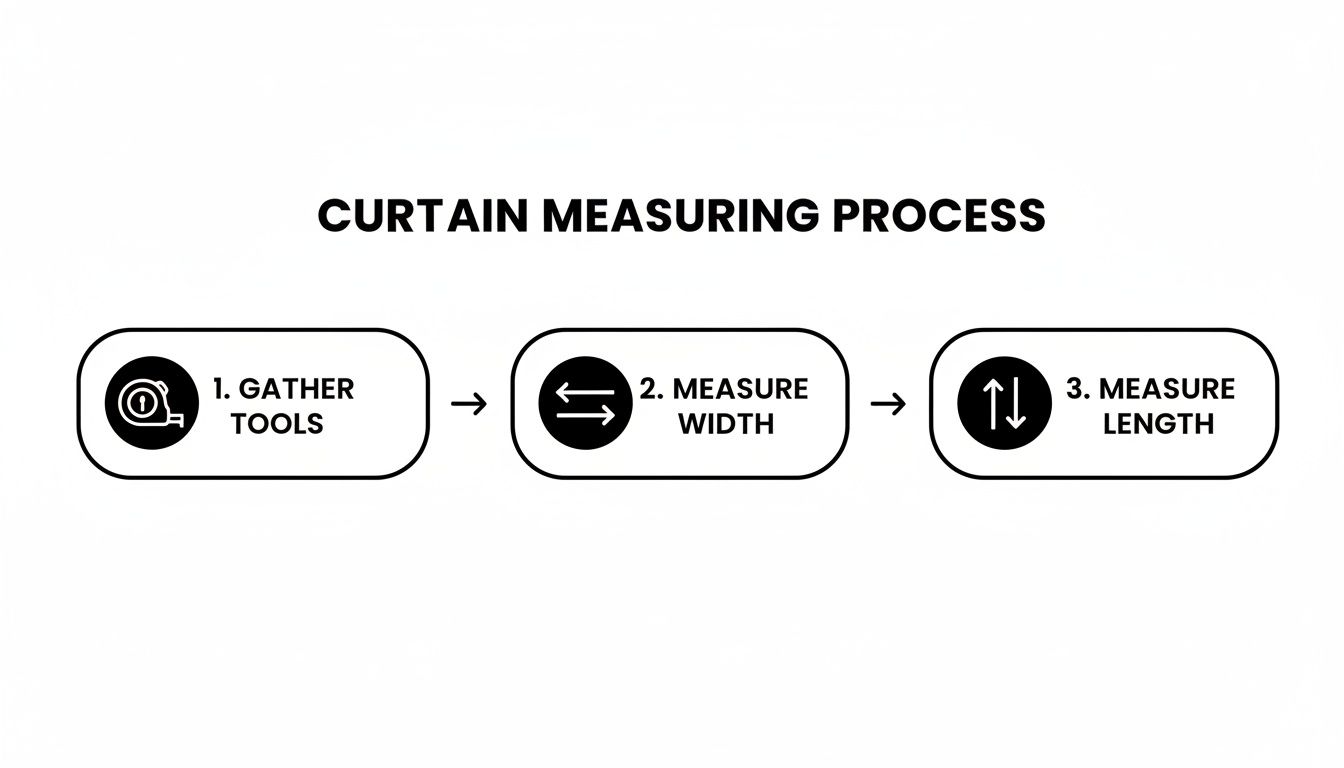
You don’t need a professional's workshop for this, just a few reliable basics.
With these simple tools, you're all set to begin.
It’s amazing how a tiny measurement error can throw off the entire look. A curtain that’s just an inch too short creates that dreaded "high-water" effect, awkwardly floating above the floor. If it's too narrow, it'll look skimpy and won't provide proper privacy or light control when closed.
Expert Tip: Getting the hang height and width right is the most important part. Hanging a rod high and wide makes your window (and room) feel bigger and more grand. It's the oldest trick in the book for a reason—it works every time.
Ultimately, being precise gives you control over the final look and feel of your room. For some fantastic advice on achieving that high-end presentation, check out this helpful guide on the correct way to hang curtains for a designer look.
Here’s a quick cheat sheet for the basic rules of thumb.
| Measurement Type | What to Measure | Pro Tip |
|---|---|---|
| Rod Width | Measure the window frame width, then add 3-6 inches to each side. | This makes the window appear larger and allows panels to stack neatly without blocking light. |
| Panel Width | Your total curtain panel width should be 1.5 to 2 times the width of your curtain rod. | This is the "fullness" factor. More fabric creates richer, more luxurious folds when closed. |
| Length | Measure from the rod's position down to your desired endpoint (floor, sill, etc.). | For a modern look, have curtains just "kiss" the floor. Add a few extra inches for a romantic "puddle" effect. |
This table should give you a solid starting point for any standard window project.
Getting your curtain width right is about so much more than just covering the glass. It’s the secret sauce to achieving that lush, gathered look we call fullness. When curtains are stretched flat, they can make a room feel unfinished. But with the right fullness, the drapes add a layer of luxury and polish.
First, and this is a big one: always measure the curtain rod, not the window frame itself. You’ll want to measure the rod from end to end, but don't include the decorative finials in your measurement. This number is your starting line.
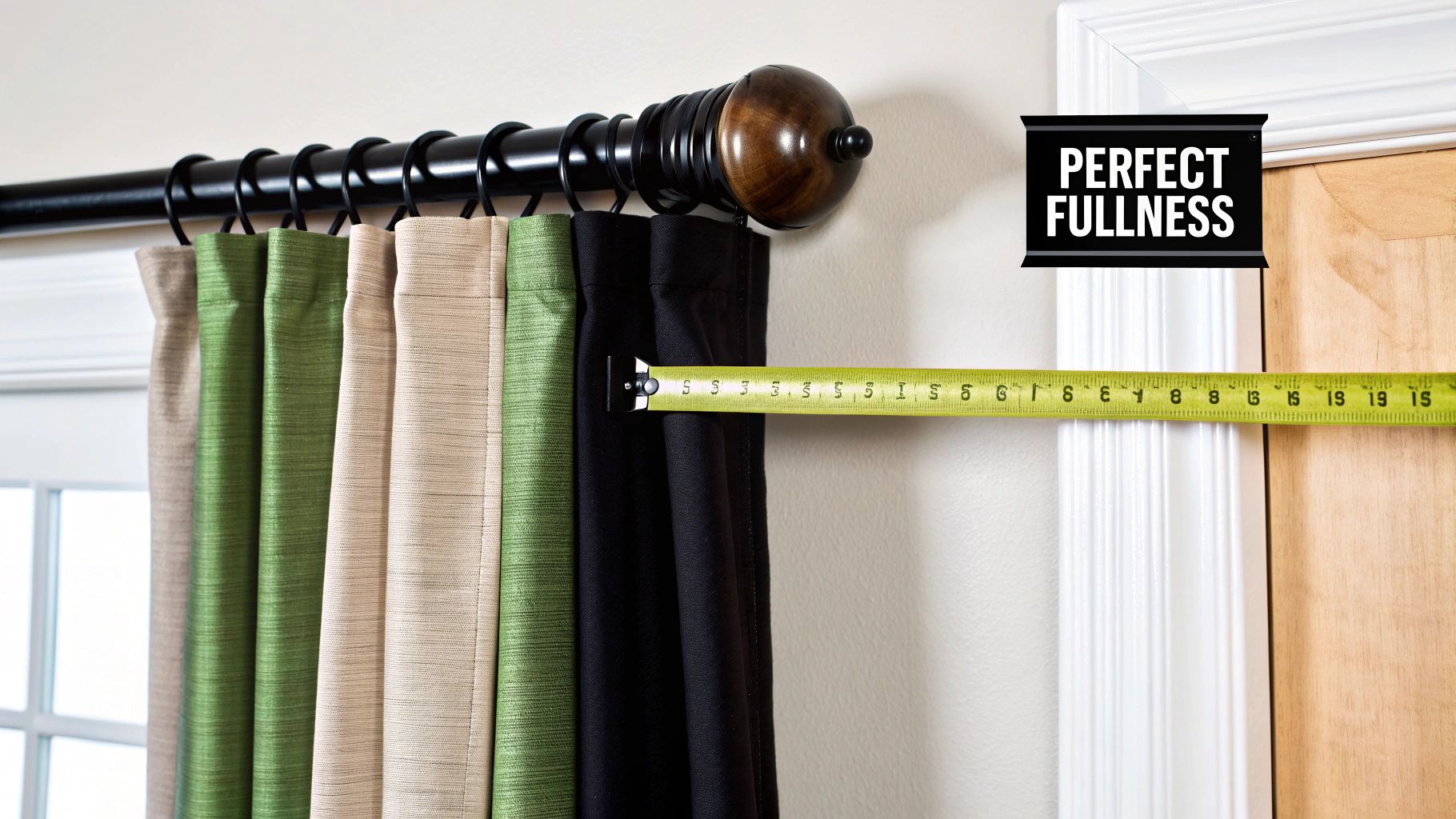
Once you have your rod’s width, you’re ready to calculate the total panel width needed. The industry standard is surprisingly simple: your total curtain panel width should be 1.5 to 3 times the length of your curtain rod. This extra fabric creates those beautiful, soft pleats you see in magazines.
So, how much extra fabric is right for you? It really comes down to the fabric you've chosen and the vibe you're going for.
Let's put this into practice. Say your curtain rod is 60 inches wide. For Deluxe Fullness (2x), you’re aiming for a total width of 120 inches (60 x 2). You could get this with two 60-inch panels.
If all this math is making your head spin, don't worry. We've got you covered. To make things super simple, you can use our handy curtain width calculator to find the perfect dimensions for any window.
Once you’ve nailed down the perfect width, it's time to tackle curtain length. This one decision can completely change a room's atmosphere, making it feel taller, cozier, or more formal. It’s about so much more than just covering a window—it’s about setting a mood.
When you hang curtains high and let them fall all the way to the floor, it automatically draws the eye upward. This simple trick creates an illusion of height, even in rooms with standard ceilings, making your whole space feel more open and grand.
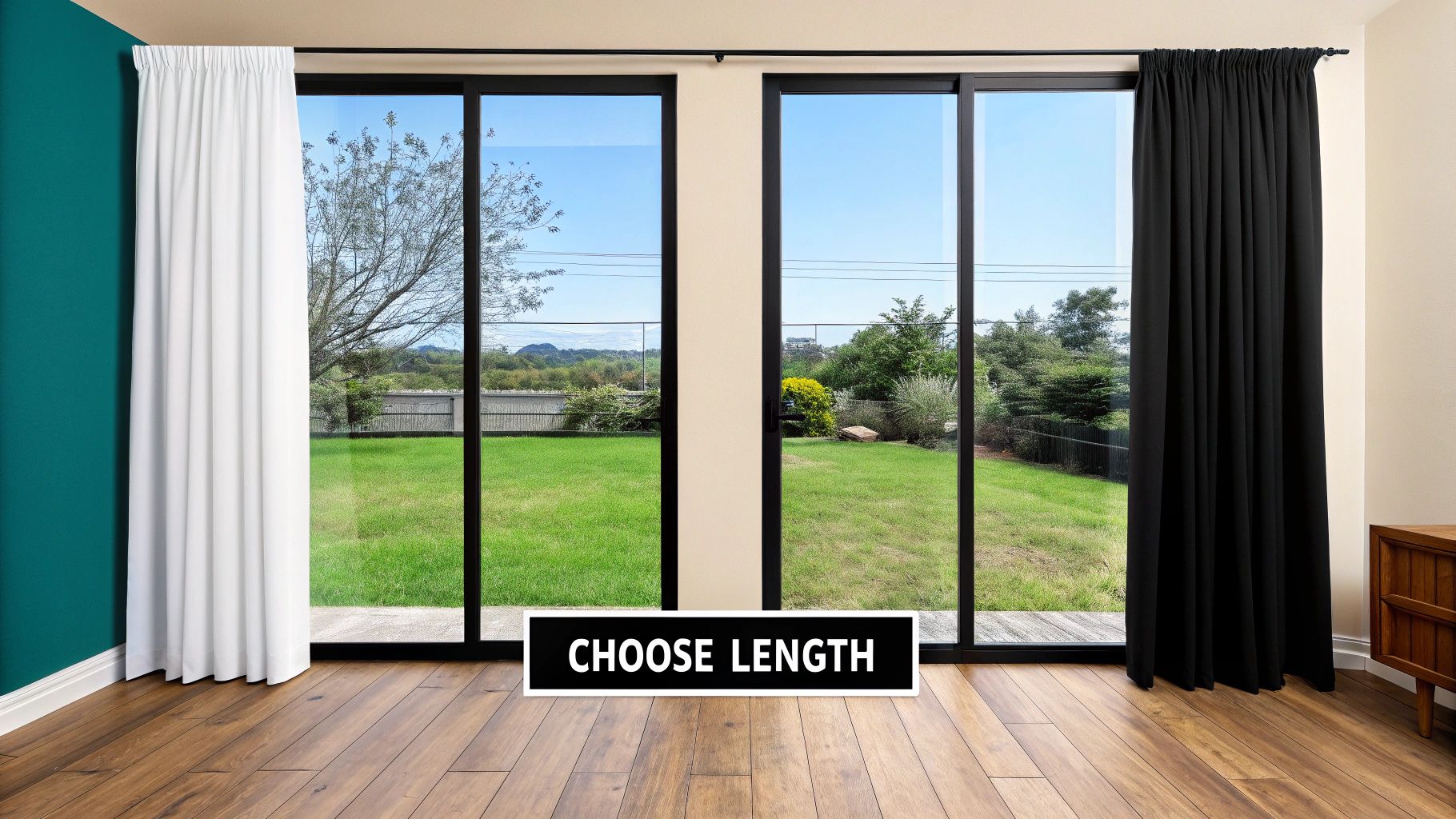
There are four main styles, and each brings its own personality and practical perks. Your final choice will depend on the room's function and the look you're trying to achieve.
Getting the right measurement is straightforward. Always measure from the very top of your curtain rod down to where you want the curtain to end. A quick heads-up: if you're using curtain rings, measure from the little eyelet at the bottom of the ring, since that's where the curtain hook attaches.
Insider Tip: To get that perfect floor-length "kiss," have a friend hold the tape measure while you step back to check the length. It's much easier to visualize and get the measurement just right with a second pair of eyes.
If you happen to find ready-made curtains that are just a little too long, don't worry. You can easily adjust them. We have a great guide that shows you how to shorten curtains without sewing, making it a quick DIY fix.
Where you hang your curtain rod is just as important as the curtains themselves. The two main players are the inside mount and the outside mount. Picking the right one comes down to your window's architecture and the look you're after.
An inside mount, where the rod sits snugly inside the window casing, gives you a clean, minimalist look. It’s a fantastic choice if you want to show off beautiful window trim. But there's a catch: your window frame needs enough depth to hold the hardware securely—at least 2-3 inches.
When measuring for an inside mount, you have to be precise. You'll measure the exact interior width of the window frame and subtract about 1/4 to 1/2 inch from the final width. This tiny clearance is crucial; it ensures the rod and brackets fit smoothly without scraping the paint or wood.
An outside mount is the go-to choice for most situations. It offers more flexibility and a ton of functional perks. With this style, the curtain rod is mounted on the wall above and outside the window frame.
An outside mount is your secret weapon for creating visual illusions. By installing the rod 4 to 6 inches above the window frame and extending it 3 to 6 inches past the frame on each side, you can make the window seem much taller and wider. This method also gives you superior light control and privacy, a must-have feature for blackout curtains in a bedroom. If you're looking for an even more advanced setup, our guide on a curtain track wall mount offers another great solution.
Still on the fence? This table breaks down the key differences to help you decide.
| Feature | Inside Mount | Outside Mount |
|---|---|---|
| Best For | Showing off decorative trim; minimalist decor | Making windows look larger; maximizing light control |
| Light Control | Fair; some light may leak around the edges | Excellent; curtains overlap the wall to block more light |
| Measurement | Requires precise interior frame measurements | More forgiving; measures wall space around the frame |
| Requirement | At least 2-3 inches of window frame depth | Works with any window, regardless of frame depth |
| Aesthetic | Clean, built-in, and streamlined | Dramatic, versatile, and traditional |
Ultimately, an inside mount is a specialized choice for the perfect window, while an outside mount offers a universally effective way to enhance just about any room.
Even with the best intentions, a small slip-up when measuring for curtains can throw the whole project off. But don't worry—most of these common errors are completely avoidable once you know what to look for. Let's walk through the most frequent pitfalls together to make sure your curtains hang perfectly from day one.
It sounds simple, but the tool you use is everything. A flimsy cloth tape measure from a sewing kit can stretch and warp, leading to inaccurate readings. Always use a rigid, retractable steel tape measure for unyielding accuracy.
This is the most common mistake of all. Your curtains hang from the rod, not the window frame. If you only measure the window's dimensions, you're almost guaranteed a poor fit.
The Fix: Decide on your rod placement first. A good rule is to mount the rod 4 to 6 inches above the window frame and 3 to 6 inches beyond it on each side. Measure this final rod width and the distance from the top of the rod to your desired endpoint. These are the only numbers that matter.
Buying curtain panels that are the exact width as your rod is a recipe for a flat, lifeless look. When you close them, the panels will be stretched taut like a bedsheet. You have to account for fullness. We always recommend aiming for a combined panel width that is 1.5 to 3 times the width of your actual rod.
This detail is especially important as styles evolve. While eyelet curtains have been popular, the broader window coverings market, valued at USD 38.5 billion in 2024, is seeing a major shift. Pinch pleat curtains are becoming the fastest-growing segment—a style that absolutely relies on proper fullness for its beautiful, tailored appearance. You can explore more about these market shifts to stay ahead of home decor trends.
Getting your window treatments just right often comes down to a handful of key questions. Here are the clear, straightforward answers you need to measure for curtains with confidence.
The short answer is your curtains should be 1.5 to 3 times wider than your curtain rod, not just the window. For a classic, full look that works in most rooms, aim for twice the rod's width. For example, a 60-inch rod needs curtains with a total width of 120 inches. This simple formula ensures your curtains look lush and intentional, not stretched thin.
This depends on the room's function and your desired style. The most popular and versatile choice is floor length, where curtains hover about a half-inch above the floor. This provides a timeless, tailored look that makes any room feel taller. Sill-length curtains are better for kitchens or bathrooms, while puddle-length curtains that pool on the floor add a dramatic touch to formal spaces.
No, and this is a critical detail! Always measure from where you plan to install the curtain rod, which is typically 4 to 6 inches above the window frame. Measuring from the top of the window is a common mistake that often results in curtains that are too short. Always decide on your rod placement before you measure for length.
Don't panic! A small error can often be fixed. If curtains are too long, they can easily be hemmed. If they are too short, you can try lowering the rod or adding a decorative trim to the bottom. If they are too narrow, you will likely need to add another panel to achieve the proper fullness, as this is the hardest issue to fix.
With these questions answered, you're ready to measure with total confidence. At Joey'z Shopping, we offer a huge variety of curtains to fit any window and match any style.
Find your perfect fit at Joey'z Shopping and complete your space today.