
Join the Joey'z Family!

Getting your measurements right is the secret to a professional, custom-fit look for your windows. Learning how to measure Roman shades really boils down to one key decision: will you mount them inside the window frame or outside? Once you decide, a few careful measurements with a steel tape measure are all it takes to get it right.
This guide will walk you through every step, ensuring you have the confidence to measure correctly and choose the perfect shades for your home.
That flawless, decorator-quality finish you see in magazines doesn't happen by accident. Precise measurements are the absolute foundation of a great-looking window treatment, ensuring your new Roman shades operate smoothly and look like they were made for your space. An eighth of an inch might not seem like much, but it's the difference between a snug fit and an awkward, light-leaking gap.
This visual guide breaks it down into a simple three-step flow: choose your mount style, measure with precision, and install with confidence.
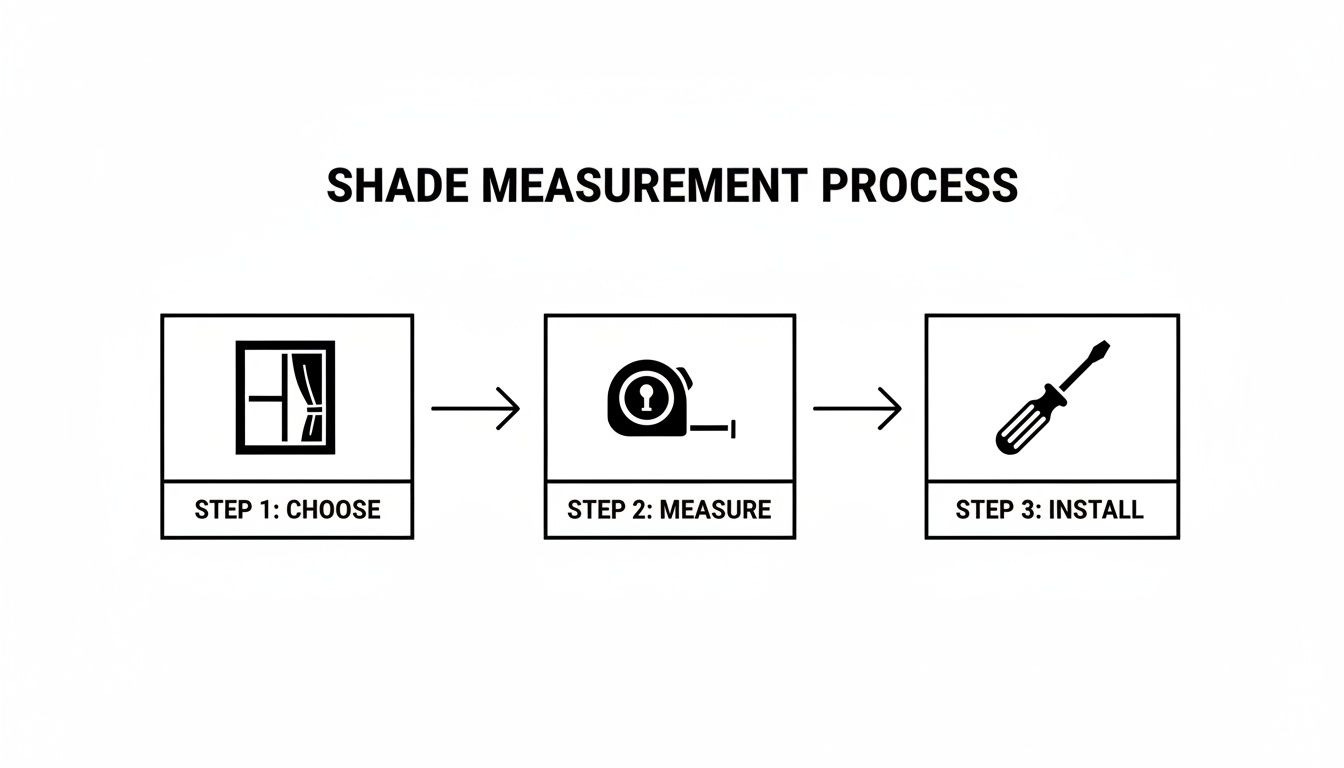
As you can see, the most important work happens long before you pick up a screwdriver.
Did you know Roman shades have a history that stretches back over 2,000 years to Ancient Rome? Originally made from thin linen, these early 'artilene' shades were designed to shield homes from sun and dust. Today, at Joey'z Shopping, we honor that legacy with modern, cordless Roman shades perfect for today’s families.
These pull-free designs comply with CPSC safety standards and can reduce child entanglement risks by a staggering 95%—a feature that parents and pet owners truly appreciate. For a comprehensive resource that walks you through every detail, check out this expert guide on how to measure Roman shades.
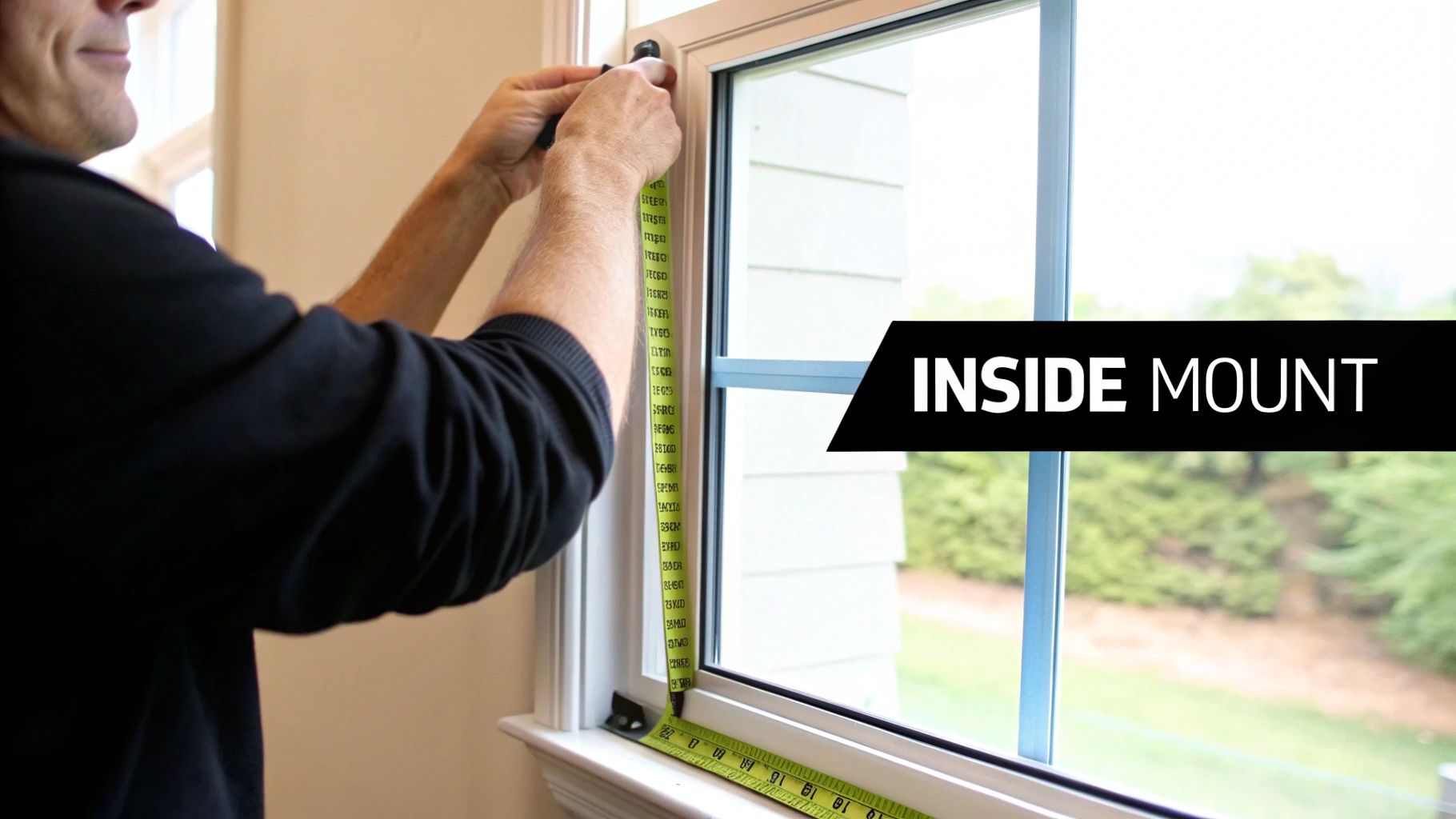
An inside mount gives you that sleek, built-in look, fitting your Roman shades perfectly inside the window frame. It’s my go-to recommendation when you want to show off beautiful window molding and keep things looking clean and uncluttered. Getting the measurements for an inside mount is simple, but precision is key.
The goal is to capture the exact interior dimensions of your window casing. This ensures the shade glides up and down smoothly without scraping the sides. Even windows that look perfectly square rarely are, which is why we always take multiple measurements.
First, let's get the width. Grab your steel tape measure and check the inside of the window frame in three different spots. This is a non-negotiable step to account for any slight variations.
Now, look at your three numbers. For width, you’ll always use the narrowest measurement of the three. For instance, if you measured 35" at the top, 34 7/8" in the middle, and 35 1/8" at the bottom, your official width is 34 7/8". This guarantees your shade will fit, even at the frame's tightest point.
Measuring for height is a similar three-point check, but how you choose the final number is the opposite of what we did for width. With your tape measure, check the height from the top of the inside frame down to the sill.
For the height, you’re going to use the longest of the three measurements. This makes sure the shade is long enough to cover the entire window pane.
Insider Tip: Round each of your final measurements (the narrowest width and longest height) down to the nearest 1/8 inch. This little bit of wiggle room is crucial for smooth operation and prevents the fabric from fraying against the frame.
When you order inside mount Roman shades from us at Joey'z Shopping, you don't have to worry about the final math—we take care of deductions for you. We’ll typically trim about 1/4" to 1/2" from the width measurement you provide.
This isn't a mistake! It's a critical step that creates clearance for the mounting hardware, allowing the shade to move freely. If you're looking into other window treatments, our guide on how to measure for blinds has more helpful tips.
Choosing an outside mount is like giving your window a custom frame. It’s the perfect solution for making windows appear larger, hiding less-than-perfect trim, or achieving a blackout effect for a peaceful bedroom. The shade is mounted on the wall or trim above the window, creating a bold statement.
By extending the shade beyond the window frame, you can play with visual proportions, making a small window feel grander or a low ceiling seem higher. It's a classic interior design trick that works wonders.
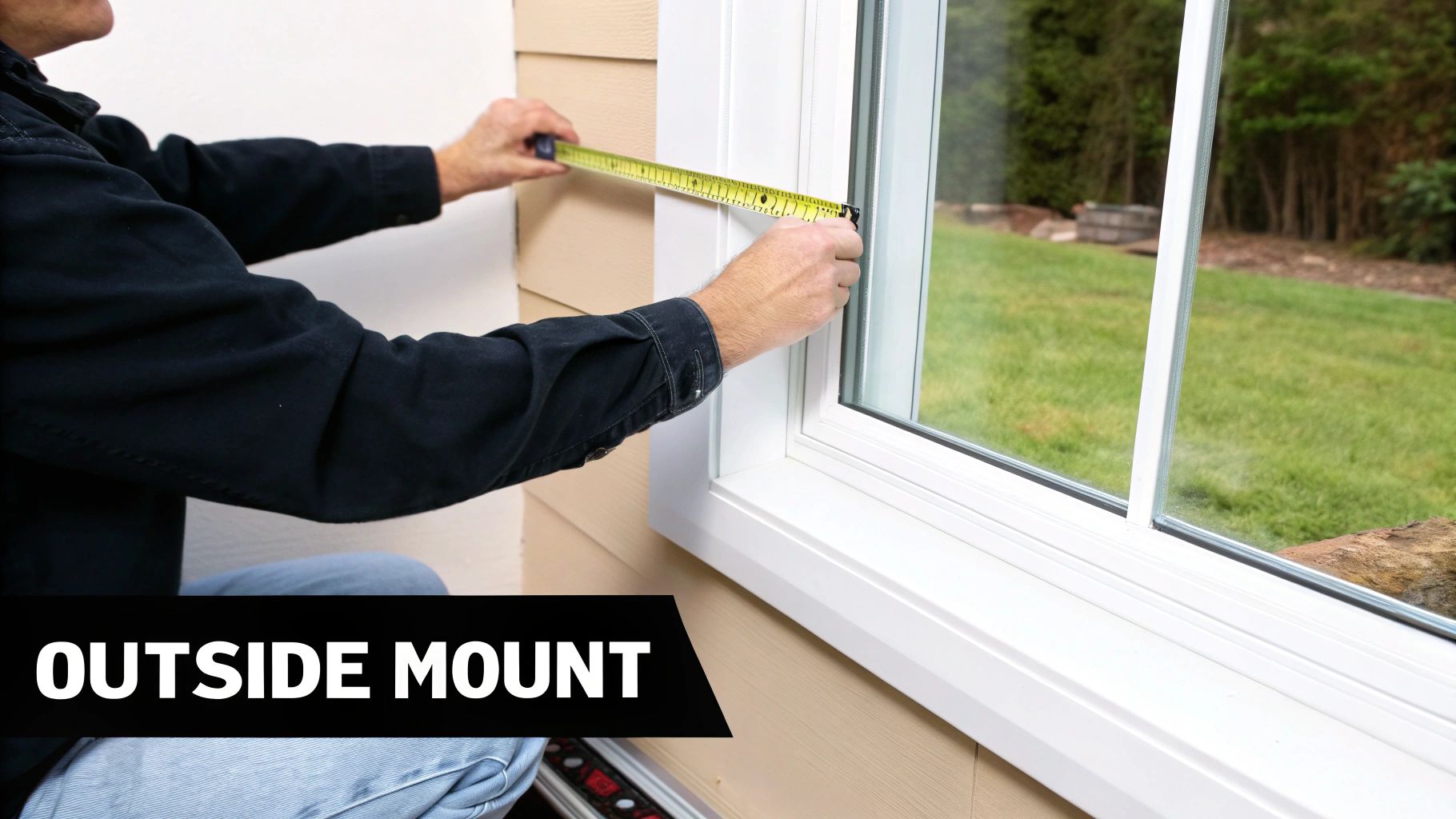
Getting the width right for an outside mount is all about creating a deliberate overlap to block light from seeping in around the edges—that pesky "halo effect." First, measure the full width of your window, including any molding you want to cover.
So, for a window frame that measures 36 inches wide, a good outside mount measurement would be between 40 and 44 inches.
With an outside mount, you control exactly where the shade begins and ends. Mounting the headrail higher above the window frame is a pro move that draws the eye upward and makes the space feel more open.
As a rule of thumb, plan to mount the headrail 3 to 6 inches above the top of the window frame. For a more dramatic flair, you can go even higher.
When measuring for the final length, you also need to decide where you want the shade to end.
Expert Insight: Before you finalize anything, look for obstacles like baseboard heaters or deep sills. Ensure your shade has a clear path to hang straight. Professionals often position the headrail 3.9 to 4 inches above the window and extend the hem 2 to 6 inches below the sill. This strategic overlap can cut summer heat gain by an impressive 35%. For more details, see our guide on how to measure for window blinds with an outside mount.
Even the most careful DIYer can make a simple measuring mistake. When you're learning how to measure Roman shades, small slip-ups can turn a perfect plan into a frustrating problem. The old saying "measure twice, order once" is the golden rule for window treatments.
Ordering your dream shades from Joey'z Shopping should be the fun part, and a few careful checks will make sure it is.
For an inside mount, this is the mistake we see most often. If your window frame isn't deep enough to hold the headrail, the shade won't fit. Always measure the depth of your window casing and check it against the minimum depth requirements on the product page.
A flimsy cloth tape measure can easily stretch or sag, giving you an inaccurate reading. This is why we always stress using a rigid steel measuring tape. It gives you the solid, unyielding accuracy you need.
Expert Tip: Don't let your tape measure bend or twist while you're measuring. Hold it taut and straight across the window to get the truest reading. An angled tape can easily add or subtract a crucial fraction of an inch.
This is a classic trap. Houses settle over time, and window frames are rarely perfect clones of each other. Even a tiny difference of 1/4 inch can throw off the fit. You must measure each window individually, no matter how similar they seem.
Those tiny lines between the inch marks can be tricky. It's easy to mistake 3/8" for 5/8". Take a moment to look closely at the tape and write down your measurement precisely to the nearest 1/8 inch. A second pair of eyes is always a good idea.
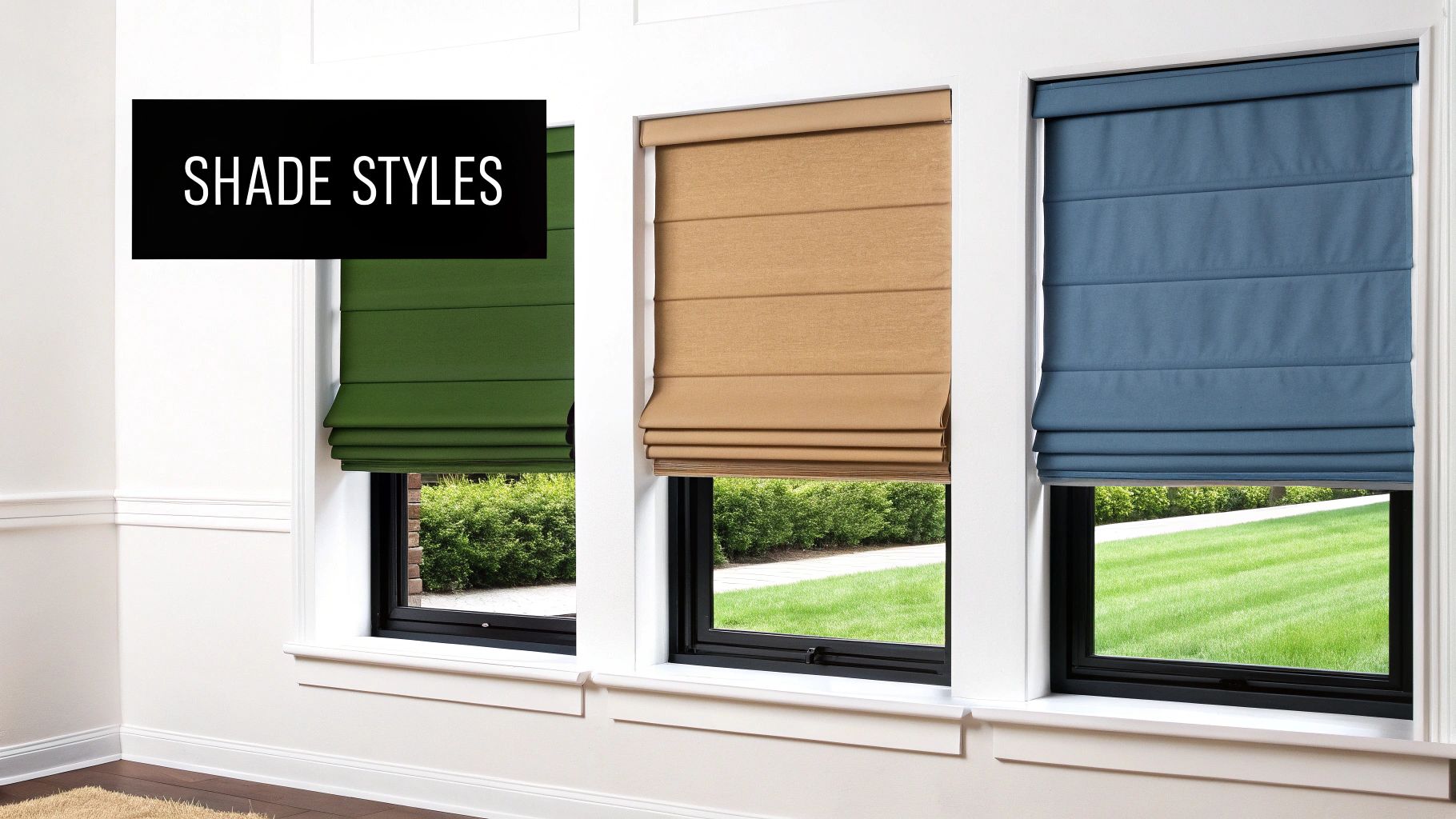
Once your measurements are down, it's time for the fun part: picking a style that brings your vision to life. The style you choose affects how the shade folds up, which impacts your view and the feel of the room. The key factor here is stack height—the amount of space the fabric takes up at the top of the window when the shade is fully raised.
Your choice should feel right for both your window's purpose and your home's personality. A minimalist flat shade has a very small stack, perfect for maximizing your view. On the other hand, a hobbled shade creates a fuller, more traditional look with a larger stack that adds texture.
Here’s a quick breakdown of the most common styles:
Expert Insight: The construction and fabric weight play a huge role. For flat styles, widths from 16 to 96 inches can stack evenly. Pleated versions often use 90-150gsm fabrics to create lush 4 to 5-inch hobbles, a style used in 65% of formal dining rooms. At Joey'z Shopping, our cascade styles—featuring crisp, aluminum-backed folds—dominate 40% of orders for contemporary kitchens.
If you're still weighing your options, our guide comparing Roman shades vs. roller shades might help you decide.
At Joey'z Shopping, we get a lot of questions about measuring for Roman shades. Let's tackle the most common ones so you can move forward with confidence.
You only need a few essential tools. The most important one is a steel measuring tape. A flexible cloth tape can stretch and give inaccurate readings. You will also need a pencil and paper (or a notes app on your phone) to record your measurements immediately.
No, you should not make your own deductions. When you order an inside-mount shade, provide us with the exact, tight measurements of your window frame. We handle all the necessary deductions at the factory, typically subtracting 1/4 to 1/2 inch from the width to ensure a perfect fit and smooth operation.
The trim helps you decide between an inside or outside mount. For an inside mount, measure between the inside edges of the trim to showcase it. For an outside mount, measure the full width including the trim, then add your desired overlap (usually 2-4 inches on each side) to cover it completely for a more dramatic look.
This is very common and why our three-point measurement technique is so important. By measuring the width at the top, middle, and bottom (and using the smallest number), and the height at three points (using the largest number), you automatically account for any irregularities. This ensures a custom fit for your unique window.
This is a critical question. An inside mount requires a certain "minimum inside mount depth" to house the headrail. Measure your frame's depth (from the front edge to the glass) and compare it to the product specifications on our site. If your window is too shallow, an outside mount is your best solution for a great result.
Ready to put your measuring skills to the test? At Joey'z Shopping, we offer a stunning collection of Roman shades to fit any style and budget.
Explore Our Full Collection of Roman Shades at JoeyzShopping.com